Epstein Files Full PDF

CLICK HERE
Technopedia Center
PMB University Brochure
Faculty of Engineering and Computer Science
S1 Informatics S1 Information Systems S1 Information Technology S1 Computer Engineering S1 Electrical Engineering S1 Civil Engineering

faculty of Economics and Business
S1 Management S1 Accountancy

Faculty of Letters and Educational Sciences
S1 English literature S1 English language education S1 Mathematics education S1 Sports Education
teknopedia

  • Registerasi
  • Brosur UTI
  • Kip Scholarship Information
  • Performance
Flag Counter
  1. World Encyclopedia
  2. Scalability - Wikipedia
Scalability - Wikipedia
From Wikipedia, the free encyclopedia
Ability of a system to handle an increasing amount of work
icon
This article needs additional citations for verification. Please help improve this article by adding citations to reliable sources. Unsourced material may be challenged and removed.
Find sources: "Scalability" – news · newspapers · books · scholar · JSTOR
(March 2012) (Learn how and when to remove this message)
Complex systems
Topics
Self-organization
Emergence
Collective behavior
Social dynamics

Collective intelligence
Collective action
Self-organized criticality
Herd mentality
Phase transition
Agent-based modelling
Synchronization
Ant colony optimization
Particle swarm optimization
Swarm behaviour

Collective consciousness
Networks
Scale-free networks

Social network analysis
Small-world networks
Centrality
Motifs
Graph theory
Scaling
Robustness
Systems biology
Dynamic networks

Adaptive networks
Evolution and adaptation
Artificial neural network

Evolutionary computation
Genetic algorithms
Genetic programming
Artificial life
Machine learning
Evolutionary developmental biology
Artificial intelligence
Evolutionary robotics

Evolvability
Pattern formation
Fractals

Reaction–diffusion systems
Partial differential equations
Dissipative structures
Percolation
Cellular automata
Spatial ecology
Self-replication

Geomorphology
Systems theory and cybernetics
Autopoiesis

Conversation theory
Entropy
Feedback
Goal-oriented
Homeostasis
Information theory
Operationalization
Second-order cybernetics
Self-reference
System dynamics
Systems science
Systems thinking
Sensemaking
Variety

Theory of computation
Nonlinear dynamics
Time series analysis

Ordinary differential equations
Phase space
Attractors
Population dynamics
Chaos
Multistability
Bifurcation

Coupled map lattices
Game theory
Prisoner's dilemma

Rational choice theory
Bounded rationality

Evolutionary game theory
  • v
  • t
  • e

Scalability is the property of a system to handle a growing amount of work. One definition for software systems specifies that this may be done by adding resources to the system.[1]

In an economic context, a scalable business model implies that a company can increase sales given increased resources. For example, a package delivery system is scalable because more packages can be delivered by adding more delivery vehicles. However, if all packages had to first pass through a single warehouse for sorting, the system would not be as scalable, because one warehouse can handle only a limited number of packages.[2]

In computing, scalability is a characteristic of computers, networks, algorithms, networking protocols, programs and applications. An example is a search engine, which must support increasing numbers of users, and the number of topics it indexes.[3] Webscale is a computer architectural approach that brings the capabilities of large-scale cloud computing companies into enterprise data centers.[4]

In distributed systems, there are several definitions according to the authors, some considering the concepts of scalability a sub-part of elasticity, others as being distinct. According to Marc Brooker: "a system is scalable in the range where marginal cost of additional workload is nearly constant." Serverless technologies fit this definition but you need to consider total cost of ownership not just the infra cost.[5]

In mathematics, scalability mostly refers to closure under scalar multiplication.

In industrial engineering and manufacturing, scalability refers to the capacity of a process, system, or organization to handle a growing workload, adapt to increasing demands, and maintain operational efficiency. A scalable system can effectively manage increased production volumes, new product lines, or expanding markets without compromising quality or performance. In this context, scalability is a vital consideration for businesses aiming to meet customer expectations, remain competitive, and achieve sustainable growth. Factors influencing scalability include the flexibility of the production process, the adaptability of the workforce, and the integration of advanced technologies. By implementing scalable solutions, companies can optimize resource utilization, reduce costs, and streamline their operations. Scalability in industrial engineering and manufacturing enables businesses to respond to fluctuating market conditions, capitalize on emerging opportunities, and thrive in an ever-evolving global landscape.[citation needed]

Examples

[edit]

The Incident Command System (ICS) is used by emergency response agencies in the United States. ICS can scale resource coordination from a single-engine roadside brushfire to an interstate wildfire. The first resource on scene establishes command, with authority to order resources and delegate responsibility (managing five to seven officers, who will again delegate to up to seven, and on as the incident grows). As an incident expands, more senior officers assume command.[6]

Dimensions

[edit]

Scalability can be measured over multiple dimensions, such as:[7]

  • Administrative scalability: The ability for an increasing number of organizations or users to access a system.
  • Functional scalability: The ability to enhance the system by adding new functionality without disrupting existing activities.
  • Geographic scalability: The ability to maintain effectiveness during expansion from a local area to a larger region.
  • Load scalability: The ability for a distributed system to expand and contract to accommodate heavier or lighter loads, including, the ease with which a system or component can be modified, added, or removed, to accommodate changing loads.
  • Generation scalability: The ability of a system to scale by adopting new generations of components.
  • Heterogeneous scalability is the ability to adopt components from different vendors.

Domains

[edit]
  • A routing protocol is considered scalable with respect to network size, if the size of the necessary routing table on each node grows as O(log N), where N is the number of nodes in the network. Some early peer-to-peer (P2P) implementations of Gnutella had scaling issues. Each node query flooded its requests to all nodes. The demand on each peer increased in proportion to the total number of peers, quickly overrunning their capacity. Other P2P systems like BitTorrent scale well because the demand on each peer is independent of the number of peers. Nothing is centralized, so the system can expand indefinitely without any resources other than the peers themselves.
  • A scalable online transaction processing system or database management system is one that can be upgraded to process more transactions by adding new processors, devices and storage, and which can be upgraded easily and transparently without shutting it down.
  • The distributed nature of the Domain Name System (DNS) allows it to work efficiently, serving billions of hosts on the worldwide Internet.

Horizontal (scale out) and vertical scaling (scale up)

[edit]
Graphic that visualizes horizontal and vertical scaling.
Horizontal scaling adds new nodes to a computing cluster, while vertical scaling adds resources to existing nodes.

Resources fall into two broad categories: horizontal and vertical.[8]

Horizontal or scale out

[edit]

Scaling horizontally (out/in) means adding or removing nodes, such as adding a new computer to a distributed software application. An example might involve scaling out from one web server to three. High-performance computing applications, such as seismic analysis and biotechnology, scale workloads horizontally to support tasks that once would have required expensive supercomputers. Other workloads, such as large social networks, exceed the capacity of the largest supercomputer and can only be handled by scalable systems. Exploiting this scalability requires software for efficient resource management and maintenance.[7]

Vertical or scale up

[edit]

Scaling vertically (up/down) means adding resources to (or removing resources from) a single node, typically involving the addition of CPUs, memory or storage to a single computer.[7]

Benefits to scale-up include avoiding increased management complexity, more sophisticated programming to allocate tasks among resources and handling issues such as throughput, latency, and synchronization across nodes. Moreover some applications do not scale horizontally.

Network scalability

[edit]

Network function virtualization defines these terms differently: scaling out/in is the ability to scale by adding/removing resource instances (e.g., virtual machine), whereas scaling up/down is the ability to scale by changing allocated resources (e.g., memory/CPU/storage capacity).[9]

Database scalability

[edit]
Main article: Database scalability

Scalability for databases requires that the database system be able to perform additional work given greater hardware resources, such as additional servers, processors, memory and storage. Workloads have continued to grow and demands on databases have followed suit.

Algorithmic innovations include row-level locking and table and index partitioning. Architectural innovations include shared-nothing and shared-everything architectures for managing multi-server configurations.

Strong versus eventual consistency (storage)

[edit]

In the context of scale-out data storage, scalability is defined as the maximum storage cluster size which guarantees full data consistency, meaning there is only ever one valid version of stored data in the whole cluster, independently from the number of redundant physical data copies. Clusters which provide "lazy" redundancy by updating copies in an asynchronous fashion are called 'eventually consistent'. This type of scale-out design is suitable when availability and responsiveness are rated higher than consistency, which is true for many web file-hosting services or web caches (if you want the latest version, wait some seconds for it to propagate). For all classical transaction-oriented applications, this design should be avoided.[10]

Many open-source and even commercial scale-out storage clusters, especially those built on top of standard PC hardware and networks, provide eventual consistency only, such as some NoSQL databases like CouchDB and others mentioned above. Write operations invalidate other copies, but often don't wait for their acknowledgements. Read operations typically don't check every redundant copy prior to answering, potentially missing the preceding write operation. The large amount of metadata signal traffic would require specialized hardware and short distances to be handled with acceptable performance (i.e., act like a non-clustered storage device or database).[citation needed]

Whenever strong data consistency is expected, look for these indicators:[citation needed]

  • the use of InfiniBand, Fibrechannel or similar low-latency networks to avoid performance degradation with increasing cluster size and number of redundant copies.
  • short cable lengths and limited physical extent, avoiding signal runtime performance degradation.
  • majority / quorum mechanisms to guarantee data consistency whenever parts of the cluster become inaccessible.

Indicators for eventually consistent designs (not suitable for transactional applications!) are:[citation needed]

  • write performance increases linearly with the number of connected devices in the cluster.
  • while the storage cluster is partitioned, all parts remain responsive. There is a risk of conflicting updates.

Performance tuning versus hardware scalability

[edit]

It is often advised to focus system design on hardware scalability rather than on capacity. It is typically cheaper to add a new node to a system in order to achieve improved performance than to partake in performance tuning to improve the capacity that each node can handle. But this approach can have diminishing returns (as discussed in performance engineering). For example: suppose 70% of a program can be sped up if parallelized and run on multiple CPUs instead of one. If α {\displaystyle \alpha } {\displaystyle \alpha } is the fraction of a calculation that is sequential, and 1 − α {\displaystyle 1-\alpha } {\displaystyle 1-\alpha } is the fraction that can be parallelized, the maximum speedup that can be achieved by using P processors is given according to Amdahl's Law:

1 α + 1 − α P . {\displaystyle {\frac {1}{\alpha +{\frac {1-\alpha }{P}}}}.} {\displaystyle {\frac {1}{\alpha +{\frac {1-\alpha }{P}}}}.}

Substituting the value for this example, using 4 processors gives
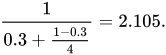
1 0.3 + 1 − 0.3 4 = 2.105. {\displaystyle {\frac {1}{0.3+{\frac {1-0.3}{4}}}}=2.105.} {\displaystyle {\frac {1}{0.3+{\frac {1-0.3}{4}}}}=2.105.}

Doubling the computing power to 8 processors gives
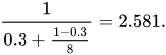
1 0.3 + 1 − 0.3 8 = 2.581. {\displaystyle {\frac {1}{0.3+{\frac {1-0.3}{8}}}}=2.581.} {\displaystyle {\frac {1}{0.3+{\frac {1-0.3}{8}}}}=2.581.}

Doubling the processing power has only sped up the process by roughly one-fifth. If the whole problem was parallelizable, the speed would also double. Therefore, throwing in more hardware is not necessarily the optimal approach.

Universal Scalability Law

[edit]

In distributed systems, you can use Universal Scalability Law (USL) to model and to optimize scalability of your system. USL is coined by Neil J. Gunther and quantifies scalability based on parameters such as contention and coherency. Contention refers to delay due to waiting or queueing for shared resources. Coherence refers to delay for data to become consistent. For example, having a high contention indicates sequential processing that could be parallelized, while having a high coherency suggests excessive dependencies among processes, prompting you to minimize interactions. Also, with help of USL, you can, in advance, calculate the maximum effective capacity of your system: scaling up your system beyond that point is a waste.[11]

Weak versus strong scaling

[edit]

High performance computing has two common notions of scalability:

  • Strong scaling is defined as how the solution time varies with the number of processors for a fixed total problem size.
  • Weak scaling is defined as how the solution time varies with the number of processors for a fixed problem size per processor.[12]

See also

[edit]
  • Computational complexity theory
  • Extensibility
  • Gustafson's law
  • List of system quality attributes
  • Load balancing (computing)
  • Lock (computer science)
  • NoSQL
  • Scalable Video Coding (SVC)
  • Similitude (model)
  • Scale (analytical tool)

References

[edit]
  1. ^ Bondi, André B. (2000). Characteristics of scalability and their impact on performance. Proceedings of the second international workshop on Software and performance – WOSP '00. p. 195. doi:10.1145/350391.350432. ISBN 158113195X.
  2. ^ Hill, Mark D. (1990). "What is scalability?" (PDF). ACM SIGARCH Computer Architecture News. 18 (4): 18. doi:10.1145/121973.121975. S2CID 1232925. and
    Duboc, Leticia; Rosenblum, David S.; Wicks, Tony (2006). A framework for modelling and analysis of software systems scalability (PDF). Proceedings of the 28th international conference on Software engineering – ICSE '06. p. 949. doi:10.1145/1134285.1134460. ISBN 1595933751.
  3. ^ Laudon, Kenneth Craig; Traver, Carol Guercio (2008). E-commerce: Business, Technology, Society. Pearson Prentice Hall/Pearson Education. ISBN 9780136006459.
  4. ^ "Why web-scale is the future". Network World. 2020-02-13. Retrieved 2017-06-01.
  5. ^ Building Serverless Applications on Knative. O'Reilly Media. ISBN 9781098142049.
  6. ^ Bigley, Gregory A.; Roberts, Karlene H. (2001-12-01). "The Incident Command System: High-Reliability Organizing for Complex and Volatile Task Environments". Academy of Management Journal. 44 (6): 1281–1299. doi:10.5465/3069401 (inactive 12 July 2025). ISSN 0001-4273.{{cite journal}}: CS1 maint: DOI inactive as of July 2025 (link)
  7. ^ a b c Hesham El-Rewini and Mostafa Abd-El-Barr (April 2005). Advanced Computer Architecture and Parallel Processing. John Wiley & Sons. p. 66. ISBN 978-0-471-47839-3.
  8. ^ Michael, Maged; Moreira, Jose E.; Shiloach, Doron; Wisniewski, Robert W. (March 26, 2007). Scale-up x Scale-out: A Case Study using Nutch/Lucene. 2007 IEEE International Parallel and Distributed Processing Symposium. p. 1. doi:10.1109/IPDPS.2007.370631. ISBN 978-1-4244-0909-9.
  9. ^ "Network Functions Virtualisation (NFV); Terminology for Main Concepts in NFV". Archived from the original (PDF) on 2020-05-11. Retrieved 2016-01-12.
  10. ^ Sadek Drobi (January 11, 2008). "Eventual consistency by Werner Vogels". InfoQ. Retrieved April 8, 2017.
  11. ^ Gunther, Neil (2007). Guerrilla Capacity Planning: A Tactical Approach to Planning for Highly Scalable Applications and Services. ISBN 978-3540261384.
  12. ^ "The Weak Scaling of DL_POLY 3". STFC Computational Science and Engineering Department. Archived from the original on March 7, 2014. Retrieved March 8, 2014.

External links

[edit]
Look up scalability in Wiktionary, the free dictionary.
  • Links to diverse learning resources – page curated by the memcached project.
  • Scalable Definition – by The Linux Information Project (LINFO)
  • Scale in Distributed Systems B. Clifford Neuman, In: Readings in Distributed Computing Systems, IEEE Computer Society Press, 1994
Authority control databases Edit this at Wikidata
  • GND
  • v
  • t
  • e
RAID
Redundant array of independent disks
Disk arrays
  • Data scrubbing
  • Data striping
  • Disk array controller
  • Disk mirroring
  • Parity drive
RAID levels
  • Standard
  • Nested
  • Non-standard
Principles
  • Availability
    • Fault tolerance
    • Data redundancy
    • Degraded mode
    • Failover
    • Parity bit
    • Replication
  • Scalability
  • Throughput
Interfaces
  • bioctl
  • geom
  • mdadm
  • Oracle ZFS
Non-RAID drive architectures
  • v
  • t
  • e
Parallel computing
General
  • Distributed computing
  • Parallel computing
  • Parallel algorithm
  • Massively parallel
  • Cloud computing
  • High-performance computing
  • Multiprocessing
  • Manycore processor
  • GPGPU
  • Computer network
  • Systolic array
Levels
  • Bit
  • Instruction
  • Thread
  • Task
  • Data
  • Memory
  • Loop
  • Pipeline
Multithreading
  • Temporal
  • Simultaneous (SMT)
  • Simultaneous and heterogenous
  • Speculative (SpMT)
  • Preemptive
  • Cooperative
  • Clustered multi-thread (CMT)
  • Hardware scout
Theory
  • PRAM model
  • PEM model
  • Analysis of parallel algorithms
  • Amdahl's law
  • Gustafson's law
  • Cost efficiency
  • Karp–Flatt metric
  • Slowdown
  • Speedup
Elements
  • Process
  • Thread
  • Fiber
  • Instruction window
  • Array
Coordination
  • Multiprocessing
  • Memory coherence
  • Cache coherence
  • Cache invalidation
  • Barrier
  • Synchronization
  • Application checkpointing
Programming
  • Stream processing
  • Dataflow programming
  • Models
    • Implicit parallelism
    • Explicit parallelism
    • Concurrency
  • Non-blocking algorithm
Hardware
  • Flynn's taxonomy
    • SISD
    • SIMD
      • Array processing (SIMT)
      • Pipelined processing
      • Associative processing
    • MISD
    • MIMD
  • Dataflow architecture
  • Pipelined processor
  • Superscalar processor
  • Vector processor
  • Multiprocessor
    • symmetric
    • asymmetric
  • Memory
    • shared
    • distributed
    • distributed shared
    • UMA
    • NUMA
    • COMA
  • Massively parallel computer
  • Computer cluster
    • Beowulf cluster
  • Grid computer
  • Hardware acceleration
APIs
  • Ateji PX
  • Boost
  • Chapel
  • HPX
  • Charm++
  • Cilk
  • Coarray Fortran
  • CUDA
  • Dryad
  • C++ AMP
  • Global Arrays
  • GPUOpen
  • MPI
  • OpenMP
  • OpenCL
  • OpenHMPP
  • OpenACC
  • Parallel Extensions
  • PVM
  • pthreads
  • RaftLib
  • ROCm
  • UPC
  • TBB
  • ZPL
Problems
  • Automatic parallelization
  • Cache stampede
  • Deadlock
  • Deterministic algorithm
  • Embarrassingly parallel
  • Parallel slowdown
  • Race condition
  • Software lockout
  • Scalability
  • Starvation
  •  Category: Parallel computing
  • v
  • t
  • e
Complex systems
Background
  • Emergence
  • Self-organization
Collective
behavior
  • Social dynamics
  • Collective intelligence
  • Collective action
  • Collective consciousness
  • Self-organized criticality
  • Herd mentality
  • Phase transition
  • Agent-based modelling
  • Synchronization
  • Ant colony optimization
  • Particle swarm optimization
  • Swarm behaviour
Evolution and
adaptation
  • Artificial neural network
  • Evolutionary computation
  • Genetic algorithms
  • Genetic programming
  • Artificial life
  • Machine learning
  • Evolutionary developmental biology
  • Artificial intelligence
  • Evolutionary robotics
  • Evolvability
Game theory
  • Prisoner's dilemma
  • Rational choice theory
  • Bounded rationality
  • Evolutionary game theory
Networks
  • Social network analysis
  • Small-world networks
  • Centrality
  • Motifs
  • Graph theory
  • Scaling
  • Robustness
  • Systems biology
  • Dynamic networks
  • Adaptive networks
Nonlinear dynamics
  • Time series analysis
  • Ordinary differential equations
  • Phase space
  • Attractor
  • Population dynamics
  • Chaos
  • Multistability
  • Bifurcation
  • Coupled map lattices
Pattern formation
  • Reaction-diffusion systems
  • Partial differential equations
  • Dissipative structures
  • Percolation
  • Cellular automata
  • Spatial ecology
  • Self-replication
  • Geomorphology
Systems theory
  • Homeostasis
  • Operationalization
  • Feedback
  • Self-reference
  • Goal-oriented
  • System dynamics
  • Sensemaking
  • Entropy
  • Cybernetics
  • Autopoiesis
  • Information theory
  • Computation theory
  • v
  • t
  • e
Software quality
Qualities
Internal
  • Size
  • Maintainability
  • Flexibility
  • Portability
  • Reusability
  • Readability
  • Scalability
  • Testability
  • Understandability
  • Loose coupling
  • Orthogonality
External
  • Usability
  • Reliability
  • Adaptability
  • Correctness
  • Accuracy
  • Efficiency
  • Robustness
  • Security
  • Safety
Standards and lists
  • ISO/IEC 9126
  • Non-functional requirements
  • List of system quality attributes
Processes
  • Software quality management
  • Software quality control
  • Software quality assurance
  • Commons
Retrieved from "https://teknopedia.ac.id/w/index.php?title=Scalability&oldid=1319910033"
Categories:
  • Computer architecture
  • Computational resources
  • Computer systems
  • Engineering concepts
  • Software quality
Hidden categories:
  • CS1 maint: DOI inactive as of July 2025
  • Articles with short description
  • Short description is different from Wikidata
  • Articles needing additional references from March 2012
  • All articles needing additional references
  • All articles with unsourced statements
  • Articles with unsourced statements from April 2023
  • Articles with unsourced statements from May 2023

  • indonesia
  • Polski
  • العربية
  • Deutsch
  • English
  • Español
  • Français
  • Italiano
  • مصرى
  • Nederlands
  • 日本語
  • Português
  • Sinugboanong Binisaya
  • Svenska
  • Українська
  • Tiếng Việt
  • Winaray
  • 中文
  • Русский
Sunting pranala
url url url url url url url url url url url url url url url url url url url url url url url url url url url url url url url url url url url url url url url url url url url url url url url url url url url url url url url url url url url url url url url url url url url url url url url url url url url url url url url url url url url url url url url url url url url url url url url url url url url url url url url url url url url url url url url url url url url url url url url url url url url url url url url url url url url url url url url url url url url url url url url url url url url url url url url url url url url url url url url url url url url url url url url url url url url url url url url url url url url url url url url url url url url url url url url url url url url url url url url url url url url url url url url url url url url url url url url url url url url url url url url url url url url url url url url url url url url url url url url url url url url url url url url url url url url url url url url url url url url url url url url url url url url url url url url url url url url url url url url url url url url url url url url url url url url url url url url url url url url url url url url url url url url url url url url url url url url url url url url url url url url url url url url url url url url url url url url url url url url url url url url url url url url url url url url url url url url url url url url url url url url url url url url url url url url url url url url url url url url url url url url url url url url url url url url url url url url url url url url url url url url url url url url url url url url url url url url url url url url url url url url url url url url url url url url url url url url url url url url url url url url url url url url url url url url url url url url url url url url url url url url url url url url url url url url url url url url url url url url url url url url url url url url url url url url url url url url url url url url url url url url url url url url url url url url url url url url url url url url url url url url url url url url url url url url url url url url url url url url url url url url url url url url url url url url url url url url url url url url url url url url url url url url url url url url url url url url url url url url url url url url url url url url url url url url url url url url url url url url url url url url url url url url url url url url url url url url url url url url url url url url url url url url url url url url url url url url url url url url url url url url url url url url url url url url url url url url url url url url url url url url url url url url url url url url url url url url url url url url url url url url url url url url url url url url url url url url url url url url url url url url url url url url url url url url url url url url url url url url url url url url url url url url url url url url url url url url url url url url url url url url url url url url url url url url url url url url url url url url url url url url url url url url url url url url url url url url url url url url url url url url url url url url url url url url url url url url url url url url url url url url url url url url url url url url url url url url url url url url url url url url url url url url url url url url url url url url url url url url url url url url url url url url url url url url url url url url url url url url url url url url url url url url url url url url url url url url url url url url url url url url url url url url url url url url url url url url url url url url url url url url url url url url url url url url url url url url url url url url url url url url url url url url url url url url url url url url url url url url url url url url url url url url url url url url url url url url url url url url url url url url url url url url url url url url url url url url url url url url url url url url url url url url url url url url url url url url url url url url url url url url url url url url url url url url url url url url url url url url url url url url url url url url url url url url url url url url url url url url url url url url url url url url url url url url url url url url url url url url url url url url url url url url url url url url url url url url url url url url url url url url url url url url url url url url url url url url url url url url url url url url url url url url url url url url url url url url url url url url url url url url url url url url url url url url url url url url url url url url url url url url url url url url url url url url url url url url url url url url url url url url url url url url url url url url url url url url url url url url url url url url url url url url url url url url url url url url url url url url url url url url url url url url url url url url url url url url url url url url url url url url url url url url url url url url url url url url url url url url url url url url url url url url url url url url url url url url url url url url url url url url url url url url url url url url url url url url url url url url url url url url url url url url url url url url url url url url url url url url url url url url url url url url url url url url url url url url url url url url url url url url url url url url url url url url url url url url url url url url url url url url url url url url url url url url url url url url url url url url url url url url url url url url url url url url url url url url url url url url url url url url url url url url url url url url url url url url url url url url url url url url url url url url url url url url url url url url url url url url url url url url url url url url url url url url url url url url url url url url url url url url url url url url url url url url url url url url url url url url url url url url url url url url url url url url url url url url url url url url url url url url url url url url url url url url url url url url url url url url url url url url url url url url url url url url url url url url url url url url url url url url url url url url url url url url url url url url url url url url url url url url url url url url url url url url url url url url url url url url url url url url url url url url url url url url url url url url url url url url url url url url url url url url url url url url url url url url url url url url url url url url url url url url url url url url url url url url url url url url url url url url url url url url url url url url url url url url url url url url url url url url url url url url url url url url url url url url url url url url url url url url url url url url url url url url url url url url url url url url url url url url url url url url url url url url url url url url url url url url url url url url url url url url url url url url url url url url url url url url url url url url url url url url url url url url url url url url url url url url url url url url url url url url url url url url url url url url url url url url url url url url url url url url url url url url url url url url url url url url url url url url url url url url url url url url url url url url url url url url url url url url url url url url url url url url url url url url url url url url url url url url url url url url url url url url url url url url url url url url url url url url url url url url url url url url url url url url url url url url url url url url url url url url url url url url url url url url url url url url url url url url url url url url url url url url url url url url url url url url url url url url url url url url url url url url url url url url url url url url url url url url url url url url url url url url url url url url url url url url url url url url url url url url url url url url url url url url url url url url url url url url url url url url url url url url url url url url url url url url url url url url url url url url url url url url url url url url url url url url url url url url url url url url url url url url url url url url url url url url url url url url url url url url url url url url url url url url url url url url url url url url url url url url url url url url url url url url url url url url url url url url url url url url url url url url url url url url url url url url url url url url url url url url url url url url url url url url url url url url url url url url url url url url url url url url url url url url url url url url url url url url url url url url url url url url url url url url url url url url url url url url url url url url url url url url url url url url url url url url url url url url url url url url url url url url url url url url url url url url url url url url url url url url url url url url url url url url url url url url url url url url url url url url url url url url url url url url url url url url url url url url url url url url url url url url url url url url url url url url url url url url url url url url url url url url url url url url url url url url url url url url url url url url url url url url url url url url url url url url url url url url url url url url url url url url url url url url url url url url url url url url url url url url url url url url url url url url url url url url url url url url url url url url url url url url url url url url url url url url url url url url url url url url url url url url url url url url url url url url url url url url url url url url url url url url url url url url url url url url url url url url url url url url url url url url url url url url url url url url url url url url url url url url url url url url url url url url url url url url url url url url url
Pusat Layanan

UNIVERSITAS TEKNOKRAT INDONESIA | ASEAN's Best Private University
Jl. ZA. Pagar Alam No.9 -11, Labuhan Ratu, Kec. Kedaton, Kota Bandar Lampung, Lampung 35132
Phone: (0721) 702022
Email: pmb@teknokrat.ac.id