Epstein Files Full PDF

CLICK HERE
Technopedia Center
PMB University Brochure
Faculty of Engineering and Computer Science
S1 Informatics S1 Information Systems S1 Information Technology S1 Computer Engineering S1 Electrical Engineering S1 Civil Engineering

faculty of Economics and Business
S1 Management S1 Accountancy

Faculty of Letters and Educational Sciences
S1 English literature S1 English language education S1 Mathematics education S1 Sports Education
teknopedia

  • Registerasi
  • Brosur UTI
  • Kip Scholarship Information
  • Performance
Flag Counter
  1. World Encyclopedia
  2. Spatial computing - Wikipedia
Spatial computing - Wikipedia
From Wikipedia, the free encyclopedia
Computing paradigm emphasizing 3D spatial interaction with technology
Not to be confused with Spatial architecture or Spatial navigation.

Spatial computing refers to 3D human–computer interaction techniques that are perceived by users as taking place in the real world, in and around their bodies and physical environments, instead of constrained to and perceptually behind computer screens or in purely virtual worlds. This concept inverts the long-standing practice of teaching people to interact with computers in digital environments, and instead teaches computers to better understand and interact with people more naturally in the human world. This concept overlaps with and encompasses others including extended reality, augmented reality, mixed reality, natural user interface, contextual computing, affective computing, and ubiquitous computing. The usage for labeling and discussing these adjacent technologies is imprecise.[1]

Spatial computing devices include sensors—such as RGB cameras, depth cameras, 3D trackers, inertial measurement units, or other tools—to sense and track nearby human bodies (including hands, arms, eyes, legs, mouths) during ordinary interactions with people and computers in a 3D space.[2] They further use computer vision to attempt to understand real world scenes, such as rooms, streets or stores, to read labels, to recognize objects, create 3D maps, and more. Quite often they also use extended reality and mixed reality to superimpose virtual 3D graphics and virtual 3D audio onto the human visual and auditory system as a way of providing information more naturally and contextually than traditional 2D screens.

Spatial computing often refers to personal computing devices like headsets and headphones, but other human-computer interactions that leverage real-time spatial positioning for displays, like projection mapping or cave automatic virtual environment displays, can also be considered spatial computing if they leverage human-computer input for the participants.

History

[edit]

The term "spatial computing" apparently originated in the field of GIS around 1985[3] or earlier to describe computations on large-scale geospatial information. Early examples of spatial computing in GIS include ArcInfo and its iterations, initially released in 1981,[4] a part of ArcGIS along with ArcEditor, which together provide mapping, analysis, editing, and geoprocessing for geodatabases.[5] This is somewhat related to the modern use, but on the scale of continents, cities, and neighborhoods.[6] Modern spatial computing is more centered on the human scale of interaction, around the size of a living room or smaller. But it is not limited to that scale in the aggregate.

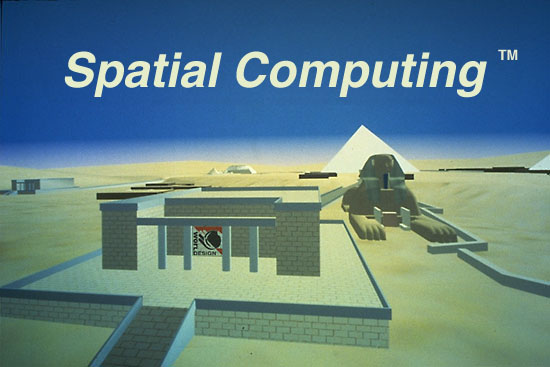
In the early 1990s, as field of virtual reality was beginning to be commercialized beyond academic and military labs, a startup called Worldesign in Seattle used the term Spatial Computing[7] to describe the interaction between individual people and 3D spaces, operating more at the human end of the scale than previous GIS examples may have contemplated. The company built a CAVE-like environment it called the Virtual Environment Theater, whose 3D experience was of a virtual flyover of the Giza Plateau, circa 3000 BC. Robert Jacobson, CEO of Worldesign, attributes the origins of the term to experiments at the Human Interface Technology Lab, at the University of Washington, under the direction of Thomas A. Furness III. Jacobson was a co-founder of that lab before spinning off this early VR startup.

In 1997, an academic publication by T. Caelli, Peng Lam, and H. Bunke called "Spatial Computing: Issues in Vision, Multimedia and Visualization Technologies" introduced the term more broadly for academic audiences,[8] focusing on a variety of topics such as image processing, dead reckoning navigation, object recognition, and visualizing spatial data.

The specific term "spatial computing" was later referenced again in 2003 by Simon Greenwold,[9] as "human interaction with a machine in which the machine retains and manipulates referents to real objects and spaces". MIT Media Lab alumnus John Underkoffler gave a TED talk in 2010[10] giving a live demo of the multi-screen, multi-user spatial computing systems being developed by Oblong Industries, which sought to bring to life the futuristic interfaces conceptualized by Underkoffler in the films Minority Report and Iron Man.

Google Earth, initially released by Keyhole Inc. in 2001 and re-released by Google in 2005 can be considered a capable GIS and includes advanced geospatial tools and capabilities.[11]

Notable instances of the use of spatial computing

[edit]

In 2019, Microsoft HoloLens released a video outlining Airbus' partnership with Microsoft Azure to utilize the latter's mixed reality services for streamlining and improving the aircraft design process, as well as reducing the error in development.[12] Airbus utilized the HoloLens 2 to this end, and the executive vice president of engineering claimed that their design process' validation phases were "hugely accelerated by 80 percent", as well as "strongly believe[d]" that up to 30% improvements in their industrial tasks could be attained with the HoloLens 2. During the presentational video, Airbus cited the maturity of Microsoft Azure services as "key" for their usage of the HoloLens 2.

Also in 2019, the U.S. army partnered with Microsoft to produce a HoloLens based Integrated Visual Augmentation System (IVAS) to enhance infantry members by giving troops various abilities, including but not limited to using holographs to train, projecting 3D maps into their vision, and seeing through smoke and corners.[13] Microsoft received tens of thousands of hours of feedback for their systems by 2021. Sergeant Marc Krugh at the time claimed that Microsoft's partnership has already caused the army to rethink some of its troops' operation strategy.

Products

[edit]

Apple Vision Pro

[edit]
Photo of an Apple Vision Pro, on a stand, with a battery. A man stands in the background in a blue shirt.
Apple Vision Pro is a spatial computing product developed by Apple.

Apple announced Apple Vision Pro, a device it markets as a "spatial computer", on June 5, 2023. It includes several features such as Spatial Audio, two 4K micro-OLED displays, the Apple R1 chip and eye tracking, and released in the United States on February 2, 2024.[14] In announcing the platform, Apple invoked its history of popularizing 2D graphical user interfaces that supplanted prior human-computer interface mechanisms such as the command line. Apple suggests the introduction of spatial computing as a new category of interactive device, on the same level of importance as the introduction of the 2D GUI.

Apple Vision Pro runs on a new operating system called visionOS, which combines eye tracking, gesture recognition, and voice input to enable immersive interaction without physical controllers. The platform is aimed at productivity, entertainment, collaboration, and enterprise use cases.

Magic Leap

[edit]

Magic Leap had also previously used the term “spatial computing” to describe its own devices. Its first headset, the Magic Leap 1, was released on August 8, 2018. [15]

Magic Leap’s technology enables the display of content into the real world using an optical see-through head-mounted display, which projects an overlay of a virtual world into the user’s field of view. This allows for an experience where the physical and digital worlds are perceived simultaneously.

Microsoft Hololens

[edit]

On February 24, 2019, Microsoft released the HoloLens 2, which includes mixed reality tools and can generate interactable, manipulatable holograms in 3D space.[16] The holograms in question can be related to a physical object or completely independent and free-floating. The Azure Spatial Anchors cloud service was released simultaneously, which gives the holograms capability to persist across time and many individuals' devices.

Meta Quest

[edit]

The Meta Quest 3, a mixed reality gaming headset that includes spatial audio, two color cameras, and grants the ability to interact with virtual characters released on October 9, 2023, at a notably cheaper price than the Apple Vision Pro, but with reduced capabilities.[17][18]

5th-generation Snap Spectacles

Snap Spectacles

[edit]

Spectacles (product) are augmented reality glasses developed by Snap Inc.. The latest generation includes a 46-degree stereoscopic display, adjustable tint, and Snapdragon processors.

Spectacles allow users to interact with a collection of augmented reality experiences designed for education, entertainment, and utility.

Currently, the device is in the hands of selected developers and creators, as part of an experimental AR ecosystem focused on creativity, use case exploration and expression.

See also

[edit]
  • Brain–computer interface – Direct communication pathway between an enhanced or wired brain and an external device
  • Cyberspace – Concept describing a widespread, interconnected digital technology
  • OpenXR – Standard for access to virtual reality and augmented reality platforms and devices
  • Transhumanism – Philosophical movement
  • Virtual community – Social network of individuals who interact through specific social media
  • Virtual world – Large-scale, interactive computer-simulated environment
  • WebXR – Experimental JavaScript API for augmented/virtual reality devices
  • Wirehead – Concept in fiction or futuristic applications

References

[edit]
  1. ^ Ovide, Shira (2024-02-02). "Apple's Vision Pro is 'spatial computing.' Nobody knows what it means". Washington Post. Retrieved 2024-02-02.
  2. ^ "Tracking in Virtual Reality and Beyond – VR 101: Part III". blog.vive.com. Retrieved 2024-04-19.
  3. ^ Reeve, D. E. (April 1985). "Computing in the geography degree: limitations and objectives". Journal of Geography in Higher Education. 9 (1): 37–44. doi:10.1080/03098268508708923. ISSN 0309-8265.
  4. ^ GISuser (2007-06-28). "ESRI, Arc/Info, ArcGIS, ArcView... 25 Years in the making - A Time Line". GIS user technology news. Retrieved 2025-05-28.
  5. ^ "ArcObjects 10 .NET SDK Help". help.arcgis.com. Retrieved 2025-05-28.
  6. ^ "Towards intelligent spatial computing for the Earth sciences in South Africa". 1993.
  7. ^ Jacobson, Bar-Zeev, Wong, Dagit (1993). "The Virtual Environment Theater using Spatial Computing". RealityPrime.
  8. ^ Caelli, Terry; Bunke, Horst (1997). Spatial Computing: Issues in Vision, Multimedia and Visualization Technologies. World Scientific. ISBN 978-981-02-2924-5.
  9. ^ Greenwold, Simon (June 2003). "Spatial Computing" (PDF). MIT Graduate Thesis. Retrieved 22 December 2019.
  10. ^ Underkoffler, John (2010). "Pointing to the Future of UI". TED Conference.
  11. ^ "Google Earth capabilities for no-code geospatial evaluation and analytics". Google Maps Platform. Retrieved 2025-05-28.
  12. ^ Microsoft HoloLens (2019-06-17). Airbus drives innovation and accelerates production with Azure mixed reality and HoloLens 2. Retrieved 2025-05-28 – via YouTube.
  13. ^ "U.S. Army to use HoloLens technology in high-tech headsets for soldiers". Source. Retrieved 2025-05-28.
  14. ^ "Apple Vision Pro". Apple. Apple Inc. Retrieved 5 June 2023.
  15. ^ "Magic Leap: Founder of Secretive Start-Up Unveils Mixed-Reality Goggles". Rolling Stone. Archived from the original on 2017-12-20. Retrieved 2025-06-18.
  16. ^ "HoloLens 2 gives Microsoft the edge in next generation of computing". Source. Retrieved 2025-05-28.
  17. ^ "Meta Quest 3". meta.com. May 28, 2025. Retrieved May 28, 2025.
  18. ^ "The Meta Quest 3: Spatial Computing and Mixed Reality Are Things Now". Display Daily. 2023-09-28. Retrieved 2025-05-28.
  • v
  • t
  • e
Extended reality (XR)
  • From least to most virtual: Augmented reality (AR)
  • Mixed reality (MR)
  • Virtual reality (VR)
    • Virtuality
Concepts
Main
  • Cinematic virtual reality
  • Computer-mediated reality
  • Immersion
  • Metaverse
    • Avatar
  • Projection augmented model
  • "Room-scale"
  • Six degrees of freedom (6DoF)
  • Spatial computing
  • Telepresence
  • Virtual reality applications
  • Virtual reality sickness
  • Virtual world
Other
  • Camera filter
  • Quantified self
  • Screen-door effect
  • Simulation hypothesis
  • Transhumanism
  • Vergence-accommodation conflict
  • VTuber
Technologies
Display
  • EyeTap
  • Head-mounted display
    • optical
  • Head-up display
  • Pancake lens
  • Smartglasses
  • Virtual reality headset
    • list
  • Virtual retinal display
3D interaction
  • Brain–computer interface
  • Eye tracking
  • Facial motion capture
  • Finger/hand tracking
  • Pose tracking
  • Simultaneous localization and mapping
Software
  • Asynchronous reprojection
  • Foveated rendering
  • Image-based modeling and rendering
  • Spatial audio
Photography
  • 360-degree video
  • Free viewpoint television
  • Omnidirectional camera
  • VR photography
Other
  • Haptic suit
  • Omnidirectional treadmill
  • Wearable computer
Peripherals
  • Cyberith Virtualizer
  • Leap Motion
  • Oculus Touch
  • PlayStation Move
  • Razer Hydra
  • Virtuix Omni
  • Wired glove
  • Wizdish ROVR
Companies
  • Apple Inc.
  • Brilliant Labs
  • ByteDance
  • Collabora
  • Google
  • HTC
  • Khronos Group
  • Liquid Image
  • Magic Leap
  • Meta Platforms
    • Reality Labs
  • Microsoft
  • Niantic, Inc.
  • Niantic Spatial
  • Pimax
  • Rokoko
  • Samsung Electronics
  • Valve Corporation
  • Varjo
  • Vuzix
Devices
Current
  • Apple Vision Pro
  • Bigscreen Beyond
  • Golden-i headsets
  • HTC Vive
  • Magic Leap
  • Meta Quest 3
    • 3S
  • Open Source Virtual Reality
  • PICO 4 Ultra
  • Pimax
  • PlayStation VR2
  • Samsung Galaxy XR
  • Vuzix
Former
  • AntVR
  • castAR
  • EyePhone
  • Google Cardboard
  • Google Daydream
  • Google Glass
  • Meta Quest Pro
  • Microsoft HoloLens
    • 2
  • Oculus Go
  • Oculus Quest
  • Oculus/Meta Quest 2
  • Oculus Rift
    • CV1
    • S
  • PICO 4
  • PlayStation VR
  • Samsung Gear VR
  • Sensorama
  • SixthSense
  • The Sword of Damocles
  • VFX1 Headgear
  • Virtual Boy
  • Virtual fixture
  • Virtuality
  • VR-1
  • Valve Index
Unreleased
  • Project Iris
  • Sega VR
Upcoming
  • Steam Frame
Software
General
  • Interactive art
    • Virtual graffiti
  • Metaverse
  • Pervasive game
  • Software related to augmented reality
  • Virtual reality game
Operating systems and
desktop environments
  • Android XR
  • Meta Horizon OS
    • version history
  • visionOS
  • Windows Mixed Reality
  • SteamOS
Development tools and
game engines
  • A-Frame
  • ARCore
  • ARKit
  • ARToolKit
  • Godot Engine
  • Jetpack Compose XR
  • Meta Spatial SDK
  • OpenVR
  • OpenXR
  • RealityKit
  • S&box
  • Source 2
  • TabletopKit
  • Unity
  • Universal Scene Description
  • Unreal Engine
  • Vuforia Augmented Reality SDK
  • WebXR
Games
  • List of HTC Vive games
  • List of Meta Quest games
  • List of Oculus Rift games
  • List of PlayStation VR games
    • VR2
Communities and
social networks
  • AltspaceVR
  • FaceTime for visionOS
  • Horizon Worlds
  • NeosVR
  • Rec Room
  • Resonite
  • Sansar
  • Sensorium
  • Sinespace
  • VRChat
  • VTime XR
  • Portals
    • Technology
  • Category
    • Augmented reality
    • Mixed reality
    • Virtual reality
    • Metaverse
    • Spatial computing
  • Commons
    • Augmented reality
    • Mixed reality
    • Virtual reality
    • Metaverse
  • v
  • t
  • e
Ambient intelligence
Concepts
  • Ambient IoT
  • Context awareness
  • Device ecology
  • Spatial computing
  • Internet of things
  • Object hyperlinking
  • Profiling
  • Spime
  • Ubiquitous computing
  • Web of Things
  • Wireless sensor networks
Technologies
  • 6LoWPAN
  • ANT+
  • DASH7
  • IEEE 802.15.4
  • Internet 0
  • Machine to machine
  • Radio-frequency identification
  • Smartdust
  • XBee
Platforms
  • Arduino
  • Contiki
  • Gadgeteer
  • ioBridge
  • Netduino
  • Raspberry Pi
  • TinyOS
  • Wiring
  • Xively
  • NodeMCU
Applications
  • Ambient device
  • CeNSE
  • Connected car
  • Home automation
  • HomeOS
  • Internet refrigerator
  • Nabaztag
  • Smart city
  • Smart TV
  • Smarter Planet
Pioneers
  • Kevin Ashton
  • Gaetano Borriello
  • Adam Dunkels
  • Stefano Marzano
  • Don Norman
  • Roel Pieper
  • Josef Preishuber-Pflügl
  • John Seely Brown
  • Bruce Sterling
  • Mark Weiser
Other
  • Ambient Devices
  • AmbieSense
  • Ebbits project
  • IPSO Alliance
Retrieved from "https://teknopedia.ac.id/w/index.php?title=Spatial_computing&oldid=1340501323"
Categories:
  • Spatial computing
  • 1985 neologisms
  • 1985 in computing
  • 2023 in computing
  • 2024 in computing
  • 2025 in computing
  • 2020s in computing
  • Augmented reality
  • Mixed reality
  • Virtual reality
  • Extended reality
  • Transhumanism
  • Science fiction themes
  • Ubiquitous computing
  • Ambient intelligence
  • Internet of things
  • Human–computer interaction
  • Wearable computers
  • Applications of artificial intelligence
Hidden categories:
  • Articles with short description
  • Short description is different from Wikidata

  • indonesia
  • Polski
  • العربية
  • Deutsch
  • English
  • Español
  • Français
  • Italiano
  • مصرى
  • Nederlands
  • 日本語
  • Português
  • Sinugboanong Binisaya
  • Svenska
  • Українська
  • Tiếng Việt
  • Winaray
  • 中文
  • Русский
Sunting pranala
url url url url url url url url url url url url url url url url url url url url url url url url url url url url url url url url url url url url url url url url url url url url url url url url url url url url url url url url url url url url url url url url url url url url url url url url url url url url url url url url url url url url url url url url url url url url url url url url url url url url url url url url url url url url url url url url url url url url url url url url url url url url url url url url url url url url url url url url url url url url url url url url url url url url url url url url url url url url url url url url url url url url url url url url url url url url url url url url url url url url url url url url url url url url url url url url url url url url url url url url url url url url url url url url url url url url url url url url url url url url url url url url url url url url url url url url url url url url url url url url url url url url url url url url url url url url url url url url url url url url url url url url url url url url url url url url url url url url url url url url url url url url url url url url url url url url url url url url url url url url url url url url url url url url url url url url url url url url url url url url url url url url url url url url url url url url url url url url url url url url url url url url url url url url url url url url url url url url url url url url url url url url url url url url url url url url url url url url url url url url url url url url url url url url url url url url url url url url url url url url url url url url url url url url url url url url url url url url url url url url url url url url url url url url url url url url url url url url url url url url url url url url url url url url url url url url url url url url url url url url url url url url url url url url url url url url url url url url url url url url url url url url url url url url url url url url url url url url url url url url url url url url url url url url url url url url url url url url url url url url url url url url url url url url url url url url url url url url url url url url url url url url url url url url url url url url url url url url url url url url url url url url url url url url url url url url url url url url url url url url url url url url url url url url url url url url url url url url url url url url url url url url url url url url url url url url url url url url url url url url url url url url url url url url url url url url url url url url url url url url url url url url url url url url url url url url url url url url url url url url url url url url url url url url url url url url url url url url url url url url url url url url url url url url url url url url url url url url url url url url url url url url url url url url url url url url url url url url url url url url url url url url url url url url url url url url url url url url url url url url url url url url url url url url url url url url url url url url url url url url url url url url url url url url url url url url url url url url url url url url url url url url url url url url url url url url url url url url url url url url url url url url url url url url url url url url url url url url url url url url url url url url url url url url url url url url url url url url url url url url url url url url url url url url url url url url url url url url url url url url url url url url url url url url url url url url url url url url url url url url url url url url url url url url url url url url url url url url url url url url url url url url url url url url url url url url url url url url url url url url url url url url url url url url url url url url url url url url url url url url url url url url url url url url url url url url url url url url url url url url url url url url url url url url url url url url url url url url url url url url url url url url url url url url url url url url url url url url url url url url url url url url url url url url url url url url url url url url url url url url url url url url url url url url url url url url url url url url url url url url url url url url url url url url url url url url url url url url url url url url url url url url url url url url url url url url url url url url url url url url url url url url url url url url url url url url url url url url url url url url url url url url url url url url url url url url url url url url url url url url url url url url url url url url url url url url url url url url url url url url url url url url url url url url url url url url url url url url url url url url url url url url url url url url url url url url url url url url url url url url url url url url url url url url url url url url url url url url url url url url url url url url url url url url url url url url url url url url url url url url url url url url url url url url url url url url url url url url url url url url url url url url url url url url url url url url url url url url url url url url url url url url url url url url url url url url url url url url url url url url url url url url url url url url url url url url url url url url url url url url url url url url url url url url url url url url url url url url url url url url url url url url url url url url url url url url url url url url url url url url url url url url url url url url url url url url url url url url url url url url url url url url url url url url url url url url url url url url url url url url url url url url url url url url url url url url url url url url url url url url url url url url url url url url url url url url url url url url url url url url url url url url url url url url url url url url url url url url url url url url url url url url url url url url url url url url url url url url url url url url url url url url url url url url url url url url url url url url url url url url url url url url url url url url url url url url url url url url url url url url url url url url url url url url url url url url url url url url url url url url url url url url url url url url url url url url url url url url url url url url url url url url url url url url url url url url url url url url url url url url url url url url url url url url url url url url url url url url url url url url url url url url url url url url url url url url url url url url url url url url url url url url url url url url url url url url url url url url url url url url url url url url url url url url url url url url url url url url url url url url url url url url url url url url url url url url url url url url url url url url url url url url url url url url url url url url url url url url url url url url url url url url url url url url url url url url url url url url url url url url url url url url url url url url url url url url url url url url url url url url url url url url url url url url url url url url url url url url url url url url url url url url url url url url url url url url url url url url url url url url url url url url url url url url url url url url url url url url url url url url url url url url url url url url url url url url url url url url url url url url url url url url url url url url url url url url url url url url url url url url url url url url url url url url url url url url url url url url url url url url url url url url url url url url url url url url url url url url url url url url url url url url url url url url url url url url url url url url url url url url url url url url url url url url url url url url url url url url url url url url url url url url url url url url url url url url url url url url url url url url url url url url url url url url url url url url url url url url url url url url url url url url url url url url url url url url url url url url url url url url url url url url url url url url url url url url url url url url url url url url url url url url url url url url url url url url url url url url url url url url url url url url url url url url url url url url url url url url url url url url url url url url url url url url url url url url url url url url url url url url url url url url url url url url url url url url url url url url url url url url url url url url url url url url url url url url url url url url url url url url url url url url url url url url url url url url url url url url url url url url url url url url url url url url url url url url url url url url url url url url url url url url url url url url url url url url url url url url url url url url url url url url url url url url url url url url url url url url url url url url url url url url url url url url url url url url url url url url url url url url url url url url url url url url url url url url url url url url url url url url url url url url url url url url url url url url url url url url url url url url url url url url url url url url url url url url url url url url url url url url url url url url url url url url url url url url url url url url url url url url url url url url url url url url url url url url url url url url url url url url url url url url url url url url url url url url url url url url url url url url url url url url url url url url url url url url url url url url url url url url url url url url url url url url url url url url url url url url url url url url url url url url url url url url url url url url url url url url url url url url url url url url url url url url url url url url url url url url url url url url url url url url url url url url url url url url url url url url url url url url url url url url url url url url url url url url url url url url url url url url url url url url
Pusat Layanan

UNIVERSITAS TEKNOKRAT INDONESIA | ASEAN's Best Private University
Jl. ZA. Pagar Alam No.9 -11, Labuhan Ratu, Kec. Kedaton, Kota Bandar Lampung, Lampung 35132
Phone: (0721) 702022
Email: pmb@teknokrat.ac.id