Epstein Files Full PDF

CLICK HERE
Technopedia Center
PMB University Brochure
Faculty of Engineering and Computer Science
S1 Informatics S1 Information Systems S1 Information Technology S1 Computer Engineering S1 Electrical Engineering S1 Civil Engineering

faculty of Economics and Business
S1 Management S1 Accountancy

Faculty of Letters and Educational Sciences
S1 English literature S1 English language education S1 Mathematics education S1 Sports Education
teknopedia

  • Registerasi
  • Brosur UTI
  • Kip Scholarship Information
  • Performance
Flag Counter
  1. World Encyclopedia
  2. Switched capacitor - Wikipedia
Switched capacitor - Wikipedia
From Wikipedia, the free encyclopedia
Electronic circuit element implementing a filter

A switched capacitor (SC) is an electronic circuit that implements a function by moving charges into and out of capacitors when electronic switches are opened and closed. Usually, non-overlapping clock signals are used to control the switches, so that not all switches are closed simultaneously. Filters implemented with these elements are termed switched-capacitor filters, which depend only on the ratios between capacitances and the switching frequency, and not on precise resistors. This makes them much more suitable for use within integrated circuits, where accurately specified resistors and capacitors are not economical to construct, but accurate clocks and accurate relative ratios of capacitances are economical.[1]

SC circuits are typically implemented using metal–oxide–semiconductor (MOS) technology, with MOS capacitors and MOS field-effect transistor (MOSFET) switches, and they are commonly fabricated using the complementary MOS (CMOS) process. Common applications of MOS SC circuits include mixed-signal integrated circuits, digital-to-analog converter (DAC) chips, analog-to-digital converter (ADC) chips, pulse-code modulation (PCM) codec-filters, and PCM digital telephony.[2]

Parallel resistor simulation using a switched-capacitor

[edit]
Switched-capacitor resistor

The simplest switched-capacitor (SC) circuit is made of one capacitor C S {\displaystyle C_{S}} {\displaystyle C_{S}} and two switches S1 and S2 which alternatively connect the capacitor to either in or out at a switching frequency of f {\displaystyle f} {\displaystyle f}.

Recall that Ohm's law can express the relationship between voltage, current, and resistance as:

R = V I .   {\displaystyle R={V \over I}.\ } {\displaystyle R={V \over I}.\ }

The following equivalent resistance calculation will show how during each switching cycle, this switched-capacitor circuit transfers an amount of charge from in to out such that it behaves according to a similar linear current–voltage relationship with R equivalent = 1 / ( C S f ) . {\displaystyle R_{\text{equivalent}}=1/(C_{S}f).} {\displaystyle R_{\text{equivalent}}=1/(C_{S}f).}

Equivalent resistance calculation

[edit]

By definition, the charge q {\displaystyle q} {\displaystyle q} on any capacitor C {\displaystyle C} {\displaystyle C} with a voltage V {\displaystyle V} {\displaystyle V} between its plates is:

q = C V .   {\displaystyle q=CV.\ } {\displaystyle q=CV.\ }

Therefore, when S1 is closed while S2 is open, the charge stored in the capacitor C S {\displaystyle C_{S}} {\displaystyle C_{S}} will be:

q in = C S V in {\displaystyle q_{\text{in}}=C_{S}V_{\text{in}}} {\displaystyle q_{\text{in}}=C_{S}V_{\text{in}}}

assuming V in {\displaystyle V_{\text{in}}} {\displaystyle V_{\text{in}}} is an ideal voltage source.

When S2 is closed (S1 is open - they are never both closed at the same time), some of that charge is transferred out of the capacitor. Exactly how much charge gets transferred can't be determined without knowing what load is attached to the output. However, by definition, the charge remaining on capacitor C S {\displaystyle C_{S}} {\displaystyle C_{S}} can be expressed in terms of the unknown variable V out {\displaystyle V_{\text{out}}} {\displaystyle V_{\text{out}}}:

q out = C S V out .   {\displaystyle q_{\text{out}}=C_{S}V_{\text{out}}.\ } {\displaystyle q_{\text{out}}=C_{S}V_{\text{out}}.\ }

Thus, the charge transferred from in to out during one switching cycle is:

q in-out = q in − q out = C S ( V in − V out ) .   {\displaystyle q_{\text{in-out}}=q_{\text{in}}-q_{\text{out}}=C_{S}(V_{\text{in}}-V_{\text{out}}).\ } {\displaystyle q_{\text{in-out}}=q_{\text{in}}-q_{\text{out}}=C_{S}(V_{\text{in}}-V_{\text{out}}).\ }

This charge is transferred at a rate of f {\displaystyle f} {\displaystyle f}. So the average electric current (rate of transfer of charge per unit time) from in to out is:

I in-out = q in-out f = C S ( V in − V out ) f .   {\displaystyle I_{\text{in-out}}=q_{\text{in-out}}f=C_{S}(V_{\text{in}}-V_{\text{out}})f.\ } {\displaystyle I_{\text{in-out}}=q_{\text{in-out}}f=C_{S}(V_{\text{in}}-V_{\text{out}})f.\ }

The voltage difference from in to out can be written as:

V in-out = V in − V out .   {\displaystyle V_{\text{in-out}}=V_{\text{in}}-V_{\text{out}}.\ } {\displaystyle V_{\text{in-out}}=V_{\text{in}}-V_{\text{out}}.\ }

Finally, the current–voltage relationship from in to out can be expressed with the same form as Ohm's law, to show that this switched-capacitor circuit simulates a resistor with an equivalent resistance of:

R equivalent = V in-out I in-out = ( V in − V out ) C S ( V in − V out ) f = 1 C S f .   {\displaystyle R_{\text{equivalent}}={V_{\text{in-out}} \over I_{\text{in-out}}}={(V_{\text{in}}-V_{\text{out}}) \over C_{S}(V_{\text{in}}-V_{\text{out}})f}={1 \over {C_{S}f}}.\ } {\displaystyle R_{\text{equivalent}}={V_{\text{in-out}} \over I_{\text{in-out}}}={(V_{\text{in}}-V_{\text{out}}) \over C_{S}(V_{\text{in}}-V_{\text{out}})f}={1 \over {C_{S}f}}.\ }

This circuit is called a parallel resistor simulation because in and out are connected in parallel and not directly coupled. Other types of SC simulated resistor circuits are bilinear resistor simulation, series resistor simulation, series-parallel resistor simulation, and parasitic-insensitive resistor simulation.

Difference with real resistor

[edit]

Charge is transferred from in to out as discrete pulses, not continuously. This transfer approximates the equivalent continuous transfer of charge of a resistor when the switching frequency is sufficiently higher (≥100x) than the bandlimit of the input signal.

The SC circuit modeled here using ideal switches with zero resistance does not suffer from the ohmic heating energy loss of a regular resistor, and so ideally could be called a loss free resistor. However real switches have some small resistance in their channel or p–n junctions, so power is still dissipated. The capacitors are not ideal either and dissipate power as well.

Because the resistance inside electric switches is typically much smaller than the resistances in circuits relying on regular resistors, SC circuits can have substantially lower Johnson–Nyquist noise. However, harmonics of the switching frequency may be manifested as high frequency noise that may need to be attenuated with a low-pass filter.

SC simulated resistors also have the benefit that their equivalent resistance can be adjusted by changing the switching frequency (i.e., it is a programmable resistance) with a resolution limited by the resolution of the switching period. Thus online or runtime adjustment can be done by controlling the oscillation of the switches (e.g. using an configurable clock output signal from a microcontroller).

Applications

[edit]
See also: Operational amplifier applications

SC simulated resistors are used as a replacement for real resistors in integrated circuits because it is easier to fabricate reliably with a wide range of values and can take up much less silicon area.

This same circuit can be used in discrete time systems (such as ADCs) as a sample and hold circuit. During the appropriate clock phase, the capacitor samples the analog voltage through switch S1 and in the second phase presents this held sampled value through switch S2 to an electronic circuit for processing.

Filters

[edit]

Electronic filters consisting of resistors and capacitors can have their resistors replaced with equivalent switched-capacitor simulated resistors, allowing the filter to be manufactured using only switches and capacitors without relying on real resistors.

The parasitic-sensitive integrator

[edit]
A simple switched-capacitor parasitic-sensitive integrator

Switched-capacitor simulated resistors can replace the input resistor in an op amp integrator to provide accurate voltage gain and integration.

One of the earliest of these circuits is the parasitic-sensitive integrator developed by the Czech engineer Bedrich Hosticka.[3]

Analysis

[edit]

Denote by T = 1 / f {\displaystyle T=1/f} {\displaystyle T=1/f} the switching period. In capacitors,

charge = capacitance × voltage {\displaystyle {\text{charge}}={\text{capacitance}}\times {\text{voltage}}} {\displaystyle {\text{charge}}={\text{capacitance}}\times {\text{voltage}}}

Then, when S1 opens and S2 closes (they are never both closed at the same time), we have the following:

1) Because C s {\displaystyle C_{s}} {\displaystyle C_{s}} has just charged:

Q s ( t ) = C s ⋅ V s ( t ) {\displaystyle Q_{s}(t)=C_{s}\cdot V_{s}(t)\,} {\displaystyle Q_{s}(t)=C_{s}\cdot V_{s}(t)\,}

2) Because the feedback cap, C f b {\displaystyle C_{fb}} {\displaystyle C_{fb}}, is suddenly charged with that much charge (by the op amp, which seeks a virtual short circuit between its inputs):


Q f b ( t ) = Q s ( t − T ) + Q f b ( t − T ) {\displaystyle Q_{fb}(t)=Q_{s}(t-T)+Q_{fb}(t-T)\,} {\displaystyle Q_{fb}(t)=Q_{s}(t-T)+Q_{fb}(t-T)\,}

Now dividing 2) by C f b {\displaystyle C_{fb}} {\displaystyle C_{fb}}:

V f b ( t ) = Q s ( t − T ) C f b + V f b ( t − T ) {\displaystyle V_{fb}(t)={\frac {Q_{s}(t-T)}{C_{fb}}}+V_{fb}(t-T)\,} {\displaystyle V_{fb}(t)={\frac {Q_{s}(t-T)}{C_{fb}}}+V_{fb}(t-T)\,}

And inserting 1):

V f b ( t ) = C s C f b ⋅ V s ( t − T ) + V f b ( t − T ) {\displaystyle V_{fb}(t)={\frac {C_{s}}{C_{fb}}}\cdot V_{s}(t-T)+V_{fb}(t-T)\,} {\displaystyle V_{fb}(t)={\frac {C_{s}}{C_{fb}}}\cdot V_{s}(t-T)+V_{fb}(t-T)\,}

This last equation represents what is going on in C f b {\displaystyle C_{fb}} {\displaystyle C_{fb}} - it increases (or decreases) its voltage each cycle according to the charge that is being "pumped" from C s {\displaystyle C_{s}} {\displaystyle C_{s}} (due to the op-amp).

However, there is a more elegant way to formulate this fact if T {\displaystyle T} {\displaystyle T} is very short. Let us introduce d t ← T {\displaystyle dt\leftarrow T} {\displaystyle dt\leftarrow T} and d V f b ← V f b ( t ) − V f b ( t − d t ) {\displaystyle dV_{fb}\leftarrow V_{fb}(t)-V_{fb}(t-dt)} {\displaystyle dV_{fb}\leftarrow V_{fb}(t)-V_{fb}(t-dt)} and rewrite the last equation divided by dt:

d V f b ( t ) d t = f C s C f b ⋅ V s ( t ) {\displaystyle {\frac {dV_{fb}(t)}{dt}}=f{\frac {C_{s}}{C_{fb}}}\cdot V_{s}(t)\,} {\displaystyle {\frac {dV_{fb}(t)}{dt}}=f{\frac {C_{s}}{C_{fb}}}\cdot V_{s}(t)\,}

Therefore, the op-amp output voltage takes the form:

V out ( t ) = − V f b ( t ) = − 1 1 f C s C f b ∫ V s ( t ) d t {\displaystyle V_{\text{out}}(t)=-V_{fb}(t)=-{\frac {1}{{\frac {1}{fC_{s}}}C_{fb}}}\int V_{s}(t)dt\,} {\displaystyle V_{\text{out}}(t)=-V_{fb}(t)=-{\frac {1}{{\frac {1}{fC_{s}}}C_{fb}}}\int V_{s}(t)dt\,}

This is the same formula as the op amp inverting integrator where the resistance is replaced by a SC simulated resistor with an equivalent resistance of:
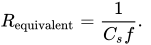
R equivalent = 1 C s f .   {\displaystyle R_{\text{equivalent}}={1 \over {C_{s}f}}.\ } {\displaystyle R_{\text{equivalent}}={1 \over {C_{s}f}}.\ }

This switched-capacitor circuit is called "parasitic-sensitive" because its behavior is significantly affected by parasitic capacitances, which will cause errors when parasitic capacitances can't be controlled. "Parasitic insensitive" circuits try to overcome this.

The parasitic insensitive integrator

[edit]

Use in discrete-time systems

[edit]

The delaying parasitic insensitive integrator[clarification needed] has a wide use in discrete time electronic circuits such as biquad filters, anti-alias structures, and delta-sigma data converters. This circuit implements the following z-domain function:
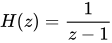
H ( z ) = 1 z − 1 {\displaystyle H(z)={\frac {1}{z-1}}} {\displaystyle H(z)={\frac {1}{z-1}}}

The multiplying digital to analog converter

[edit]
A 1.5 bit multiplying digital to analog converter

One useful characteristic of switched-capacitor circuits is that they can be used to perform many circuit tasks at the same time, which is difficult with non-discrete time components (i.e. analog electronics).[clarification needed] The multiplying digital to analog converter (MDAC) is an example as it can take an analog input, add a digital value d {\displaystyle d} {\displaystyle d} to it, and multiply this by some factor based on the capacitor ratios. The output of the MDAC is given by the following:


V O u t = V i ⋅ ( C 1 + C 2 ) − ( d − 1 ) ⋅ V r ⋅ C 2 + V o s ⋅ ( C 1 + C 2 + C p ) C 1 + ( C 1 + C 2 + C p ) A {\displaystyle V_{Out}={\frac {V_{i}\cdot (C_{1}+C_{2})-(d-1)\cdot V_{r}\cdot C_{2}+V_{os}\cdot (C_{1}+C_{2}+C_{p})}{C_{1}+{\frac {(C_{1}+C_{2}+C_{p})}{A}}}}} {\displaystyle V_{Out}={\frac {V_{i}\cdot (C_{1}+C_{2})-(d-1)\cdot V_{r}\cdot C_{2}+V_{os}\cdot (C_{1}+C_{2}+C_{p})}{C_{1}+{\frac {(C_{1}+C_{2}+C_{p})}{A}}}}}

The MDAC is a common component in modern pipeline analog to digital converters as well as other precision analog electronics and was first created in the form above by Stephen Lewis and others at Bell Laboratories.[4]

Analysis of switched-capacitor circuits

[edit]

Switched-capacitor circuits are analysed by writing down charge conservation equations, as in this article, and solving them with a computer algebra tool. For hand analysis and for getting more insight into the circuits, it is also possible to do a Signal-flow graph analysis, with a method that is very similar for switched-capacitor and continuous-time circuits.[5]

See also

[edit]
  • Aliasing
  • Charge pump
  • Nyquist–Shannon sampling theorem
  • Switched-mode power supply
  • Thyristor-switched capacitor (TSC)

References

[edit]
  1. ^ Switched Capacitor Circuits, Swarthmore College course notes, accessed 2009-05-02
  2. ^ Allstot, David J. (2016). "Switched Capacitor Filters". In Maloberti, Franco; Davies, Anthony C. (eds.). A Short History of Circuits and Systems: From Green, Mobile, Pervasive Networking to Big Data Computing (PDF). IEEE Circuits and Systems Society. pp. 105–110. ISBN 9788793609860.
  3. ^ B. Hosticka, R. Brodersen, P. Gray, "MOS Sampled Data Recursive Filters Using Switched Capacitor Integrators", IEEE Journal of Solid-State Circuits, Vol SC-12, No.6, December 1977.
  4. ^ Stephen H. Lewis et al., "A 10-bit, 20Msample/s Analog to Digital Converter", IEEE Journal of Solid-State Circuits, March 1992
  5. ^ H. Schmid and A. Huber, "Analysis of switched-capacitor circuits using driving-point signal-flow graphs", Analog Integr Circ Sig Process (2018). https://doi.org/10.1007/s10470-018-1131-7.
  • Mingliang Liu, Demystifying Switched-Capacitor Circuits, ISBN 0-7506-7907-7
  • v
  • t
  • e
Electronic components
Semiconductor
devices
MOS
transistors
  • Transistor
  • NMOS
  • PMOS
  • BiCMOS
  • BioFET
  • Chemical field-effect transistor (ChemFET)
  • Complementary MOS (CMOS)
  • Depletion-load NMOS
  • Fin field-effect transistor (FinFET)
  • Floating-gate MOSFET (FGMOS)
  • Insulated-gate bipolar transistor (IGBT)
  • ISFET
  • LDMOS
  • MOS field-effect transistor (MOSFET)
  • Multi-gate field-effect transistor (MuGFET)
  • Power MOSFET
  • Thin-film transistor (TFT)
  • VMOS
  • UMOS
Other
transistors
  • Bipolar junction transistor (BJT)
  • Darlington transistor
  • Diffused junction transistor
  • Field-effect transistor (FET)
    • Junction Gate FET (JFET)
    • Organic FET (OFET)
  • Light-emitting transistor (LET)
    • Organic LET (OLET)
  • Pentode transistor
  • Point-contact transistor
  • Programmable unijunction transistor (PUT)
  • Static induction transistor (SIT)
  • Tetrode transistor
  • Unijunction transistor (UJT)
Diodes
  • Avalanche diode
  • Constant-current diode (CLD, CRD)
  • Gunn diode
  • Laser diode (LD)
  • Light-emitting diode (LED)
  • Organic light-emitting diode (OLED)
  • Photodiode
  • PIN diode
  • Schottky diode
  • Step recovery diode
  • Zener diode
Other
devices
  • Printed electronics
  • Printed circuit board
  • DIAC
  • Heterostructure barrier varactor
  • Integrated circuit (IC)
  • Hybrid integrated circuit
  • Light emitting capacitor (LEC)
  • Memistor
  • Memristor
  • Memtransistor
  • Memory cell
  • Metal-oxide varistor (MOV)
  • Mixed-signal integrated circuit
  • MOS integrated circuit (MOS IC)
  • Organic semiconductor
  • Photodetector
  • Quantum circuit
  • RF CMOS
  • Silicon controlled rectifier (SCR)
  • Solaristor
  • Static induction thyristor (SITh)
  • Three-dimensional integrated circuit (3D IC)
  • Thyristor
  • Trancitor
  • TRIAC
  • Varicap
Voltage regulators
  • Linear regulator
  • Low-dropout regulator
  • Switching regulator
  • Buck
  • Boost
  • Buck–boost
  • Split-pi
  • Ćuk
  • SEPIC
  • Charge pump
  • Switched capacitor
Vacuum tubes
  • Acorn tube
  • Audion
  • Beam tetrode
  • Barretter
  • Compactron
  • Diode
  • Fleming valve
  • Neutron tube
  • Nonode
  • Nuvistor
  • Pentagrid (Hexode, Heptode, Octode)
  • Pentode
  • Photomultiplier
  • Phototube
  • Tetrode
  • Triode
Vacuum tubes (RF)
  • Backward-wave oscillator (BWO)
  • Cavity magnetron
  • Crossed-field amplifier (CFA)
  • Gyrotron
  • Inductive output tube (IOT)
  • Klystron
  • Maser
  • Sutton tube
  • Traveling-wave tube (TWT)
  • X-ray tube
Cathode ray tubes
  • Beam deflection tube
  • Charactron
  • Iconoscope
  • Magic eye tube
  • Monoscope
  • Selectron tube
  • Storage tube
  • Trochotron
  • Video camera tube
  • Williams tube
Gas-filled tubes
  • Cold cathode
  • Crossatron
  • Dekatron
  • Ignitron
  • Krytron
  • Mercury-arc valve
  • Neon lamp
  • Nixie tube
  • Thyratron
  • Trigatron
  • Voltage-regulator tube
Adjustable
  • Potentiometer
    • digital
  • Variable capacitor
  • Varicap
Passive
  • Connector
    • audio and video
    • electrical power
    • RF
  • Electrolytic detector
  • Ferrite
  • Antifuse
  • Fuse
    • resettable
    • eFuse
  • Resistor
  • Switch
  • Thermistor
  • Transformer
  • Varistor
  • Wire
    • Wollaston wire
Reactive
  • Capacitor
    • types
  • Ceramic resonator
  • Crystal oscillator
  • Inductor
  • Parametron
  • Relay
    • reed relay
    • mercury relay
Other devices
  • Cam timer
Retrieved from "https://teknopedia.ac.id/w/index.php?title=Switched_capacitor&oldid=1339558700"
Categories:
  • Capacitors
  • Electronic filter applications
  • Electronic filter topology
  • MOSFETs
  • Voltage regulation
Hidden categories:
  • Articles with short description
  • Short description matches Wikidata
  • Wikipedia articles needing clarification from September 2022

  • indonesia
  • Polski
  • العربية
  • Deutsch
  • English
  • Español
  • Français
  • Italiano
  • مصرى
  • Nederlands
  • 日本語
  • Português
  • Sinugboanong Binisaya
  • Svenska
  • Українська
  • Tiếng Việt
  • Winaray
  • 中文
  • Русский
Sunting pranala
url url url url url url url url url url url url url url url url url url url url url url url url url url url url url url url url url url url url url url url url url url url url url url url url url url url url url url url url url url url url url url url url url url url url url url url url url url url url url url url url url url url url url url url url url url url url url url url url url url url url url url url url url url url url url url url url url url url url url url url url url url url url url url url url url url url url url url url url url url url url url url url url url url url url url url url url url url url url url url url url url url url url url url url url url url url url url url url url url url url url url url url url url url url url url url url url url url url url url url url url url url url url url url url url url url url url url url url url url url url url url url url url url url url url url url url url url url url url url url url url url url url url url url url url url url url url url url url url url url url url url url url url url url url url url url url url url url url url url url url url url url url url url url url url url url url url url url url url url url url url url url url url url url url url url url url url url url url url url url url url url url url url url url url url url url url url url url url url url url url url url url url url url url url url url url url url url url url url url url url url url url url url url url url url url url url url url url url url url url url url url url url url url url url url url url url url url url url url url url url url url url url url url url url url url url url url url url url url url url url url url url url url url url url url url url url url url url url url url url url url url url url url url url url url url url url url url url url url url url url url url url url url url url url url url url url url url url url url url url url url url url url url url url url url url url url url url url url url url url url url url url url url url url url url url url url url url url url url url url url url url url url url url url url url url url url url url url url url url url url url url url url url url url url url url url url url url url url url url url url url url url url url url url url url url url url url url url url url url url url url url url url url url url url url url url url url url url url url url url url url url url url url url url url url url url url url url url url url url url url url url url url url url url url url url url url url url url url url url url url url url url url url url url url url url url url url url url url url url url url url url url url url url url url url url url url url url url url url url url url url url url url url url url url url url url url url url url url url url url url url url url url url url url url url url url url url url url url url url url url url url url url url url url url url url url url url url url url url url url url url url url url url url url url url url url url url url url url url url url url url url url url url url url url url url url url url url url url url url url url url url url url url url url url url url url url url url url url url url url url url url url url url url url url url url url url url url url url url url url url url url url url url url url url url url url url url url url url url url url url url url url url url url url url url url url url url url url url url url url url url url url url url url url url url url url url url url url url url url url url url url url url url url url url url url url url url url url url url url url url url url url url url url url url url url url url url url url url url url url url url url url url url url url url url url url url url url url url url url url url url url url url url url url url url url url url url url url url url url url url url url url url url url url url url url url url url url url url url url url url url url url url url url url url url url url url url url url url url url url url url url url url url url url url url url url url url url url url url url url url url url url url url url url url url url url url url url url url url url url url url url url url url url url url url url url url url url url url url url url url url url url url url url url url url url url url url url url url url url url url url url url url url url url url url url url url url url url url url url url url url url url url url url url url url url url url url url url url url url url url url url url url url url url url url url url url url url url url url url url url url url url url url url url url url url url url url url url url url url url url url url url url url url url url url url url url url url url url url url url url url url url url url url url url url url url url url url url url url url url url url url url url url url url url url url url url url url url url url url url url url url url url url url url url url url url url url url url url url url url url url url url url url url url url url url url url url url url url url url url url url url url url url url url url url url url url url url url url url url url url url url url url url url url url url url url url url url url url url url url url url url url url url url url url url url url url url url url url url url url url url url url url url url url url url url url url url url url url url url url url url url url url url url url url url url url url url url url url url url url url url url url url url url url url url url url url url url url url url url url url url url url url url url url url url url url url url url url url url url url url url url url url url url url url url url url url url url url url url url url url url url url url url url url url url url url url url url url url url url url url url url url url url url url url url url url url url url url url url url url url url url url url url url url url url url url url url url url url url url url url url url url url url url url url url url url url url url url url url url url url url url url url url url url url url url url url url url url url url url url url url url url url url url url url url url url url url url url url url url url url url url url url url url url url url url url url url url url url url url url url url url url url url url url url url url url url url url url url url url url url url url url url url url url url url url url url url url url url url url url url url url url url url url url url url url url url url url url url url url url url url url url url url url url url url url url url url url url url url url url url url url url url url url url url url url url url url url url url url url url url url url url url url url url url url url url url url url url url url url url url url url url url url url url url url url url url url url url url url url url url url url url url url url url url url url url url url url url url url url url url url url url url url url url url url url url url url url url url url url url url url url url url url url url url url url url url url url url url url url url url url url url url url url url url url url url url url url url url url url url url url url url url url url url url url url url url url url url url url url url url url url url url url url url url url url url url url url url url url url url url url url url url url url url url url url url url url url url url url url url url url url url url url url url url url url url url url url url url url url url url url url url url url url url url url url url url url url url url url url url url url url url url url url url url url url url url url url url url url url url url url url url url url url url url url url url url url url url url url url url url url url url url url url url url url url url url url url url url url url url url url url url url url url url url url url url url url url url url url url url url url url url url url url url url url url url url url url url url url url url url url url url url url url url url url url url url url url url url url url url url url url url url url url url url url url url url url url url url url url url url url url url url url url url url url url url url url url url url url url url url url url url url url url url url url url url url url url url url url url url url url url url url url url url url url url url url url url url url url url url url url url url url url url url url url url url url url url url url url url url url url url url url url url url url url url url url url url url url url url url url url url url url url url url url url url url url url url url url url url url url url url url url url url url url url url url url url url url url url url url url url url url url url url url url url url url url url url url url url url url url url url url url url url url url url url url url url url url url url url url url url url url url url url url url url url url url url url url url url url url url url url url url url url url url url url url url url url url url url url url url url url url url url url url url url url url url url url url url url url url url url url url url url url url url url url url url url url url url url url url url url url url url url url url url url url url url url url url url url url url url url url url url url url url url url url url url url url url url url url url url url url url url url url url url url url url url url url url url url url url url url url url url url url url url url url url url url url url url url url url url url url url url url url url url url url url url url url url url url url url url url url url url url url url url url url url url url url url url url url url url url url url url url url url url url url url url url url url url url url url url url url url url url
Pusat Layanan

UNIVERSITAS TEKNOKRAT INDONESIA | ASEAN's Best Private University
Jl. ZA. Pagar Alam No.9 -11, Labuhan Ratu, Kec. Kedaton, Kota Bandar Lampung, Lampung 35132
Phone: (0721) 702022
Email: pmb@teknokrat.ac.id




