Epstein Files Full PDF

CLICK HERE
Technopedia Center
PMB University Brochure
Faculty of Engineering and Computer Science
S1 Informatics S1 Information Systems S1 Information Technology S1 Computer Engineering S1 Electrical Engineering S1 Civil Engineering

faculty of Economics and Business
S1 Management S1 Accountancy

Faculty of Letters and Educational Sciences
S1 English literature S1 English language education S1 Mathematics education S1 Sports Education
teknopedia

  • Registerasi
  • Brosur UTI
  • Kip Scholarship Information
  • Performance
Flag Counter
  1. World Encyclopedia
  2. Boost converter - Wikipedia
Boost converter - Wikipedia
From Wikipedia, the free encyclopedia
DC-to-DC power converter with an output voltage greater than its input voltage
icon
This article needs additional citations for verification. Please help improve this article by adding citations to reliable sources. Unsourced material may be challenged and removed.
Find sources: "Boost converter" – news · newspapers · books · scholar · JSTOR
(July 2009) (Learn how and when to remove this message)
Low-cost converter modules: two boost and one buck.
Left is a boost converter from a TI calculator, originally generating 9 V from 2.4 V provided by two AA rechargeable cells (right is an added 9V battery snap connector).

A boost converter or step-up converter is a DC-to-DC converter that increases voltage, while decreasing current, from its input (supply) to its output (load).

It is a class of switched-mode power supply (SMPS) containing at least two semiconductors, a diode and a transistor, and at least one energy storage element: a capacitor, inductor, or the two in combination. To reduce voltage ripple, filters made of capacitors (sometimes in combination with inductors) are normally added to such a converter's output (load-side filter) and input (supply-side filter).

Overview

[edit]

Power for the boost converter can come from any suitable DC source, such as batteries, solar panels, rectifiers, and DC generators. A process that changes one DC voltage to a different DC voltage is called DC to DC conversion. A boost converter is a DC to DC converter with an output voltage greater than the source voltage. A boost converter is sometimes called a step-up converter since it "steps up" the source voltage. Since power ( P = U ⋅ I {\textstyle P=U\cdot I} {\textstyle P=U\cdot I}) must be conserved, the output current is lower than the source current.

History

[edit]

For high efficiency, the switched-mode power supply (SMPS) switch must turn on and off quickly and have low losses. The advent of a commercial semiconductor switch in the 1950s represented a major milestone that made SMPSs such as the boost converter possible. The major DC to DC converters were developed in the early 1960s when semiconductor switches had become available. The aerospace industry’s need for small, lightweight, and efficient power converters led to the converter’s rapid development.

Switched systems such as SMPS are a challenge to design since their models depend on whether a switch is opened or closed. R. D. Middlebrook from Caltech in 1977 published the models for DC to DC converters used today. Middlebrook averaged the circuit configurations for each switch state in a technique called state-space averaging. This simplification reduced two systems into one. The new model led to insightful design equations which helped the growth of SMPS.

Applications

[edit]

Battery power systems

[edit]

Battery power systems often stack cells in series to achieve higher voltage. However, sufficient stacking of cells is not possible in many high voltage applications due to lack of space. Boost converters can increase the voltage and reduce the number of cells. Two battery-powered applications that use boost converters are used in hybrid electric vehicles (HEV) and lighting systems.

The NHW20 model Toyota Prius HEV uses a 500 V motor. Without a boost converter, the Prius would need nearly 417 cells to power the motor. However, a Prius actually uses only 168 cells[1][failed verification] and boosts the battery voltage from 202 V to 500 V. Boost converters also power devices at smaller scale applications, such as portable lighting systems. A white LED typically requires 3.3 V to emit light, and a boost converter can step up the voltage from a single 1.5 V alkaline cell to power the lamp.

Joule thief

[edit]

An unregulated boost converter is used as the voltage increase mechanism in the circuit known as the "Joule thief", based on blocking oscillator concepts. This circuit topology is used with low power battery applications, and is aimed at the ability of a boost converter to "steal" the remaining energy in a battery. This energy would otherwise be wasted since the low voltage of a nearly depleted battery makes it unusable for a normal load. This voltage decrease occurs as batteries become depleted, and is a characteristic of the ubiquitous alkaline battery. Since the equation for power is P = V 2 R {\textstyle P={\frac {V^{2}}{R}}} {\textstyle P={\frac {V^{2}}{R}}}, and R tends to be stable, power available to the load goes down significantly as voltage decreases.

Photovoltaic cells

[edit]

The special kind of boost-converters called voltage-lift type boost converters are used in solar photovoltaic (PV) systems. These power converters add up the passive components (diode, inductor and capacitor) of a traditional boost-converter to improve the power quality and increase the performance of complete PV system.[2]

Circuit analysis

[edit]
Fig. 1. Boost converter schematic
Fig. 2. The two current paths of a boost converter, depending on the state of the switch S

Operation

[edit]
Boost converter animation.

The key principle that drives the boost converter is the tendency of an inductor to resist changes in current by either increasing or decreasing the energy stored in the inductor's magnetic field. In a boost converter, the output voltage is always higher than the input voltage. A schematic of a boost power stage is shown in Figure 1.

  • When the switch is closed (on-state), current flows through the inductor in the clockwise direction and the inductor stores some energy by generating a magnetic field. The polarity of the left side of the inductor is positive.
  • When the switch is opened (off-state), the magnetic field previously created will be reduced in energy to maintain the current through the inductor. The polarity of the inductor will be reversed, which means the left side of the inductor will become negative. As a result, the current from both the voltage source and the inductor in series will add together and be redirected through the now forward-biased diode "D" towards the load.

If the switch is cycled fast enough, the inductor will not discharge fully in between charging stages, and the load will always see a voltage greater than that of the input source alone when the switch is opened. Also, while the switch is opened, the capacitor, in parallel with the load, is charged to this combined voltage. When the switch is then closed, and the right-hand side is shorted out from the left-hand side, the capacitor is, therefore, able to provide the voltage and energy to the load. During this time, the blocking diode prevents the capacitor from discharging through the switch. The switch must, of course, be opened again fast enough to prevent the capacitor from discharging too much.

The basic principle of a boost converter consists of 2 distinct states (see Figure 2):

  • In the on-state, the switch S (see Figure 1) is closed, resulting in an increase in the inductor current;
  • In the off-state, the switch is open, and the only path offered to inductor current is through the flyback diode D, the capacitor C and the load R. This results in transferring the energy accumulated during the on-state into the capacitor.
  • The input current is the same as the inductor current, as shown in figure 2. So, it is not discontinuous as in the buck converter, and the requirements on the input filter are relaxed compared to a buck converter.

Continuous mode

[edit]

When a boost converter operates in continuous mode, the current through the inductor ( I L {\displaystyle I_{L}} {\displaystyle I_{L}}) never falls to zero. Figure 3 shows the typical waveforms of inductor current and voltage in a converter operating in this mode.

Fig. 3. Waveforms of inductor current and voltage in a boost converter operating in continuous mode.

In the steady state, the DC (average) voltage across the inductor must be zero so that after each cycle, the inductor returns the same state because the voltage across the inductor is proportional to the rate of change of current through it (explained in more detail below). Note in Figure 1 that the left-hand side of L is at V i {\displaystyle V_{i}} {\displaystyle V_{i}}, and the right-hand side of L sees the V s {\displaystyle V_{s}} {\displaystyle V_{s}} voltage waveform from Figure 3. The average value of V s {\displaystyle V_{s}} {\displaystyle V_{s}} is ( 1 − D ) V o {\displaystyle (1-D)V_{o}} {\displaystyle (1-D)V_{o}}, where D is the duty cycle of the waveform driving the switch. From this we get the ideal transfer function:

V i = ( 1 − D ) V o {\displaystyle V_{i}=(1-D)V_{o}} {\displaystyle V_{i}=(1-D)V_{o}}

or

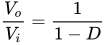
V o V i = 1 1 − D {\displaystyle {\frac {V_{o}}{V_{i}}}={\frac {1}{1-D}}} {\displaystyle {\frac {V_{o}}{V_{i}}}={\frac {1}{1-D}}}.

We get the same result from a more detailed analysis as follows: The output voltage can be calculated as follows in the case of an ideal converter (i.e. using components with an ideal behaviour) operating in steady conditions:[3]

During the on-state, the switch S is closed, which makes the input voltage ( V i {\displaystyle V_{i}} {\displaystyle V_{i}}) appear across the inductor, which causes a change in current ( I L {\displaystyle I_{L}} {\displaystyle I_{L}}) flowing through the inductor during a time period (t) by the formula:

Δ I L Δ t = V i L {\displaystyle {\frac {\Delta I_{L}}{\Delta t}}={\frac {V_{i}}{L}}} {\displaystyle {\frac {\Delta I_{L}}{\Delta t}}={\frac {V_{i}}{L}}}

Where L is the inductor value.

At the end of the on-state, the increase of IL is therefore:

Δ I L On = 1 L ∫ 0 D T V i d t = D T L V i {\displaystyle \Delta I_{L_{\text{On}}}={\frac {1}{L}}\int _{0}^{DT}V_{i}dt={\frac {DT}{L}}V_{i}} {\displaystyle \Delta I_{L_{\text{On}}}={\frac {1}{L}}\int _{0}^{DT}V_{i}dt={\frac {DT}{L}}V_{i}}

D is the duty cycle. It represents the fraction of the commutation period T during which the switch is on. Therefore, D ranges between 0 (S is never on) and 1 (S is always on).

During the Off-state, the switch S is open, so the inductor current flows through the load. If we consider zero voltage drop in the diode and a capacitor large enough for its voltage to remain constant, the evolution of IL is:
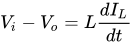
V i − V o = L d I L d t {\displaystyle V_{i}-V_{o}=L{\frac {dI_{L}}{dt}}} {\displaystyle V_{i}-V_{o}=L{\frac {dI_{L}}{dt}}}

Therefore, the variation of IL during the Off-period is:

Δ I L Off = ∫ D T T ( V i − V o ) d t L = ( V i − V o ) ( 1 − D ) T L {\displaystyle \Delta I_{L_{\text{Off}}}=\int _{DT}^{T}{\frac {\left(V_{i}-V_{o}\right)dt}{L}}={\frac {\left(V_{i}-V_{o}\right)\left(1-D\right)T}{L}}} {\displaystyle \Delta I_{L_{\text{Off}}}=\int _{DT}^{T}{\frac {\left(V_{i}-V_{o}\right)dt}{L}}={\frac {\left(V_{i}-V_{o}\right)\left(1-D\right)T}{L}}}

As we consider that the converter operates in steady state conditions, the amount of energy stored in each of its components has to be the same at the beginning and at the end of a commutation cycle. In particular, the energy stored in the inductor is given by:

E = 1 2 L I L 2 {\displaystyle E={\frac {1}{2}}LI_{L}^{2}} {\displaystyle E={\frac {1}{2}}LI_{L}^{2}}

So, the inductor current has to be the same at the start and end of the commutation cycle. This means the overall change in the current (the sum of the changes) is zero:

Δ I L On + Δ I L Off = 0 {\displaystyle \Delta I_{L_{\text{On}}}+\Delta I_{L_{\text{Off}}}=0} {\displaystyle \Delta I_{L_{\text{On}}}+\Delta I_{L_{\text{Off}}}=0}

Substituting Δ I L On {\displaystyle \Delta I_{L_{\text{On}}}} {\displaystyle \Delta I_{L_{\text{On}}}} and Δ I L Off {\displaystyle \Delta I_{L_{\text{Off}}}} {\displaystyle \Delta I_{L_{\text{Off}}}} by their expressions yields:

Δ I L On + Δ I L Off = V i D T L + ( V i − V o ) ( 1 − D ) T L = 0 {\displaystyle \Delta I_{L_{\text{On}}}+\Delta I_{L_{\text{Off}}}={\frac {V_{i}DT}{L}}+{\frac {\left(V_{i}-V_{o}\right)\left(1-D\right)T}{L}}=0} {\displaystyle \Delta I_{L_{\text{On}}}+\Delta I_{L_{\text{Off}}}={\frac {V_{i}DT}{L}}+{\frac {\left(V_{i}-V_{o}\right)\left(1-D\right)T}{L}}=0}

This can be written as:

V o V i = 1 1 − D {\displaystyle {\frac {V_{o}}{V_{i}}}={\frac {1}{1-D}}} {\displaystyle {\frac {V_{o}}{V_{i}}}={\frac {1}{1-D}}}

The above equation shows that the output voltage is always higher than the input voltage (as the duty cycle goes from 0 to 1), and that it increases with D, theoretically to infinity as D approaches 1. This is why this converter is sometimes referred to as a step-up converter.

Rearranging the equation reveals the duty cycle to be:

D = 1 − V i V o {\displaystyle D=1-{\frac {V_{i}}{V_{o}}}} {\displaystyle D=1-{\frac {V_{i}}{V_{o}}}}

Discontinuous mode

[edit]

If the ripple amplitude of the current is too high, the inductor may be completely discharged before the end of a whole commutation cycle. This commonly occurs under light loads. In this case, the current through the inductor falls to zero during part of the period (see waveforms in Figure 4). Although the difference is slight, it has a strong effect on the output voltage equation.

Fig. 4. Waveforms of inductor current and voltage in a boost converter operating in discontinuous mode.

The voltage gain can be calculated as follows:

As the inductor current at the beginning of the cycle is zero, its maximum value I L Max {\displaystyle I_{L_{\text{Max}}}} {\displaystyle I_{L_{\text{Max}}}} (at t = D T {\displaystyle t=DT} {\displaystyle t=DT}) is

I L Max = V i D T L {\displaystyle I_{L_{\text{Max}}}={\frac {V_{i}DT}{L}}} {\displaystyle I_{L_{\text{Max}}}={\frac {V_{i}DT}{L}}}

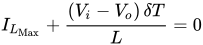
During the off-period, IL falls to zero after δ T {\displaystyle \delta T} {\displaystyle \delta T}:

I L Max + ( V i − V o ) δ T L = 0 {\displaystyle I_{L_{\text{Max}}}+{\frac {\left(V_{i}-V_{o}\right)\delta T}{L}}=0} {\displaystyle I_{L_{\text{Max}}}+{\frac {\left(V_{i}-V_{o}\right)\delta T}{L}}=0}

Using the two previous equations, δ is:

δ = V i D V o − V i {\displaystyle \delta ={\frac {V_{i}D}{V_{o}-V_{i}}}} {\displaystyle \delta ={\frac {V_{i}D}{V_{o}-V_{i}}}}

The load current Io is equal to the average diode current (ID). As can be seen in Figure 4, the diode current is equal to the inductor current during the off-state. The average value of Io can be sorted out geometrically from figure 4. Therefore, the output current can be written as:
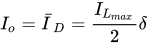
I o = I ¯ D = I L m a x 2 δ {\displaystyle I_{o}={\bar {I}}_{D}={\frac {I_{L_{max}}}{2}}\delta } {\displaystyle I_{o}={\bar {I}}_{D}={\frac {I_{L_{max}}}{2}}\delta }

Replacing ILmax and δ by their respective expressions yields:

I o = V i D T 2 L ⋅ V i D V o − V i = V i 2 D 2 T 2 L ( V o − V i ) {\displaystyle I_{o}={\frac {V_{i}DT}{2L}}\cdot {\frac {V_{i}D}{V_{o}-V_{i}}}={\frac {V_{i}^{2}D^{2}T}{2L\left(V_{o}-V_{i}\right)}}} {\displaystyle I_{o}={\frac {V_{i}DT}{2L}}\cdot {\frac {V_{i}D}{V_{o}-V_{i}}}={\frac {V_{i}^{2}D^{2}T}{2L\left(V_{o}-V_{i}\right)}}}

Therefore, the output voltage gain can be written as follows:
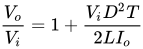
V o V i = 1 + V i D 2 T 2 L I o {\displaystyle {\frac {V_{o}}{V_{i}}}=1+{\frac {V_{i}D^{2}T}{2LI_{o}}}} {\displaystyle {\frac {V_{o}}{V_{i}}}=1+{\frac {V_{i}D^{2}T}{2LI_{o}}}}

Compared to the expression of the output voltage gain for continuous mode, this expression is much more complicated. Furthermore, in discontinuous operation, the output voltage gain not only depends on the duty cycle (D), but also on the inductor value (L), the input voltage (Vi), the commutation period (T) and the output current (Io).

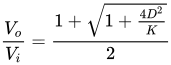
Substituting I 0 = V 0 R {\textstyle I_{0}={\frac {V_{0}}{R}}} {\textstyle I_{0}={\frac {V_{0}}{R}}} into the equation (R is the load), the output voltage gain can be rewritten as:

V o V i = 1 + 1 + 4 D 2 K 2 {\displaystyle {\frac {V_{o}}{V_{i}}}={\frac {1+{\sqrt {1+{\frac {4D^{2}}{K}}}}}{2}}} {\displaystyle {\frac {V_{o}}{V_{i}}}={\frac {1+{\sqrt {1+{\frac {4D^{2}}{K}}}}}{2}}}

where

K = 2 L R T {\textstyle K={\frac {2L}{RT}}} {\textstyle K={\frac {2L}{RT}}}[4]

See also

[edit]
  • Joule thief
  • Buck converter
  • Buck–boost converter
  • Split-pi topology
  • Transformer
  • Vibrator (electronic)
  • Voltage doubler
  • Voltage multiplier
  • The hydraulic ram can be seen as analogous to a boost converter, using the electronic–hydraulic analogy.[5][6]

Further reading

[edit]
  • Mohan, Ned; Undeland, Tore M.; Robbins, William P. (2003). Power Electronics. Hoboken: John Wiley & Sons, Inc. ISBN 978-0-471-42908-1.
  • Basso, Christophe (2008). Switch Mode Power Supplies: SPICE Simulations and Practical Designs. New-York: McGraw-Hill. ISBN 978-0-07-150858-2.

References

[edit]
  1. ^ "Hybrid Batteries: Everything You Need to Know". 9 August 2024.
  2. ^ Sharma, Kalyani; B., Raj Kiran (November 2016). "Simulation Analysis of Voltage-Lift Type Boost Converter for Solar Photovoltaic System" (PDF). International Journal of Science and Research. 5 (11): 1899–1903 – via IJSR.
  3. ^ "Boost Converter Operation". LT1070 Design Manual, Carl Nelson & Jim Williams
  4. ^ http://www.ti.com/lit/an/slva061/slva061.pdf Texas Instruments Understanding Boost Power Stages in Switchmode Power Supplies - Application Report (March 1999 SLVA061)
  5. ^ Kypuros, Javier A.; Longoria, Raul G. (2004-01-29). "Model Synthesis for Design of Switched Systems Using a Variable Structure System Formulation". Journal of Dynamic Systems, Measurement, and Control. 125 (4): 618–629. doi:10.1115/1.1636774. ISSN 0022-0434. The hydraulic-ram pump ... structure parallels that of the boost converter making it a hydraulic analog
  6. ^ Longoria, R.G.; Kypuros, J.A.; Raynter, H.M. (1997). "Bond graph and wave-scattering models of switched power conversion". 1997 IEEE International Conference on Systems, Man, and Cybernetics. Computational Cybernetics and Simulation. Vol. 2. pp. 1522–1526. doi:10.1109/ICSMC.1997.638209. ISBN 978-0-7803-4053-4. S2CID 58941781. Indeed, this self-acting pump has much to offer in a parallel study with its electrical cousin.

External links

[edit]
Wikimedia Commons has media related to Boost converters.
  • Explanation of nonlinear behavior, modeling, and linearization of the boost dc/dc converter
  • Boost converter maximum output power operation for energy harvesting
  • v
  • t
  • e
Electronic components
Semiconductor
devices
MOS
transistors
  • Transistor
  • NMOS
  • PMOS
  • BiCMOS
  • BioFET
  • Chemical field-effect transistor (ChemFET)
  • Complementary MOS (CMOS)
  • Depletion-load NMOS
  • Fin field-effect transistor (FinFET)
  • Floating-gate MOSFET (FGMOS)
  • Insulated-gate bipolar transistor (IGBT)
  • ISFET
  • LDMOS
  • MOS field-effect transistor (MOSFET)
  • Multi-gate field-effect transistor (MuGFET)
  • Power MOSFET
  • Thin-film transistor (TFT)
  • VMOS
  • UMOS
Other
transistors
  • Bipolar junction transistor (BJT)
  • Darlington transistor
  • Diffused junction transistor
  • Field-effect transistor (FET)
    • Junction Gate FET (JFET)
    • Organic FET (OFET)
  • Light-emitting transistor (LET)
    • Organic LET (OLET)
  • Pentode transistor
  • Point-contact transistor
  • Programmable unijunction transistor (PUT)
  • Static induction transistor (SIT)
  • Tetrode transistor
  • Unijunction transistor (UJT)
Diodes
  • Avalanche diode
  • Constant-current diode (CLD, CRD)
  • Gunn diode
  • Laser diode (LD)
  • Light-emitting diode (LED)
  • Organic light-emitting diode (OLED)
  • Photodiode
  • PIN diode
  • Schottky diode
  • Step recovery diode
  • Zener diode
Other
devices
  • Printed electronics
  • Printed circuit board
  • DIAC
  • Heterostructure barrier varactor
  • Integrated circuit (IC)
  • Hybrid integrated circuit
  • Light emitting capacitor (LEC)
  • Memistor
  • Memristor
  • Memtransistor
  • Memory cell
  • Metal-oxide varistor (MOV)
  • Mixed-signal integrated circuit
  • MOS integrated circuit (MOS IC)
  • Organic semiconductor
  • Photodetector
  • Quantum circuit
  • RF CMOS
  • Silicon controlled rectifier (SCR)
  • Solaristor
  • Static induction thyristor (SITh)
  • Three-dimensional integrated circuit (3D IC)
  • Thyristor
  • Trancitor
  • TRIAC
  • Varicap
Voltage regulators
  • Linear regulator
  • Low-dropout regulator
  • Switching regulator
  • Buck
  • Boost
  • Buck–boost
  • Split-pi
  • Ćuk
  • SEPIC
  • Charge pump
  • Switched capacitor
Vacuum tubes
  • Acorn tube
  • Audion
  • Beam tetrode
  • Barretter
  • Compactron
  • Diode
  • Fleming valve
  • Neutron tube
  • Nonode
  • Nuvistor
  • Pentagrid (Hexode, Heptode, Octode)
  • Pentode
  • Photomultiplier
  • Phototube
  • Tetrode
  • Triode
Vacuum tubes (RF)
  • Backward-wave oscillator (BWO)
  • Cavity magnetron
  • Crossed-field amplifier (CFA)
  • Gyrotron
  • Inductive output tube (IOT)
  • Klystron
  • Maser
  • Sutton tube
  • Traveling-wave tube (TWT)
  • X-ray tube
Cathode ray tubes
  • Beam deflection tube
  • Charactron
  • Iconoscope
  • Magic eye tube
  • Monoscope
  • Selectron tube
  • Storage tube
  • Trochotron
  • Video camera tube
  • Williams tube
Gas-filled tubes
  • Cold cathode
  • Crossatron
  • Dekatron
  • Ignitron
  • Krytron
  • Mercury-arc valve
  • Neon lamp
  • Nixie tube
  • Thyratron
  • Trigatron
  • Voltage-regulator tube
Adjustable
  • Potentiometer
    • digital
  • Variable capacitor
  • Varicap
Passive
  • Connector
    • audio and video
    • electrical power
    • RF
  • Electrolytic detector
  • Ferrite
  • Antifuse
  • Fuse
    • resettable
    • eFuse
  • Resistor
  • Switch
  • Thermistor
  • Transformer
  • Varistor
  • Wire
    • Wollaston wire
Reactive
  • Capacitor
    • types
  • Ceramic resonator
  • Crystal oscillator
  • Inductor
  • Parametron
  • Relay
    • reed relay
    • mercury relay
Other devices
  • Cam timer
Retrieved from "https://teknopedia.ac.id/w/index.php?title=Boost_converter&oldid=1334794731"
Categories:
  • Choppers
  • Voltage regulation
Hidden categories:
  • Articles with short description
  • Short description matches Wikidata
  • Articles needing additional references from July 2009
  • All articles needing additional references
  • All articles with failed verification
  • Articles with failed verification from January 2025
  • Commons category link is on Wikidata

  • indonesia
  • Polski
  • العربية
  • Deutsch
  • English
  • Español
  • Français
  • Italiano
  • مصرى
  • Nederlands
  • 日本語
  • Português
  • Sinugboanong Binisaya
  • Svenska
  • Українська
  • Tiếng Việt
  • Winaray
  • 中文
  • Русский
Sunting pranala
url url url url url url url url url url url url url url url url url url url url url url url url url url url url url url url url url url url url url url url url url url url url url url url url url url url url url url url url url url url url url url url url url url url url url url url url url url url url url url url url url url url url url url url url url url url url url url url url url url url url url url url url url url url url url url url url url url url url url url url url url url url url url url url url url url url url url url url url url url url url url url url url url url url url url url url url url url url url url url url url url url url url url url url url url url url url url url url url url url url url url url url url url url url url url url url url url url url url url url url url url url url url url url url url url url url url url url url url url url url url url url url url url url url url url url url url url url url url url url url url url url url url url url url url url url url url url url url url url url url url url url url url url url url url url url url url url url url url url url url url url url url url url url url url url url url url url url url url url url url url url url url url url url url url url url url url url url url url url url url url url url url url url url url url url url url url url url url url url url url url url url url url url url url url url url url url url url url url url url url url url url url url url url url url url url url url url url url url url url url url url url url url url url url url url url url url url url url url url url url url url url url url url url url url url url url url url url url url url url url url url url url url url url url url url url url url url url url url url url url url url url url url url url url url url url url url url url url url url url url url url url url url url url url url url url url url url url url url url url url url url url url url url url url url url url url url url url url url url url url url url url url url url url url url url url url url url url url url url url url url url url url url url url url url url url url url url url url url url url url url url url url url url url url url url url url url url url url url url url url url url url url url url url url url url url url url url url url url url url url url url url url url url url url url url url url url url url url url url url url url url url url url url url url url url url url url url url url url url url url url url url url url url url url url url url url url url url url url url url url url url url url url url url url url url url url url url url url url url url url url url url url url url url url url url url url url url url url url url url url url url url url url url url url url url url url url url url url url url url url url url url url url url url url url url url url url url url url url url url url url url url url url url url url url url url url url url url url url url url url url url url url url url url url url url url url url url url url url url url url url url url url url url url url url url url url url url url url url url url url url url url url url url url url url url url url url url url url url url url url url url url url url url url url url url url url url url url url url url url url url url url url url url url url url url url url url url url url url url url url url url url url url url url url url url url url url url url url url url url url url url url url url url url url url url url url url url url url url url url url url url url url url url url url url url url url url url url url url url url url url url url url url url url url url url url url url url url url url url url url url url url url url url url url url url url url url url url url url url url url url url url url url url url url url url url url url url url url url url url url url url url url url url url url url url url url url url url url url url url url url url url url url url url url url url url url url url url url url url url url url url url url url url url url url url url url url url url url url url url url url url url url url url url url url url url url url url url url url url url url url url url url url url url url url url url url url url url url url url url url url url url url url url url url url url url url url url url url url url url url url url url url url url url url url url url url url url url url url url url url url url url url url url url url url url url url url url url url url url url url url url url url url url url url url url url url url url url url url url url url url url url url url url url url url url url url url url url url url url url url url url url url url url url url url url url url url url url url url url url url url url url url url url url url url url url url url url url url url url url url url url url url url url url url url url url url url url url url url url url url url url url url url url url url url url url url url url url url url url url url url url url url url url url url url url url url url url url url url url url url url url url url url url url url url url url url url url url url url url url url url url url url url url url url url url url url url url url url url url url url url url url url url url url url url url url url url url url url url url url url url url url url url url url url url url url url url url url url url url url url url url url url url url url url url url url url url url url url url url url url url url url url url url url url url url url url url url url url url url url url url url url url url url url url url url url url url url url url url url url url url url url url url url url url url url url url url url url url url url url url url url url url url url url url url url url url url url url url url url url url url url url url url url url url url url url url url url url url url url url url url url url url url url url url url url url url url url url url url url url url url url url url url url url url url url url url url url url url url url url url url url url url url url url url url url url url url url url url url url url url url url url url url url url url url url url url url url url url url url url url url url url url url url url url url url url url url url url url url url url url url url url url url url url url url url url url url url url url url url url url url url url url url url url url url url url url url url url url url url url url url url url url url url url url url url url url url url url url url url url url url url url url url url url url url url url url url url url url url url url url url url url url url url url url url url url url url url url url url url url url url url url url url url url url url url url url url url url url url url url url url url url url url url url url url url url url url url url url url url url url url url url url url url url url url url url url url url url url url url url url url url url url url url url url url url url url url url url url url url url url url url url url url url url url url url url url url url url url url url url url url url url url url url url url url url url url url url url url url url url url url url url url url url url url url url url url url url url url url url url url url url url url url url url url url url url url url url url url url url url url url url url url url url url url url url url url url url url url url url url url url url url url url url url url url url url url url url url url url url url url url url url url url url url url url url url url url url url url url url url url url url url url url url url url url url url url url url url url url url url url url url url url url url url url url url url url url url url url url url url url url url url url url url url url url url url url url url url url url url url url url url url url url url url url url url url url url url url url url url url url url url url url url url url url url url url url url url url url url url url url url url url url url url url url url url url url url url url url url url url url url url url url url url url url url url url url url url url url url url url url url url url url url url url url url url url url url url url url url url url url url url url url url url url url url url url url url url url url url url url url url url url url url url url url url url url url url url url url url url url url url url url url url url url url url url url url url url url url url url url url url url url url url url url url url url url url url url url url url url url url url url url url url url url url url url url url url url url url url url url url url url url url url url url url url url url url url url url url url url url url url url url url url url url url url url url url url url url url url url url url url url url url url url url url url url url url url url url url url url url url url url url url url url url url url url url url url url url url url url url url url url url url url url url url url url url url url url url url url url url url url url url url url url url url url url url url url url url url url url url url url url url url url url url url url url url url url url url url url url url url url url url url url url url url url url url url url url url url url url url url url url url url url url url url url url url url url url url url url url url url url url url url url url url url url url url url url url url url url url url url url url url url url url url url url url url url url url url url url url url url url url url url url url url url url url url url url url url url url url url url url url url url url url url url url url url url url url url url url url url url url url url url url url url url url url url url url url url url url url url url url url url url url
Pusat Layanan

UNIVERSITAS TEKNOKRAT INDONESIA | ASEAN's Best Private University
Jl. ZA. Pagar Alam No.9 -11, Labuhan Ratu, Kec. Kedaton, Kota Bandar Lampung, Lampung 35132
Phone: (0721) 702022
Email: pmb@teknokrat.ac.id