Epstein Files Full PDF

CLICK HERE
Technopedia Center
PMB University Brochure
Faculty of Engineering and Computer Science
S1 Informatics S1 Information Systems S1 Information Technology S1 Computer Engineering S1 Electrical Engineering S1 Civil Engineering

faculty of Economics and Business
S1 Management S1 Accountancy

Faculty of Letters and Educational Sciences
S1 English literature S1 English language education S1 Mathematics education S1 Sports Education
teknopedia

  • Registerasi
  • Brosur UTI
  • Kip Scholarship Information
  • Performance
Flag Counter
  1. World Encyclopedia
  2. Analytic function
Analytic function
From Wikipedia, the free encyclopedia
(Redirected from Analytic map)
Type of function in mathematics
Not to be confused with analytic expression or analytic signal.
This article is about both real and complex analytic functions. For analytic functions in complex analysis specifically, see holomorphic function. For analytic functions in SQL, see Window function (SQL).
Mathematical analysis → Complex analysis
Complex analysis
Complex numbers
  • Real number
  • Imaginary number
  • Complex plane
  • Complex conjugate
  • Euler's formula
Basic theory
  • Argument principle
  • Residue
  • Essential singularity
  • Isolated singularity
  • Removable singularity
  • Zeros and poles
Complex functions
  • Complex-valued function
  • Antiderivative
  • Analytic function
  • Entire function
  • Holomorphic function
  • Meromorphic function
  • Cauchy–Riemann equations
  • Formal power series
  • Laurent series
Theorems
  • Analyticity of holomorphic functions
  • Cauchy's integral theorem
  • Cauchy's integral formula
  • Residue theorem
  • Liouville's theorem
  • Picard theorem
  • Weierstrass factorization theorem
Advanced theorems
  • Borel–Carathéodory theorem
  • Maximum modulus principle
  • Open mapping theorem
  • Rouché's theorem
Geometric function theory
  • Complex manifold
  • Conformal map
  • Quasiconformal mapping
  • Riemann surface
  • Schwarz lemma
  • Winding number
  • Analytic continuation
  • Riemann's mapping theorem
People
  • Augustin-Louis Cauchy
  • Leonhard Euler
  • Carl Friedrich Gauss
  • Bernhard Riemann
  • Karl Weierstrass
  • icon Mathematics portal
  • v
  • t
  • e

In mathematics, an analytic function is a function that is locally given by a convergent power series. There exist both real analytic functions and complex analytic functions. Functions of each type are infinitely differentiable, but complex analytic functions exhibit properties that do not generally hold for real analytic functions.

A function is analytic if and only if for every x 0 {\displaystyle x_{0}} {\displaystyle x_{0}} in its domain, its Taylor series about x 0 {\displaystyle x_{0}} {\displaystyle x_{0}} converges to the function in some neighborhood of ⁠ x 0 {\displaystyle x_{0}} {\displaystyle x_{0}}⁠. This is stronger than merely being infinitely differentiable at ⁠ x 0 {\displaystyle x_{0}} {\displaystyle x_{0}}⁠, and therefore having a well-defined Taylor series; the Fabius function is an example of a function that is infinitely differentiable but not analytic.

Definitions

[edit]

Formally, a function f {\displaystyle f} {\displaystyle f} is real analytic on an open set D {\displaystyle D} {\displaystyle D} in the real line if for every x 0 ∈ D {\displaystyle x_{0}\in D} {\displaystyle x_{0}\in D} one can write f ( x ) = ∑ n = 0 ∞ a n ( x − x 0 ) n = a 0 + a 1 ( x − x 0 ) + a 2 ( x − x 0 ) 2 + ⋯ {\displaystyle f(x)=\sum _{n=0}^{\infty }a_{n}\left(x-x_{0}\right)^{n}=a_{0}+a_{1}(x-x_{0})+a_{2}(x-x_{0})^{2}+\cdots } {\displaystyle f(x)=\sum _{n=0}^{\infty }a_{n}\left(x-x_{0}\right)^{n}=a_{0}+a_{1}(x-x_{0})+a_{2}(x-x_{0})^{2}+\cdots } in which the coefficients ⁠ a 0 {\displaystyle a_{0}} {\displaystyle a_{0}}⁠, ⁠ a 1 {\displaystyle a_{1}} {\displaystyle a_{1}}⁠, ...are real numbers and this series (the right-hand side of this equation) is convergent to f ( x ) {\displaystyle f(x)} {\displaystyle f(x)} for x {\displaystyle x} {\displaystyle x} in a neighborhood of x 0 {\displaystyle x_{0}} {\displaystyle x_{0}} (that is a set containing an open set including ⁠ x 0 {\displaystyle x_{0}} {\displaystyle x_{0}}⁠).

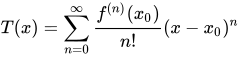
Alternatively, a real analytic function is an infinitely differentiable function such that the Taylor series at each point x 0 {\displaystyle x_{0}} {\displaystyle x_{0}} in its domain T ( x ) = ∑ n = 0 ∞ f ( n ) ( x 0 ) n ! ( x − x 0 ) n {\displaystyle T(x)=\sum _{n=0}^{\infty }{\frac {f^{(n)}(x_{0})}{n!}}(x-x_{0})^{n}} {\displaystyle T(x)=\sum _{n=0}^{\infty }{\frac {f^{(n)}(x_{0})}{n!}}(x-x_{0})^{n}} converges to f ( x ) {\displaystyle f(x)} {\displaystyle f(x)} for x {\displaystyle x} {\displaystyle x} in a neighborhood of x 0 {\displaystyle x_{0}} {\displaystyle x_{0}} pointwise.[a] The set of all real analytic functions on a given set D {\displaystyle D} {\displaystyle D} is often denoted by ⁠ C ω ( D ) {\displaystyle {\mathcal {C}}^{\omega }(D)} {\displaystyle {\mathcal {C}}^{\omega }(D)}⁠, or just by C ω {\displaystyle {\mathcal {C}}^{\omega }} {\displaystyle {\mathcal {C}}^{\omega }} if the domain is understood.

A function f {\displaystyle f} {\displaystyle f} defined on some subset of the real line is said to be real analytic at a point x {\displaystyle x} {\displaystyle x} if there is a neighborhood D {\displaystyle D} {\displaystyle D} of x {\displaystyle x} {\displaystyle x} on which f {\displaystyle f} {\displaystyle f} is real analytic.

The definition of a complex analytic function is obtained by replacing, in the definitions above, "real" with "complex" and "real line" with "complex plane". A function is complex analytic if and only if it is holomorphic i.e. it is complex differentiable. For this reason the terms "holomorphic" and "analytic" are often used interchangeably for such functions.[1]

In complex analysis, a function is called analytic in an open set ⁠ U {\displaystyle U} {\displaystyle U}⁠ if it is (complex) differentiable at each point in ⁠ U {\displaystyle U} {\displaystyle U}⁠ and its complex derivative is continuous on ⁠ U {\displaystyle U} {\displaystyle U}⁠.[2]

Examples

[edit]

Typical examples of analytic functions are

  • The following elementary functions:
    • All polynomials: if a polynomial has degree ⁠ n {\displaystyle n} {\displaystyle n}⁠, any terms of degree larger than ⁠ n {\displaystyle n} {\displaystyle n}⁠ in its Taylor series expansion must immediately vanish to 0, and so this series will be trivially convergent. Furthermore, every polynomial is its own Maclaurin series.
    • The exponential function is analytic. Any Taylor series for this function converges not only for ⁠ x {\displaystyle x} {\displaystyle x}⁠ close enough to ⁠ x 0 {\displaystyle x_{0}} {\displaystyle x_{0}}⁠ (as in the definition) but for all values of ⁠ x {\displaystyle x} {\displaystyle x}⁠ (real or complex).
    • The trigonometric functions, logarithm, and the power functions are analytic on any open set of their domain.
  • Most special functions (at least in some range of the complex plane):
    • hypergeometric functions
    • Bessel functions
    • gamma functions

Typical examples of functions that are not analytic are

  • The absolute value function when defined on the set of real numbers or complex numbers is not everywhere analytic because it is not differentiable at ⁠ 0 {\displaystyle 0} {\displaystyle 0}⁠.
  • Piecewise defined functions (functions given by different formulae in different regions) are typically not analytic where the pieces meet.
  • The complex conjugate function ⁠ z → z ∗ {\displaystyle z\to z^{*}} {\displaystyle z\to z^{*}}⁠ is not complex analytic, although its restriction to the real line is the identity function and therefore real analytic, and it is real analytic as a function from R 2 {\displaystyle \mathbb {R} ^{2}} {\displaystyle \mathbb {R} ^{2}} to ⁠ R 2 {\displaystyle \mathbb {R} ^{2}} {\displaystyle \mathbb {R} ^{2}}⁠.
  • Other non-analytic smooth functions, and in particular any smooth function f {\displaystyle f} {\displaystyle f} with compact support, i.e. ⁠ f ∈ C 0 ∞ ( R n ) {\displaystyle f\in {\mathcal {C}}_{0}^{\infty }(\mathbb {R} ^{n})} {\displaystyle f\in {\mathcal {C}}_{0}^{\infty }(\mathbb {R} ^{n})}⁠, cannot be analytic on ⁠ R n {\displaystyle \mathbb {R} ^{n}} {\displaystyle \mathbb {R} ^{n}}⁠.[3]

Alternative characterizations

[edit]

The following conditions are equivalent:

  1. f {\displaystyle f} {\displaystyle f} is real analytic on an open set ⁠ D {\displaystyle D} {\displaystyle D}⁠.
  2. There is a complex analytic extension of f {\displaystyle f} {\displaystyle f} to an open set G ⊂ C {\displaystyle G\subset \mathbb {C} } {\displaystyle G\subset \mathbb {C} } that contains ⁠ D {\displaystyle D} {\displaystyle D}⁠.
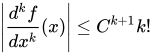
  3. f {\displaystyle f} {\displaystyle f} is smooth and for every compact set K ⊂ D {\displaystyle K\subset D} {\displaystyle K\subset D} there exists a constant C {\displaystyle C} {\displaystyle C} such that for every x ∈ K {\displaystyle x\in K} {\displaystyle x\in K} and every non-negative integer k {\displaystyle k} {\displaystyle k} the following bound holds;[4] | d k f d x k ( x ) | ≤ C k + 1 k ! {\displaystyle \left|{\frac {d^{k}f}{dx^{k}}}(x)\right|\leq C^{k+1}k!} {\displaystyle \left|{\frac {d^{k}f}{dx^{k}}}(x)\right|\leq C^{k+1}k!}

Complex analytic functions are exactly equivalent to holomorphic functions, and are thus much more easily characterized.

For the case of an analytic function with several variables (see below), the real analyticity can be characterized using the Fourier–Bros–Iagolnitzer transform.

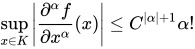
In the multivariable case, real analytic functions satisfy a direct generalization of the third characterization.[5] Let U ⊂ R n {\displaystyle U\subset \mathbb {R} ^{n}} {\displaystyle U\subset \mathbb {R} ^{n}} be an open set, and let ⁠ f : U → R {\displaystyle f:U\to \mathbb {R} } {\displaystyle f:U\to \mathbb {R} }⁠. Then f {\displaystyle f} {\displaystyle f} is real analytic on U {\displaystyle U} {\displaystyle U} if and only if f ∈ C ∞ ( U ) {\displaystyle f\in C^{\infty }(U)} {\displaystyle f\in C^{\infty }(U)} and for every compact K ⊆ U {\displaystyle K\subseteq U} {\displaystyle K\subseteq U} there exists a constant C {\displaystyle C} {\displaystyle C} such that for every multi-index α ∈ Z ≥ 0 n {\displaystyle \alpha \in \mathbb {Z} _{\geq 0}^{n}} {\displaystyle \alpha \in \mathbb {Z} _{\geq 0}^{n}} the following bound holds[6] sup x ∈ K | ∂ α f ∂ x α ( x ) | ≤ C | α | + 1 α ! {\displaystyle \sup _{x\in K}\left|{\frac {\partial ^{\alpha }f}{\partial x^{\alpha }}}(x)\right|\leq C^{|\alpha |+1}\alpha !} {\displaystyle \sup _{x\in K}\left|{\frac {\partial ^{\alpha }f}{\partial x^{\alpha }}}(x)\right|\leq C^{|\alpha |+1}\alpha !}

Properties of analytic functions

[edit]
  • The sums, products, and compositions of analytic functions are analytic.
  • The reciprocal of an analytic function that is nowhere zero is analytic, as is the inverse of an invertible analytic function whose derivative is nowhere zero. (See also Lagrange inversion theorem.)
  • Any analytic function is smooth, that is, infinitely differentiable. The converse is not true for real functions; in fact, in a certain sense, the real analytic functions are sparse compared to all real infinitely differentiable functions. For the complex numbers, the converse does hold, and in fact any function differentiable once on an open set is analytic on that set (see § Analyticity and differentiability).
  • For any open set ⁠ Ω ⊆ C {\displaystyle \Omega \subseteq \mathbb {C} } {\displaystyle \Omega \subseteq \mathbb {C} }⁠, the set ⁠ A ( Ω ) {\displaystyle A(\Omega )} {\displaystyle A(\Omega )}⁠ of all analytic functions u : Ω → C {\displaystyle u:\Omega \to \mathbb {C} } {\displaystyle u:\Omega \to \mathbb {C} } is a Fréchet space with respect to the uniform convergence on compact sets. The fact that uniform limits on compact sets of analytic functions are analytic is an easy consequence of Morera's theorem. The set A ∞ ( Ω ) {\displaystyle A_{\infty }(\Omega )} {\displaystyle A_{\infty }(\Omega )} of all bounded analytic functions with the supremum norm is a Banach space.

A polynomial cannot be zero at too many points unless it is the zero polynomial (more precisely, the number of zeros is at most the degree of the polynomial). A similar but weaker statement holds for analytic functions. If the set of zeros of an analytic function ⁠ f {\displaystyle f} {\displaystyle f}⁠ has an accumulation point inside its domain, then ⁠ f {\displaystyle f} {\displaystyle f}⁠ is zero everywhere on the connected component containing the accumulation point. In other words, if ⁠ ( r n ) {\displaystyle (r_{n})} {\displaystyle (r_{n})}⁠ is a sequence of distinct numbers such that ⁠ f ( r n ) = 0 {\displaystyle f(r_{n})=0} {\displaystyle f(r_{n})=0}⁠ for all ⁠ n {\displaystyle n} {\displaystyle n}⁠ and this sequence converges to a point ⁠ r {\displaystyle r} {\displaystyle r}⁠ in the domain of ⁠ D {\displaystyle D} {\displaystyle D}⁠, then ⁠ f {\displaystyle f} {\displaystyle f}⁠ is identically zero on the connected component of ⁠ D {\displaystyle D} {\displaystyle D}⁠ containing ⁠ r {\displaystyle r} {\displaystyle r}⁠. This is known as the identity theorem.

Also, if all the derivatives of an analytic function at a point are zero, the function is constant on the corresponding connected component.

These statements imply that while analytic functions do have more degrees of freedom than polynomials, they are still quite rigid.

Analyticity and differentiability

[edit]

As noted above, any analytic function (real or complex) is infinitely differentiable (also known as smooth, or ⁠ C ∞ {\displaystyle {\mathcal {C}}^{\infty }} {\displaystyle {\mathcal {C}}^{\infty }}⁠). (Note that this differentiability is in the sense of real variables; compare complex derivatives below.) There exist smooth real functions that are not analytic: see Non-analytic smooth function. In fact there are many such functions.

The situation is quite different when one considers complex analytic functions and complex derivatives. It can be proved that any complex function differentiable (in the complex sense) in an open set is analytic. Consequently, in complex analysis, the term analytic function is synonymous with holomorphic function.

Real versus complex analytic functions

[edit]

Real and complex analytic functions have important differences (one could notice that even from their different relationship with differentiability). Analyticity of complex functions is a more restrictive property, as it has more restrictive necessary conditions and complex analytic functions have more structure than their real-line counterparts.[7]

According to Liouville's theorem, any bounded complex analytic function defined on the whole complex plane is constant. The corresponding statement for real analytic functions, with the complex plane replaced by the real line, is clearly false; this is illustrated by f ( x ) = 1 x 2 + 1 . {\displaystyle f(x)={\frac {1}{x^{2}+1}}.} {\displaystyle f(x)={\frac {1}{x^{2}+1}}.}
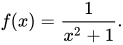
Also, if a complex analytic function is defined in an open ball around a point ⁠ x 0 {\displaystyle x_{0}} {\displaystyle x_{0}}⁠, its power series expansion at ⁠ x 0 {\displaystyle x_{0}} {\displaystyle x_{0}}⁠ is convergent in the whole open ball (holomorphic functions are analytic). This statement for real analytic functions (with open ball meaning an open interval of the real line rather than an open disk of the complex plane) is not true in general; the function of the example above gives an example for ⁠ x 0 = 0 {\displaystyle x_{0}=0} {\displaystyle x_{0}=0}⁠ and a ball of radius exceeding ⁠ 1 {\displaystyle 1} {\displaystyle 1}⁠, since the power series ⁠ 1 − x 2 + x 4 − x 6 + … {\displaystyle 1-x^{2}+x^{4}-x^{6}+\ldots } {\displaystyle 1-x^{2}+x^{4}-x^{6}+\ldots }⁠ diverges for ⁠ | x | ≥ 1 {\displaystyle \vert x\vert \geq 1} {\displaystyle \vert x\vert \geq 1}⁠.

Any real analytic function on some open set on the real line can be extended to a complex analytic function on some open set of the complex plane. However, not every real analytic function defined on the whole real line can be extended to a complex function defined on the whole complex plane. The function ⁠ f ( x ) {\displaystyle f(x)} {\displaystyle f(x)}⁠ defined in the paragraph above is a counterexample, as it is not defined for ⁠ x = ± i {\displaystyle x=\pm i} {\displaystyle x=\pm i}⁠. This explains why the Taylor series of ⁠ f ( x ) {\displaystyle f(x)} {\displaystyle f(x)}⁠ diverges for ⁠ | x | > 1 {\displaystyle \vert x\vert >1} {\displaystyle \vert x\vert >1}⁠, i.e., the radius of convergence is ⁠ 1 {\displaystyle 1} {\displaystyle 1}⁠ because the complexified function has a pole at distance ⁠ 1 {\displaystyle 1} {\displaystyle 1}⁠ from the evaluation point ⁠ 0 {\displaystyle 0} {\displaystyle 0}⁠ and no further poles within the open disc of radius ⁠ 1 {\displaystyle 1} {\displaystyle 1}⁠ around the evaluation point.

Analytic functions of several variables

[edit]

One can define analytic functions in several variables by means of power series in those variables (see Power series). Analytic functions of several variables have some of the same properties as analytic functions of one variable. However, especially for complex analytic functions, new and interesting phenomena show up in two or more complex dimensions:

  • Zero sets of complex analytic functions in more than one variable are never discrete. This can be proved by Hartogs's extension theorem.
  • Domains of holomorphy for single-valued functions consist of arbitrary (connected) open sets. In several complex variables, however, only some connected open sets are domains of holomorphy. The characterization of domains of holomorphy leads to the notion of pseudoconvexity.

See also

[edit]
  • Cauchy–Riemann equations
  • Holomorphic function
  • Paley–Wiener theorem
  • Quasi-analytic function
  • Infinite compositions of analytic functions
  • Non-analytic smooth function

Notes

[edit]
  1. ^ This implies uniform convergence as well in a (possibly smaller) neighborhood of ⁠ x 0 {\displaystyle x_{0}} {\displaystyle x_{0}}⁠.
  1. ^ Churchill; Brown; Verhey (1948). Complex Variables and Applications. McGraw-Hill. p. 46. ISBN 0-07-010855-2. A function f of the complex variable z is analytic at point z0 if its derivative exists not only at z but at each point z in some neighborhood of z0. It is analytic in a region R if it is analytic at every point in R. The term holomorphic is also used in the literature to denote analyticity {{cite book}}: ISBN / Date incompatibility (help)
  2. ^ Gamelin, Theodore W. (2004). Complex Analysis. Springer. ISBN 9788181281142.
  3. ^ Strichartz, Robert S. (1994). A guide to distribution theory and Fourier transforms. Boca Raton: CRC Press. ISBN 0-8493-8273-4. OCLC 28890674.
  4. ^ Krantz & Parks 2002, p. 15.
  5. ^ Komatsu, Hikosaburo (1960). "A characterization of real analytic functions". Proceedings of the Japan Academy. 36 (3): 90–93. doi:10.3792/pja/1195524081. ISSN 0021-4280.
  6. ^ "Gevrey class – Encyclopedia of Mathematics". encyclopediaofmath.org. Retrieved 2020-08-30.
  7. ^ Krantz & Parks 2002.

References

[edit]
  • Conway, John B. (1978). Functions of One Complex Variable I. Graduate Texts in Mathematics 11 (2nd ed.). Springer-Verlag. ISBN 978-0-387-90328-6.
  • Krantz, Steven; Parks, Harold R. (2002). A Primer of Real Analytic Functions (2nd ed.). Birkhäuser. ISBN 0-8176-4264-1.
  • Gamelin, Theodore W. (2004). Complex Analysis. Springer. ISBN 9788181281142.

External links

[edit]
  • "Analytic function", Encyclopedia of Mathematics, EMS Press, 2001 [1994]
  • Weisstein, Eric W. "Analytic Function". MathWorld.
  • Solver for all zeros of a complex analytic function that lie within a rectangular region by Ivan B. Ivanov
  • v
  • t
  • e
Function
  • History
  • List of specific functions
Types by domain and codomain
  • X → 𝔹
  • 𝔹 → X
  • 𝔹ⁿ → 𝔹
  • X → ℤ
  • ℤ → X
  • X → ℝ
  • ℝ → X
  • ℝⁿ → X
  • X → ℂ
  • ℂ → X
  • ℂⁿ → X
Classes/properties
  • Constant
  • Identity
  • Linear
  • Polynomial
  • Rational
  • Algebraic
  • Analytic
  • Smooth
  • Continuous
  • Measurable
  • Injective
  • Surjective
  • Bijective
Constructions
  • Restriction
  • Composition
  • λ
  • Inverse
Generalizations
  • Relation (Binary relation)
  • Set-valued
  • Multivalued
  • Partial
  • Implicit
  • Space
  • Higher-order
  • Morphism
  • Functor
  • Category
Authority control databases Edit this at Wikidata
National
  • United States
  • France
  • BnF data
  • Japan
  • Czech Republic
  • Israel
Other
  • Encyclopedia of Modern Ukraine
  • Yale LUX
Retrieved from "https://en.wikipedia.org/w/index.php?title=Analytic_function&oldid=1338713399"
Category:
  • Analytic functions
Hidden categories:
  • CS1 errors: ISBN date
  • Articles with short description
  • Short description is different from Wikidata
  • Pages that use a deprecated format of the math tags

  • indonesia
  • Polski
  • العربية
  • Deutsch
  • English
  • Español
  • Français
  • Italiano
  • مصرى
  • Nederlands
  • 日本語
  • Português
  • Sinugboanong Binisaya
  • Svenska
  • Українська
  • Tiếng Việt
  • Winaray
  • 中文
  • Русский
Sunting pranala
url url url url url url url url url url url url url url url url url url url url url url url url url url url url url url url url url url url url url url url url url url url url url url url url url url url url url url url url url url url url url url url url url url url url url url url url url url url url url url url url url url url url url url url url url url url url url url url url url url url url url url url url url url url url url url url url url url url url url url url url url url url url url url url url url url url url url url url url url url url url url url url url url url url url url url url url url url url url url url url url url url url url url url url url url url url url url url url url url url url url url url url url url url url url url url url url url url url url url url url url url url url url url url url url url url url url url url url url url url url url url url url url url url url url url url url url url url url url url url url url url url url url url url url url url url url url url url url url url url url url url url url url url url url url url url url url url url url url url url url url url url url url url url url url url url url url url url url url url url url url url url url url url url url url url url url url url url url url url url url url url url url url url url url url url url url url url url url url url url url url url url url url url url url url url url url url url url url url url url url url url url url url url url url url url url url url url url url url url url url url url url url url url url url url url url url url url url url url url url url url url url url url url url url url url url url url url url url url url url url url url url url url url url url url url url url url url url url url url url url url url url url url url url url url url url url url url url url url url url url url url url url url url url url url url url url url url url url url url url url url url url url url url url url url url url url url url url url url url url url url url url url url url url url url url url url url url url url url url url url url url url url url url url url url url url url url url url url url url url url url url url url url url url url url url url url url url url url url url url url url url url url url url url url url url url url url url url url url url url url url url url url url url url url url url url url url url url url url url url url url url url url url url url url url url url url url url url url url url url url url url url url url url url url url url url url url url url url url url url url url url url url url url url url url url url url url url url url url url url url url url url url url url url url url url url url url url url url url url url url url url url url url url url url url url url url url url url url url url url url url url url url url url url url url url url url url url url url url url url url url url url url url url url url url url url url url url url url url url url url url url url url url url url url url url url url url url url url url url url url url url url url url url url url url url url url url url url url url url url url url url url url url url url url url url url url url url url url url url url url url url url url url url url url url url url url url url url url url url url url url url url url url url url url url url url url url url url url url url url url url url url url url url url url url url url url url url url url url url url url url url url url url url url url url url url url url url url url url url url url url url url url url url url url url url url url url url url url url url url url url url url url url url url url url url url url url url url url url url url url url url url url url url url url url url url url url url url url url url url url url url url url url url url url url url url url url url url url url url url url url url url url url url url url url url url url url url url url url url url url url url url url url url url url url url url url url url url url url url url url url url url url url url url url url url url url url url url url url url url url url url url url url url url url url url url url url url url url url url url url url url url url url url url url url url url url url url url url url url url url url url url url url url url url url url url url url url url url url url url url url url url url url url url url url url url url url url url url url url url url url url url url url url url url url url url url url url url url url url url url url url url url url url url url url url url url url url url url url url url url url url url url url url url url url url url url url url url url url url url url url url url url url url url url url url url url url url url url url url url url url url url url url url url url url url url url url url url url url url url url url url url url url url url url url url url url url url url url url url url url url url url url url url url url url url url url url url url url url url url url url url url url url url url url url url url url url url url url url url url url url url url url url url url url url url url url url url url url url url url url url url url url url url url url url url url url url url url url url url url url url url url url url url url url url url url url url url url url url url url url url url url url url url url url url url url url url url url url url url url url url url url url url url url url url url url url url url url url url url url url url url url url url url url url url url url url url url url url url url url url url url url url url url url url url url url url url url url url url url url url url url url url url url url url url url url url url url url url url url url url url url url url url url url url url url url url url url url url url url url url url url url url url url url url url url url url url url url url url url url url url url url url url url url url url url url url url url url url url url url url url url url url url url url url url url url url url url url url url url url url url url url url url url url url url url url url url url url url url url url url url url url url url url url url url url url url url url url url url url url url url url url url url url url url url url url url url url url url url url url url url url url url url url url url url url url url url url url url url url url url url url url url url url url url url url url url url url url url url url url url url url url url url url url url url url url url url url url url url url url url url url url url url url url url url url url url url url url url url url url url url url url url url url url url url url url url url url url url url url url url url url url url url url url url url url url url url url url url url url url url url url url url url url url url url url url url url url url url url url url url url url url url url url url url url url url url url url url url url url url url url url url url url url url url url url url url url url url url url url url url url url url url url url url url url url url url url url url url url url url url url url url url url url url url url url url url url url url url url url url url url url url url url url url url url url url url url url url url url url url url url url url url url url url url url url url url url url url url url url url url url url url url url url url url url url url url url url url url url url url url url url url url url url url url url url url url url url url url url url url url url url url url url url url url url url url url url url url url url url url url url url url url url url url url url url url url url url url url url url url url url url url url url url url url url url url url url url url url url url url url url url url url url url url url url url url url url url url url url url url url url url url url url url url url url url url url url url url url url url url url url url url url url url url url url url url url url url url url url url url url url url url url url url url url url url url url url url url url url url url url url url url url url url url url url url url url url url url url url url url url url url url url url url url url url url url url url url url url url url url url url url url url url url url url url url url url url url url url url url url url url url url url url url url url url url url url url url url url url url url url url url url url url url url url url url url url url url url url url url url url url url url url url url url url url url url url url url url url url url url url url url url url url url url url url url url url url url url url url url url url url url url url url url url url url url url url url url url url url url url url url url url url url url url url url url url url url url url url url url url url url url url url url url url url url url url url url url url url url url url url url url url url url url url url url url url url url url url url url url url url url url url url url url url url url url url url url url url url url url url url url url url url url url url url url url url url url url url url url url url url url url url url url url url url url url url url url url url url url url url url url url url url url url url url url url url url url url url url url url url url url url url url url url url url url url url url url url url url url url url url url url url url url url url url url url url url url url url url url url url url url url url url url url url url url url url url url url url url url url url url url url url url url url url url url url url url url url url url url url url url url url url url url url url url url url url url url url url url url url url url url url url url url url url url url url url url url url url url url url url url url url url url url
Pusat Layanan

UNIVERSITAS TEKNOKRAT INDONESIA | ASEAN's Best Private University
Jl. ZA. Pagar Alam No.9 -11, Labuhan Ratu, Kec. Kedaton, Kota Bandar Lampung, Lampung 35132
Phone: (0721) 702022
Email: pmb@teknokrat.ac.id