Epstein Files Full PDF

CLICK HERE
Technopedia Center
PMB University Brochure
Faculty of Engineering and Computer Science
S1 Informatics S1 Information Systems S1 Information Technology S1 Computer Engineering S1 Electrical Engineering S1 Civil Engineering

faculty of Economics and Business
S1 Management S1 Accountancy

Faculty of Letters and Educational Sciences
S1 English literature S1 English language education S1 Mathematics education S1 Sports Education
teknopedia

  • Registerasi
  • Brosur UTI
  • Kip Scholarship Information
  • Performance
Flag Counter
  1. World Encyclopedia
  2. Contingency table - Wikipedia
Contingency table - Wikipedia
From Wikipedia, the free encyclopedia
Table that displays the frequency of variables
For cross-tabulation that aggregates by summing, averaging, etc. (rather than only by counting), see Pivot table.

In statistics, a contingency table (also known as a cross tabulation or crosstab) is a type of table in a matrix format that displays the multivariate frequency distribution of the variables. They are heavily used in survey research, business intelligence, engineering, and scientific research. They provide a basic picture of the interrelation between two variables and can help find interactions between them. The term contingency table was first used by Karl Pearson in "On the Theory of Contingency and Its Relation to Association and Normal Correlation",[1] part of the Drapers' Company Research Memoirs Biometric Series I published in 1904.

A crucial problem of multivariate statistics is finding the (direct-)dependence structure underlying the variables contained in high-dimensional contingency tables. If some of the conditional independences are revealed, then even the storage of the data can be done in a smarter way (see Lauritzen (2002)). In order to do this one can use information theory concepts, which gain the information only from the distribution of probability, which can be expressed easily from the contingency table by the relative frequencies.

A pivot table is a way to create contingency tables using spreadsheet software.

Example

[edit]

Suppose there are two variables, sex (male or female) and handedness (right- or left-handed). Further suppose that 100 individuals are randomly sampled from a very large population as part of a study of sex differences in handedness. A contingency table can be created to display the numbers of individuals who are male right-handed and left-handed, female right-handed and left-handed. Such a contingency table is shown below.

Handed-
ness
Sex
Right-handed Left-handed Total
Male 43 9 52
Female 44 4 48
Total 87 13 100

The numbers of the males, females, and right- and left-handed individuals are called marginal totals. The grand total (the total number of individuals represented in the contingency table) is the number in the bottom right corner.

The table allows users to see at a glance that the proportion of men who are right-handed is about the same as the proportion of women who are right-handed although the proportions are not identical. The strength of the association can be measured by the odds ratio, and the population odds ratio estimated by the sample odds ratio. The significance of the difference between the two proportions can be assessed with a variety of statistical tests including Pearson's chi-squared test, the G-test, Fisher's exact test, Boschloo's test, and Barnard's test, provided the entries in the table represent individuals randomly sampled from the population about which conclusions are to be drawn. If the proportions of individuals in the different columns vary significantly between rows (or vice versa), it is said that there is a contingency between the two variables. In other words, the two variables are not independent. If there is no contingency, it is said that the two variables are independent.

The example above is the simplest kind of contingency table, a table in which each variable has only two levels; this is called a 2 × 2 contingency table. In principle, any number of rows and columns may be used. There may also be more than two variables, but higher order contingency tables are difficult to represent visually. The relation between ordinal variables, or between ordinal and categorical variables, may also be represented in contingency tables, although such a practice is rare. For more on the use of a contingency table for the relation between two ordinal variables, see Goodman and Kruskal's gamma.

Standard contents of a contingency table

[edit]
  • Multiple columns (historically, they were designed to use up all the white space of a printed page). Where each row refers to a specific sub-group in the population (in this case men or women), the columns are sometimes referred to as banner points or cuts (and the rows are sometimes referred to as stubs).
  • Significance tests. Typically, either column comparisons, which test for differences between columns and display these results using letters, or, cell comparisons, which use color or arrows to identify a cell in a table that stands out in some way.
  • Nets or netts which are sub-totals.
  • One or more of: percentages, row percentages, column percentages, indexes or averages.
  • Unweighted sample sizes (counts).

Measures of association

[edit]

The degree of association between the two variables can be assessed by a number of coefficients. The following subsections describe a few of them. For a more complete discussion of their uses, see the main articles linked under each subsection heading.

Odds ratio

[edit]
Main article: Odds ratio

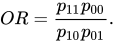
The simplest measure of association for a 2 × 2 contingency table is the odds ratio. Given two events, A and B, the odds ratio is defined as the ratio of the odds of A in the presence of B and the odds of A in the absence of B, or equivalently (due to symmetry), the ratio of the odds of B in the presence of A and the odds of B in the absence of A. Two events are independent if and only if the odds ratio is 1; if the odds ratio is greater than 1, the events are positively associated; if the odds ratio is less than 1, the events are negatively associated.

The odds ratio has a simple expression in terms of probabilities; given the joint probability distribution:
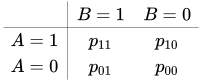
B = 1 B = 0 A = 1 p 11 p 10 A = 0 p 01 p 00 {\displaystyle {\begin{array}{c|cc}&B=1&B=0\\\hline A=1&p_{11}&p_{10}\\A=0&p_{01}&p_{00}\end{array}}} {\displaystyle {\begin{array}{c|cc}&B=1&B=0\\\hline A=1&p_{11}&p_{10}\\A=0&p_{01}&p_{00}\end{array}}}

the odds ratio is:

O R = p 11 p 00 p 10 p 01 . {\displaystyle OR={\frac {p_{11}p_{00}}{p_{10}p_{01}}}.} {\displaystyle OR={\frac {p_{11}p_{00}}{p_{10}p_{01}}}.}

Phi coefficient

[edit]
Main article: Phi coefficient

A simple measure, applicable only to the case of 2 × 2 contingency tables, is the phi coefficient (φ) defined by
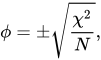
ϕ = ± χ 2 N , {\displaystyle \phi =\pm {\sqrt {\frac {\chi ^{2}}{N}}},} {\displaystyle \phi =\pm {\sqrt {\frac {\chi ^{2}}{N}}},}

where χ2 is computed as in Pearson's chi-squared test, and N is the grand total of observations. φ varies from 0 (corresponding to no association between the variables) to 1 or −1 (complete association or complete inverse association), provided it is based on frequency data represented in 2 × 2 tables. Then its sign equals the sign of the product of the main diagonal elements of the table minus the product of the off–diagonal elements. φ takes on the minimum value −1.0 or the maximum value of +1.0 if and only if every marginal proportion is equal to 0.5 (and two diagonal cells are empty).[2]

Cramér's V and the contingency coefficient C

[edit]
Main article: Cramér's V

Two alternatives are the contingency coefficient C, and Cramér's V.

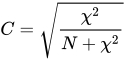
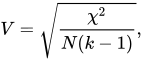
The formulae for the C and V coefficients are:

C = χ 2 N + χ 2 {\displaystyle C={\sqrt {\frac {\chi ^{2}}{N+\chi ^{2}}}}} {\displaystyle C={\sqrt {\frac {\chi ^{2}}{N+\chi ^{2}}}}} and
V = χ 2 N ( k − 1 ) , {\displaystyle V={\sqrt {\frac {\chi ^{2}}{N(k-1)}}},} {\displaystyle V={\sqrt {\frac {\chi ^{2}}{N(k-1)}}},}

k being the number of rows or the number of columns, whichever is less.

C suffers from the disadvantage that it does not reach a maximum of 1.0, notably the highest it can reach in a 2 × 2 table is 0.707 . It can reach values closer to 1.0 in contingency tables with more categories; for example, it can reach a maximum of 0.870 in a 4 × 4 table. It should, therefore, not be used to compare associations in different tables if they have different numbers of categories.[3]

C can be adjusted so it reaches a maximum of 1.0 when there is complete association in a table of any number of rows and columns by dividing C by k − 1 k {\displaystyle {\sqrt {\frac {k-1}{k}}}} {\displaystyle {\sqrt {\frac {k-1}{k}}}} where k is the number of rows or columns, when the table is square [citation needed], or by r − 1 r × c − 1 c 4 {\displaystyle {\sqrt[{\scriptstyle 4}]{{r-1 \over r}\times {c-1 \over c}}}} {\displaystyle {\sqrt[{\scriptstyle 4}]{{r-1 \over r}\times {c-1 \over c}}}} where r is the number of rows and c is the number of columns.[4]

Tetrachoric correlation coefficient

[edit]
Main article: Polychoric correlation

Another choice is the tetrachoric correlation coefficient but it is only applicable to 2 × 2 tables. Polychoric correlation is an extension of the tetrachoric correlation to tables involving variables with more than two levels.

Tetrachoric correlation assumes that the variable underlying each dichotomous measure is normally distributed.[5] The coefficient provides "a convenient measure of [the Pearson product-moment] correlation when graduated measurements have been reduced to two categories."[6]

The tetrachoric correlation coefficient should not be confused with the Pearson correlation coefficient computed by assigning, say, values 0.0 and 1.0 to represent the two levels of each variable (which is mathematically equivalent to the φ coefficient).

Lambda coefficient

[edit]
Main article: Goodman and Kruskal's lambda

The lambda coefficient is a measure of the strength of association of the cross tabulations when the variables are measured at the nominal level. Values range from 0.0 (no association) to 1.0 (the maximum possible association).

Asymmetric lambda measures the percentage improvement in predicting the dependent variable. Symmetric lambda measures the percentage improvement when prediction is done in both directions.

Uncertainty coefficient

[edit]
Main article: Uncertainty coefficient

The uncertainty coefficient, or Theil's U, is another measure for variables at the nominal level. Its values range from −1.0 (100% negative association, or perfect inversion) to +1.0 (100% positive association, or perfect agreement). A value of 0.0 indicates the absence of association.

Also, the uncertainty coefficient is conditional and an asymmetrical measure of association, which can be expressed as

U ( X | Y ) ≠ U ( Y | X ) {\displaystyle U(X|Y)\neq U(Y|X)} {\displaystyle U(X|Y)\neq U(Y|X)}.

This asymmetrical property can lead to insights not as evident in symmetrical measures of association.[7]

Others

[edit]
Main articles: Goodman and Kruskal's gamma and Kendall rank correlation coefficient

Gamma, Tau-b and Tau-c are used when the categories or levels of both variables have a natural order.

  • Gamma test: No adjustment for either table size or ties.
  • Kendall's tau: Adjustment for ties.
    • Tau-b: Used for square tables.
    • Tau-c: Used for rectangular tables.

See also

[edit]
  • Confusion matrix
  • Pivot table, in spreadsheet software, cross-tabulates sampling data with counts (contingency table) and/or sums.
  • TPL Tables is a tool for generating and printing crosstabs.
  • The iterative proportional fitting procedure essentially manipulates contingency tables to match altered joint distributions or marginal sums.
  • The multivariate statistics in special multivariate discrete probability distributions. Some procedures used in this context can be used in dealing with contingency tables.
  • OLAP cube, a modern multidimensional computing form of contingency tables
  • Panel data, multidimensional data over time

References

[edit]
  1. ^ Karl Pearson, F.R.S. (1904). Mathematical contributions to the theory of evolution. Dulau and Co.
  2. ^ Ferguson, G. A. (1966). Statistical analysis in psychology and education. New York: McGraw–Hill.
  3. ^ Smith, S. C., & Albaum, G. S. (2004) Fundamentals of marketing research. Sage: Thousand Oaks, CA. p. 631
  4. ^ Blaikie, N. (2003) Analyzing Quantitative Data. Sage: Thousand Oaks, CA. p. 100
  5. ^ Ferguson.[full citation needed]
  6. ^ Ferguson, 1966, p. 244
  7. ^ "The Search for Categorical Correlation". 26 December 2019.

Further reading

[edit]
  • Andersen, Erling B. 1980. Discrete Statistical Models with Social Science Applications. North Holland, 1980.
  • Bishop, Y. M. M.; Fienberg, S. E.; Holland, P. W. (1975). Discrete Multivariate Analysis: Theory and Practice. MIT Press. ISBN 978-0-262-02113-5. MR 0381130.
  • Christensen, Ronald (1997). Log-linear models and logistic regression. Springer Texts in Statistics (Second ed.). New York: Springer-Verlag. pp. xvi+483. ISBN 0-387-98247-7. MR 1633357.
  • Lauritzen, Steffen L. (1979). Lectures on Contingency Tables (Aalborg University) (PDF) (4th edition (first electronic edition), 2002 ed.).
  • Gokhale, D. V.; Kullback, Solomon (1978). The Information in Contingency Tables. Marcel Dekker. ISBN 0-824-76698-9.

External links

[edit]
Wikimedia Commons has media related to Contingency tables.
  • On-line analysis of contingency tables: calculator with examples
  • Interactive cross tabulation, chi-squared independent test, and tutorial
  • Fisher and chi-squared calculator of 2 × 2 contingency table
  • More Correlation Coefficients
  • Nominal Association: Phi, Contingency Coefficient, Tschuprow's T, Cramer's V, Lambda, Uncertainty Coefficient, March 24, 2008, G. David Garson, North Carolina State University
  • CustomInsight.com Cross Tabulation
  • The POWERMUTT Project: IV. DISPLAYING CATEGORICAL DATA
  • StATS: Steves Attempt to Teach Statistics Odds ratio versus relative risk (January 9, 2001)
  • Epi Info Community Health Assessment Tutorial Lesson 5 Analysis: Creating Statistics
  • v
  • t
  • e
Statistics
  • Outline
  • Index
Descriptive statistics
Continuous data
Center
  • Mean
    • Arithmetic
    • Arithmetic-Geometric
    • Contraharmonic
    • Cubic
    • Generalized/power
    • Geometric
    • Harmonic
    • Heronian
    • Heinz
    • Lehmer
  • Median
  • Mode
Dispersion
  • Average absolute deviation
  • Coefficient of variation
  • Interquartile range
  • Percentile
  • Range
  • Standard deviation
  • Variance
Shape
  • Central limit theorem
  • Moments
    • Kurtosis
    • L-moments
    • Skewness
Count data
  • Index of dispersion
Summary tables
  • Contingency table
  • Frequency distribution
  • Grouped data
Dependence
  • Partial correlation
  • Pearson product-moment correlation
  • Rank correlation
    • Kendall's τ
    • Spearman's ρ
  • Scatter plot
Graphics
  • Bar chart
  • Biplot
  • Box plot
  • Control chart
  • Correlogram
  • Fan chart
  • Forest plot
  • Histogram
  • Pie chart
  • Q–Q plot
  • Radar chart
  • Run chart
  • Scatter plot
  • Stem-and-leaf display
  • Violin plot
Data collection
Study design
  • Effect size
  • Missing data
  • Optimal design
  • Population
  • Replication
  • Sample size determination
  • Statistic
  • Statistical power
Survey methodology
  • Sampling
    • Cluster
    • Stratified
  • Opinion poll
  • Questionnaire
  • Standard error
Controlled experiments
  • Blocking
  • Factorial experiment
  • Interaction
  • Random assignment
  • Randomized controlled trial
  • Randomized experiment
  • Scientific control
Adaptive designs
  • Adaptive clinical trial
  • Stochastic approximation
  • Up-and-down designs
Observational studies
  • Cohort study
  • Cross-sectional study
  • Natural experiment
  • Quasi-experiment
Statistical inference
Statistical theory
  • Population
  • Statistic
  • Probability distribution
  • Sampling distribution
    • Order statistic
  • Empirical distribution
    • Density estimation
  • Statistical model
    • Model specification
    • Lp space
  • Parameter
    • location
    • scale
    • shape
  • Parametric family
    • Likelihood (monotone)
    • Location–scale family
    • Exponential family
  • Completeness
  • Sufficiency
  • Statistical functional
    • Bootstrap
    • U
    • V
  • Optimal decision
    • loss function
  • Efficiency
  • Statistical distance
    • divergence
  • Asymptotics
  • Robustness
Frequentist inference
Point estimation
  • Estimating equations
    • Maximum likelihood
    • Method of moments
    • M-estimator
    • Minimum distance
  • Unbiased estimators
    • Mean-unbiased minimum-variance
      • Rao–Blackwellization
      • Lehmann–Scheffé theorem
    • Median unbiased
  • Plug-in
Interval estimation
  • Confidence interval
  • Pivot
  • Likelihood interval
  • Prediction interval
  • Tolerance interval
  • Resampling
    • Bootstrap
    • Jackknife
Testing hypotheses
  • 1- & 2-tails
  • Power
    • Uniformly most powerful test
  • Permutation test
    • Randomization test
  • Multiple comparisons
Parametric tests
  • Likelihood-ratio
  • Score/Lagrange multiplier
  • Wald
Specific tests
  • Z-test (normal)
  • Student's t-test
  • F-test
Goodness of fit
  • Chi-squared
  • G-test
  • Kolmogorov–Smirnov
  • Anderson–Darling
  • Lilliefors
  • Jarque–Bera
  • Normality (Shapiro–Wilk)
  • Likelihood-ratio test
  • Model selection
    • Cross validation
    • AIC
    • BIC
Rank statistics
  • Sign
    • Sample median
  • Signed rank (Wilcoxon)
    • Hodges–Lehmann estimator
  • Rank sum (Mann–Whitney)
  • Nonparametric anova
    • 1-way (Kruskal–Wallis)
    • 2-way (Friedman)
    • Ordered alternative (Jonckheere–Terpstra)
  • Van der Waerden test
Bayesian inference
  • Bayesian probability
    • prior
    • posterior
  • Credible interval
  • Bayes factor
  • Bayesian estimator
    • Maximum posterior estimator
  • Correlation
  • Regression analysis
Correlation
  • Pearson product-moment
  • Partial correlation
  • Confounding variable
  • Coefficient of determination
Regression analysis
  • Errors and residuals
  • Regression validation
  • Mixed effects models
  • Simultaneous equations models
  • Multivariate adaptive regression splines (MARS)
  • Template:Least squares and regression analysis
Linear regression
  • Simple linear regression
  • Ordinary least squares
  • General linear model
  • Bayesian regression
Non-standard predictors
  • Nonlinear regression
  • Nonparametric
  • Semiparametric
  • Isotonic
  • Robust
  • Homoscedasticity and Heteroscedasticity
Generalized linear model
  • Exponential families
  • Logistic (Bernoulli) / Binomial / Poisson regressions
Partition of variance
  • Analysis of variance (ANOVA, anova)
  • Analysis of covariance
  • Multivariate ANOVA
  • Degrees of freedom
Categorical / multivariate / time-series / survival analysis
Categorical
  • Cohen's kappa
  • Contingency table
  • Graphical model
  • Log-linear model
  • McNemar's test
  • Cochran–Mantel–Haenszel statistics
Multivariate
  • Regression
  • Manova
  • Principal components
  • Canonical correlation
  • Discriminant analysis
  • Cluster analysis
  • Classification
  • Structural equation model
    • Factor analysis
  • Multivariate distributions
    • Elliptical distributions
      • Normal
Time-series
General
  • Decomposition
  • Trend
  • Stationarity
  • Seasonal adjustment
  • Exponential smoothing
  • Cointegration
  • Structural break
  • Granger causality
Specific tests
  • Dickey–Fuller
  • Johansen
  • Q-statistic (Ljung–Box)
  • Durbin–Watson
  • Breusch–Godfrey
Time domain
  • Autocorrelation (ACF)
    • partial (PACF)
  • Cross-correlation (XCF)
  • ARMA model
  • ARIMA model (Box–Jenkins)
  • Autoregressive conditional heteroskedasticity (ARCH)
  • Vector autoregression (VAR) (Autoregressive model (AR))
Frequency domain
  • Spectral density estimation
  • Fourier analysis
  • Least-squares spectral analysis
  • Wavelet
  • Whittle likelihood
Survival
Survival function
  • Kaplan–Meier estimator (product limit)
  • Proportional hazards models
  • Accelerated failure time (AFT) model
  • First hitting time
Hazard function
  • Nelson–Aalen estimator
Test
  • Log-rank test
Applications
Biostatistics
  • Bioinformatics
  • Clinical trials / studies
  • Epidemiology
  • Medical statistics
Engineering statistics
  • Chemometrics
  • Methods engineering
  • Probabilistic design
  • Process / quality control
  • Reliability
  • System identification
Social statistics
  • Actuarial science
  • Census
  • Crime statistics
  • Demography
  • Econometrics
  • Jurimetrics
  • National accounts
  • Official statistics
  • Population statistics
  • Psychometrics
Spatial statistics
  • Cartography
  • Environmental statistics
  • Geographic information system
  • Geostatistics
  • Kriging
  • Category
  • icon Mathematics portal
  • Commons
  • WikiProject
Authority control databases Edit this at Wikidata
National
  • United States
  • France
  • BnF data
  • Israel
Other
  • Yale LUX
Retrieved from "https://teknopedia.ac.id/w/index.php?title=Contingency_table&oldid=1303449303"
Categories:
  • Contingency table
  • Infographics
  • Frequency distribution
Hidden categories:
  • All articles with incomplete citations
  • Articles with incomplete citations from April 2019
  • Articles with short description
  • Short description is different from Wikidata
  • All articles with unsourced statements
  • Articles with unsourced statements from June 2020
  • Commons category link is on Wikidata

  • indonesia
  • Polski
  • العربية
  • Deutsch
  • English
  • Español
  • Français
  • Italiano
  • مصرى
  • Nederlands
  • 日本語
  • Português
  • Sinugboanong Binisaya
  • Svenska
  • Українська
  • Tiếng Việt
  • Winaray
  • 中文
  • Русский
Sunting pranala
url url url url url url url url url url url url url url url url url url url url url url url url url url url url url url url url url url url url url url url url url url url url url url url url url url url url url url url url url url url url url url url url url url url url url url url url url url url url url url url url url url url url url url url url url url url url url url url url url url url url url url url url url url url url url url url url url url url url url url url url url url url url url url url url url url url url url url url url url url url url url url url url url url url url url url url url url url url url url url url url url url url url url url url url url url url url url url url url url url url url url url url url url url url url url url url url url url url url url url url url url url url url url url url url url url url url url url url url url url url url url url url url url url url url url url url url url url url url url url url url url url url url url url url url url url url url url url url url url url url url url url url url url url url url url url url url url url url url url url url url url url url url url url url url url url url url url url url url url url url url url url url url url url url url url url url url url url url url url url url url url url url url url url url url url url url url url url url url url url url url url url url url url url url url url url url url url url url url url url url url url url url url url url url url url url url url url url url url url url url url url url url url url url url url url url url url url url url url url url url url url url url url url url url url url url url url url url url url url url url url url url url url url url url url url url url url url url url url url url url url url url url url url url url url url url url url url url url url url url url url url url url url url url url url url url url url url url url url url url url url url url url url url url url url url url url url url url url url url url url url url url url url url url url url url url url url url url url url url url url url url url url url url url url url url url url url url url url url url url url url url url url url url url url url url url url url url url url url url url url url url url url url url url url url url url url url url url url url url url url url url url url url url url url url url url url url url url url url url url url url url url url url url url url url url url url url url url url url url url url url url url url url url url url url url url url url url url url url url url url url url url url url url url url url url url url url url url url url url url url url url url url url url url url url url url url url url url url url url url url url url url url url url url url url url url url url url url url url url url url url url url url url url url url url url url url url url url url url url url url url url url url url url url url url url url url url url url url url url url url url url url url url url url url url url url url url url url url url url url url url url url url url url url url url url url url url url url url url url url url url url url url url url url url url url url url url url url url url url url url url url url url url url url url url url url url url url url url url url url url url url url url url url url url url url url url url url url url url url url url url url url url url url url url url url url url url url url url url url url url url url url url url url url url url url url url url url url url url url url url url url url url url url url url url url url url url url url url url url url url url url url url url url url url url url url url url url url url url url url url url url url url url url url url url url url url url url url url url url url url url url url url url url url url url url url url url url url url url url url url url url url url url url url url url url url url url url url url url url url url url url url url url url url url url url url url url url url url url url url url url url url url url url url url url url url url url url url url url url url url url url url url url url url url url url url url url url url url url url url url url url url url url url url url url url url url url url url url url url url url url url url url url url url url url url url url url url url url url url url url url url url url url url url url url url url url url url url url url url url url url url url url url url url url url url url url url url url url url url url url url url url url url url url url url url url url url url url url url url url url url url url url url url url url url url url url url url url url url url url url url url url url url url url url url url url url url url url url url url url url url url url url url url url url url url url url url url url url url url url url url url url url url url url url url url url url url url url url url url url url url url url url url url url url url url url url url url url url url url url url url url url url url url url url url url url url url url url url url url url url url url url url url url url url url url url url url url url url url url url url url url url url url url url url url url url url url url url url url url url url url url url url url url url url url url url url url url url url url url url url url url url url url url url url url url url url url url url url url url url url url url url url url url url url url url url url url url url url url url url url url url url url url url url url url url url url url url url url url url url url url url url url url url url url url url url url url url url url url url url url url url url url url url url url url url url url url url url url url url url url url url url url url url url url url url url url url url url url url url url url url url url url url url url url url url url url url url url url url url url url url url url url url url url url url url url url url url url url url url url url url url url url url url url url url url url url url url url url url url url url url url url url url url url url url url url url url url url url url url url url url url url url url url url url url url url url url url url url url url url url url url url url url url url url url url url url url url url url url url url url url url url url url url url url url url url url url url url url url url url url url url url url url url url url url url url url url url url url url url url url url url url url url url url url url url url url url url url url url url url url url url url url url url url url url url url url url url url url url url url url url url url url url url url url url url url url url url url url url url url url url url url url url url url url url url url url url url url url url url url url url url url url url url url url url url url url url url url url url url url url url url url url url url url url url url url url url url url url url url url url url url url url url url url url url url url url url url url url url url url url url url url url url url url url url url url url url url url url url url url url url url url url url url url url url url url url url url url url url url url url url url url url url url url url url url url url url url url url url url url url url url url url url url url url url url url url url url url url url url url url url url url url url url url url url url url url url url url url url url url url url url url url url url url url url url url url url url url url url url url url url url url url url url url url url url url url url url url url url url url url url url url url url url url url url url url url url url url url url url url url url url url url url url url url url url url url url url url url url url url url url url url url url url url url url url url url url url url url url url url url url url url url url url url url url url url url url url url url url url url url url url url url url url url url url url url url url url url url url url url url url url url url url url url url url url url url url url url url url url url url url url url url url url url url url url url url url url url url url url url url url url url url url url url url url url url url url url url url url url url url url url url url url url url url url url url url url url url url url url url url url url url url url url url url url url url url url url url url url url url url url url url url url url url url url url url url url url url url url url url url url url url url url url url url url url url url url url url url url url url url url url url url url url url url url url url url url url url url url url url url url url url url url url url url url url url url url url url url url url url url url url url url url url url url url url url url url url url url url url url url url url url url url url url url url url url url url url url url url url url url url url url url url url url url url url url url url url url url url url url url url url url url url url url url url url url url url url url url url url url url url url url url url url url url url url url url url url url url url url url url url url url url url url url url url url url url url url url url url url url url url url url url url url url url url url url url url url url url url url url url url url url url url url url url url url url url url url url url url url url url url url url url url url url url url url url url url url url url url url url url url url url url url url url url url url url url url url url url url url url url url url url url url url url url url url url url url url url url url url url url url url url url url url url url url url url url url url url url url url url url url url url url url url url url url url url url url url url url url url url url url url url url url
Pusat Layanan

UNIVERSITAS TEKNOKRAT INDONESIA | ASEAN's Best Private University
Jl. ZA. Pagar Alam No.9 -11, Labuhan Ratu, Kec. Kedaton, Kota Bandar Lampung, Lampung 35132
Phone: (0721) 702022
Email: pmb@teknokrat.ac.id