Epstein Files Full PDF

CLICK HERE
Technopedia Center
PMB University Brochure
Faculty of Engineering and Computer Science
S1 Informatics S1 Information Systems S1 Information Technology S1 Computer Engineering S1 Electrical Engineering S1 Civil Engineering

faculty of Economics and Business
S1 Management S1 Accountancy

Faculty of Letters and Educational Sciences
S1 English literature S1 English language education S1 Mathematics education S1 Sports Education
teknopedia

  • Registerasi
  • Brosur UTI
  • Kip Scholarship Information
  • Performance
Flag Counter
  1. World Encyclopedia
  2. Nonlinear regression - Wikipedia
Nonlinear regression - Wikipedia
From Wikipedia, the free encyclopedia
Regression analysis
Part of a series on
Regression analysis
Models
  • Linear regression
  • Simple regression
  • Polynomial regression
  • General linear model
  • Generalized linear model
  • Vector generalized linear model
  • Discrete choice
  • Binomial regression
  • Binary regression
  • Logistic regression
  • Multinomial logistic regression
  • Mixed logit
  • Probit
  • Multinomial probit
  • Ordered logit
  • Ordered probit
  • Poisson
  • Multilevel model
  • Fixed effects
  • Random effects
  • Linear mixed-effects model
  • Nonlinear mixed-effects model
  • Nonlinear regression
  • Nonparametric
  • Semiparametric
  • Robust
  • Quantile
  • Isotonic
  • Principal components
  • Least angle
  • Local
  • Segmented
  • Errors-in-variables
Estimation
  • Least squares
  • Linear
  • Non-linear
  • Ordinary
  • Weighted
  • Generalized
  • Generalized estimating equation
  • Partial
  • Total
  • Non-negative
  • Ridge regression
  • Regularized
  • Least absolute deviations
  • Iteratively reweighted
  • Bayesian
  • Bayesian multivariate
  • Least-squares spectral analysis
Background
  • Regression validation
  • Mean and predicted response
  • Errors and residuals
  • Goodness of fit
  • Studentized residual
  • Gauss–Markov theorem
  • icon Mathematics portal
  • v
  • t
  • e
See Michaelis–Menten kinetics for details

In statistics, nonlinear regression is a form of regression analysis in which observational data are modeled by a function which is a nonlinear combination of the model parameters and depends on one or more independent variables. The data are fitted by a method of successive approximations (iterations).

General

[edit]

In nonlinear regression, a statistical model of the form,

y ∼ f ( x , β ) {\displaystyle \mathbf {y} \sim f(\mathbf {x} ,{\boldsymbol {\beta }})} {\displaystyle \mathbf {y} \sim f(\mathbf {x} ,{\boldsymbol {\beta }})}

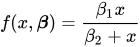
relates a vector of independent variables, x {\displaystyle \mathbf {x} } {\displaystyle \mathbf {x} }, and its associated observed dependent variables, y {\displaystyle \mathbf {y} } {\displaystyle \mathbf {y} }. The function f {\displaystyle f} {\displaystyle f} is nonlinear in the components of the vector of parameters β {\displaystyle \beta } {\displaystyle \beta }, but otherwise arbitrary. For example, the Michaelis–Menten model for enzyme kinetics has two parameters and one independent variable, related by f {\displaystyle f} {\displaystyle f} by:[a]

f ( x , β ) = β 1 x β 2 + x {\displaystyle f(x,{\boldsymbol {\beta }})={\frac {\beta _{1}x}{\beta _{2}+x}}} {\displaystyle f(x,{\boldsymbol {\beta }})={\frac {\beta _{1}x}{\beta _{2}+x}}}

This function, which is a rectangular hyperbola, is nonlinear because it cannot be expressed as a linear combination of the two β {\displaystyle \beta } {\displaystyle \beta }s.

Systematic error may be present in the independent variables but its treatment is outside the scope of regression analysis. If the independent variables are not error-free, this is an errors-in-variables model, also outside this scope.

Other examples of nonlinear functions include exponential functions, logarithmic functions, trigonometric functions, power functions, Gaussian function, and Lorentz distributions. Some functions, such as the exponential or logarithmic functions, can be transformed so that they are linear. When so transformed, standard linear regression can be performed but must be applied with caution. See § Linearization §§ Transformation, below, for more details. In microbiology and biotechnology, nonlinear regression is used to model complex microbial growth kinetics. While simple growth follows monoauxic functions (such as the Gompertz or Boltzmann models), multiphasic (polyauxic) growth is modeled using linear combinations of these nonlinear functions. Estimating parameters for these complex models often requires robust regression techniques (e.g., using a Lorentzian loss function to mitigate outliers) and global optimization algorithms (such as Differential evolution with L-BFGS-B) to avoid local minima and ensure biologically interpretable results.[1][2]

In general, there is no closed-form expression for the best-fitting parameters, as there is in linear regression. Usually numerical optimization algorithms are applied to determine the best-fitting parameters. Again in contrast to linear regression, there may be many local minima of the function to be optimized and even the global minimum may produce a biased estimate. In practice, estimated values of the parameters are used, in conjunction with the optimization algorithm, to attempt to find the global minimum of a sum of squares.

For details concerning nonlinear data modeling see least squares and non-linear least squares.

Regression statistics

[edit]

The assumption underlying this procedure is that the model can be approximated by a linear function, namely a first-order Taylor series:

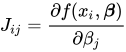
f ( x i , β ) ≈ f ( x i , 0 ) + ∑ j J i j β j {\displaystyle f(x_{i},{\boldsymbol {\beta }})\approx f(x_{i},0)+\sum _{j}J_{ij}\beta _{j}} {\displaystyle f(x_{i},{\boldsymbol {\beta }})\approx f(x_{i},0)+\sum _{j}J_{ij}\beta _{j}}

where J i j = ∂ f ( x i , β ) ∂ β j {\displaystyle J_{ij}={\frac {\partial f(x_{i},{\boldsymbol {\beta }})}{\partial \beta _{j}}}} {\displaystyle J_{ij}={\frac {\partial f(x_{i},{\boldsymbol {\beta }})}{\partial \beta _{j}}}} are Jacobian matrix elements. It follows from this that the least squares estimators are given by
β ^ ≈ ( J T J ) − 1 J T y , {\displaystyle {\hat {\boldsymbol {\beta }}}\approx \mathbf {(J^{T}J)^{-1}J^{T}y} ,} {\displaystyle {\hat {\boldsymbol {\beta }}}\approx \mathbf {(J^{T}J)^{-1}J^{T}y} ,} compare generalized least squares with covariance matrix proportional to the unit matrix. The nonlinear regression statistics are computed and used as in linear regression statistics, but using J in place of X in the formulas.

When the function f ( x i , β ) {\displaystyle f(x_{i},{\boldsymbol {\beta }})} {\displaystyle f(x_{i},{\boldsymbol {\beta }})} itself is not known analytically, but needs to be linearly approximated from n + 1 {\displaystyle n+1} {\displaystyle n+1}, or more, known values (where n {\displaystyle n} {\displaystyle n} is the number of estimators), the best estimator is obtained directly from the Linear Template Fit as [3] β ^ = ( ( Y M ~ ) T Ω − 1 Y M ~ ) − 1 ( Y M ~ ) T Ω − 1 ( d − Y m ¯ ) {\displaystyle {\hat {\boldsymbol {\beta }}}=((\mathbf {Y{\tilde {M}}} )^{\mathsf {T}}{\boldsymbol {\Omega }}^{-1}\mathbf {Y{\tilde {M}}} )^{-1}(\mathbf {Y{\tilde {M}}} )^{\mathsf {T}}{\boldsymbol {\Omega }}^{-1}(\mathbf {d} -\mathbf {Y{\bar {m}})} } {\displaystyle {\hat {\boldsymbol {\beta }}}=((\mathbf {Y{\tilde {M}}} )^{\mathsf {T}}{\boldsymbol {\Omega }}^{-1}\mathbf {Y{\tilde {M}}} )^{-1}(\mathbf {Y{\tilde {M}}} )^{\mathsf {T}}{\boldsymbol {\Omega }}^{-1}(\mathbf {d} -\mathbf {Y{\bar {m}})} } (see also linear least squares).

The linear approximation introduces bias into the statistics. Therefore, more caution than usual is required in interpreting statistics derived from a nonlinear model.

Ordinary and weighted least squares

[edit]

The best-fit curve is often assumed to be that which minimizes the sum of squared residuals. This is the ordinary least squares (OLS) approach. However, in cases where the dependent variable does not have constant variance, or there are some outliers, a sum of weighted squared residuals may be minimized; see weighted least squares. Each weight should ideally be equal to the reciprocal of the variance of the observation, or the reciprocal of the dependent variable to some power in the outlier case,[4] but weights may be recomputed on each iteration, in an iteratively weighted least squares algorithm.

Linearization

[edit]

Transformation

[edit]
Further information: Data transformation (statistics)

Some nonlinear regression problems can be moved to a linear domain by a suitable transformation of the model formulation.

For example, consider the nonlinear regression problem

y = a e b x U {\displaystyle y=ae^{bx}U} {\displaystyle y=ae^{bx}U}

with parameters a and b and with multiplicative error term U. If we take the logarithm of both sides, this becomes

ln ⁡ ( y ) = ln ⁡ ( a ) + b x + u , {\displaystyle \ln {(y)}=\ln {(a)}+bx+u,} {\displaystyle \ln {(y)}=\ln {(a)}+bx+u,}

where u = ln(U), suggesting estimation of the unknown parameters by a linear regression of ln(y) on x, a computation that does not require iterative optimization. However, use of a nonlinear transformation requires caution. The influences of the data values will change, as will the error structure of the model and the interpretation of any inferential results. These may not be desired effects. On the other hand, depending on what the largest source of error is, a nonlinear transformation may distribute the errors in a Gaussian fashion, so the choice to perform a nonlinear transformation must be informed by modeling considerations.

For Michaelis–Menten kinetics, the linear Lineweaver–Burk plot

1 v = 1 V max + K m V max [ S ] {\displaystyle {\frac {1}{v}}={\frac {1}{V_{\max }}}+{\frac {K_{m}}{V_{\max }[S]}}} {\displaystyle {\frac {1}{v}}={\frac {1}{V_{\max }}}+{\frac {K_{m}}{V_{\max }[S]}}}

of 1/v against 1/[S] has been much used. However, since it is very sensitive to data error and is strongly biased toward fitting the data in a particular range of the independent variable, [S], its use is strongly discouraged.

For error distributions that belong to the exponential family, a link function may be used to transform the parameters under the Generalized linear model framework.

Segmentation

[edit]
Yield of mustard and soil salinity
Main article: Segmented regression

The independent or explanatory variable (say X) can be split up into classes or segments and linear regression can be performed per segment. Segmented regression with confidence analysis may yield the result that the dependent or response variable (say Y) behaves differently in the various segments.[5] For example, the figure shows that the soil salinity (X) initially exerts no influence on the crop yield (Y) of mustard, until a critical or threshold value (breakpoint), after which the yield is affected negatively.[6]

See also

[edit]
  • iconMathematics portal
  • Non-linear least squares
  • Curve fitting
  • Generalized linear model
  • Local regression
  • Response modeling methodology
  • Genetic programming
  • Multi expression programming
  • Linear or quadratic template fit

Notes

[edit]
  1. ^ This model can also be expressed in the conventional biological notation: v = V max   [ S ] K m + [ S ] {\displaystyle v={\frac {V_{\max }\ [\mathrm {S} ]}{K_{m}+[\mathrm {S} ]}}} {\displaystyle v={\frac {V_{\max }\ [\mathrm {S} ]}{K_{m}+[\mathrm {S} ]}}}

References

[edit]
  1. ^ Mockaitis, Gustavo (2025). "Mono- and Polyauxic Growth Kinetics: A Semi-Mechanistic Framework for Complex Biological Dynamics". arXiv:2507.05960 [q-bio.QM].
  2. ^ Mockaitis, Gustavo (2026). "Polyauxic Modeling Platform v1.0.0 (Streamlit)". doi:10.5281/zenodo.18025828.
  3. ^ Britzger, Daniel (2022). "The Linear Template Fit". Eur. Phys. J. C. 82 (8) 731. arXiv:2112.01548. Bibcode:2022EPJC...82..731B. doi:10.1140/epjc/s10052-022-10581-w.
  4. ^ Motulsky, H.J.; Ransnas, L.A. (1987). "Fitting curves to data using nonlinear regression: a practical and nonmathematical review". The FASEB Journal. 1 (5): 365–374. doi:10.1096/fasebj.1.5.3315805. PMID 3315805.
  5. ^ Oosterbaan, R. J. (1994). "Frequency and Regression Analysis" (PDF). Drainage Principles and Applications. Wageningen: International Institute for Land Reclamation and Improvement (ILRI). pp. 175–224. ISBN 90-70754-33-9.
  6. ^ Oosterbaan, R. J. (2002). "Drainage research in farmers' fields: analysis of data" (PDF). Part of project "Liquid Gold" of the International Institute for Land Reclamation and Improvement (ILRI), Wageningen, The Netherlands.

Further reading

[edit]
  • Bethea, R. M.; Duran, B. S.; Boullion, T. L. (1985). Statistical Methods for Engineers and Scientists. New York: Marcel Dekker. ISBN 0-8247-7227-X.
  • Meade, N.; Islam, T. (1995). "Prediction Intervals for Growth Curve Forecasts". Journal of Forecasting. 14 (5): 413–430. doi:10.1002/for.3980140502.
  • Schittkowski, K. (2002). Data Fitting in Dynamical Systems. Boston: Kluwer. ISBN 1402010796.
  • Seber, G. A. F.; Wild, C. J. (1989). Nonlinear Regression. New York: John Wiley and Sons. ISBN 0471617601.
  • v
  • t
  • e
Statistics
  • Outline
  • Index
Descriptive statistics
Continuous data
Center
  • Mean
    • Arithmetic
    • Arithmetic-Geometric
    • Contraharmonic
    • Cubic
    • Generalized/power
    • Geometric
    • Harmonic
    • Heronian
    • Heinz
    • Lehmer
  • Median
  • Mode
Dispersion
  • Average absolute deviation
  • Coefficient of variation
  • Interquartile range
  • Percentile
  • Range
  • Standard deviation
  • Variance
Shape
  • Central limit theorem
  • Moments
    • Kurtosis
    • L-moments
    • Skewness
Count data
  • Index of dispersion
Summary tables
  • Contingency table
  • Frequency distribution
  • Grouped data
Dependence
  • Partial correlation
  • Pearson product-moment correlation
  • Rank correlation
    • Kendall's τ
    • Spearman's ρ
  • Scatter plot
Graphics
  • Bar chart
  • Biplot
  • Box plot
  • Control chart
  • Correlogram
  • Fan chart
  • Forest plot
  • Histogram
  • Pie chart
  • Q–Q plot
  • Radar chart
  • Run chart
  • Scatter plot
  • Stem-and-leaf display
  • Violin plot
Data collection
Study design
  • Effect size
  • Missing data
  • Optimal design
  • Population
  • Replication
  • Sample size determination
  • Statistic
  • Statistical power
Survey methodology
  • Sampling
    • Cluster
    • Stratified
  • Opinion poll
  • Questionnaire
  • Standard error
Controlled experiments
  • Blocking
  • Factorial experiment
  • Interaction
  • Random assignment
  • Randomized controlled trial
  • Randomized experiment
  • Scientific control
Adaptive designs
  • Adaptive clinical trial
  • Stochastic approximation
  • Up-and-down designs
Observational studies
  • Cohort study
  • Cross-sectional study
  • Natural experiment
  • Quasi-experiment
Statistical inference
Statistical theory
  • Population
  • Statistic
  • Probability distribution
  • Sampling distribution
    • Order statistic
  • Empirical distribution
    • Density estimation
  • Statistical model
    • Model specification
    • Lp space
  • Parameter
    • location
    • scale
    • shape
  • Parametric family
    • Likelihood (monotone)
    • Location–scale family
    • Exponential family
  • Completeness
  • Sufficiency
  • Statistical functional
    • Bootstrap
    • U
    • V
  • Optimal decision
    • loss function
  • Efficiency
  • Statistical distance
    • divergence
  • Asymptotics
  • Robustness
Frequentist inference
Point estimation
  • Estimating equations
    • Maximum likelihood
    • Method of moments
    • M-estimator
    • Minimum distance
  • Unbiased estimators
    • Mean-unbiased minimum-variance
      • Rao–Blackwellization
      • Lehmann–Scheffé theorem
    • Median unbiased
  • Plug-in
Interval estimation
  • Confidence interval
  • Pivot
  • Likelihood interval
  • Prediction interval
  • Tolerance interval
  • Resampling
    • Bootstrap
    • Jackknife
Testing hypotheses
  • 1- & 2-tails
  • Power
    • Uniformly most powerful test
  • Permutation test
    • Randomization test
  • Multiple comparisons
Parametric tests
  • Likelihood-ratio
  • Score/Lagrange multiplier
  • Wald
Specific tests
  • Z-test (normal)
  • Student's t-test
  • F-test
Goodness of fit
  • Chi-squared
  • G-test
  • Kolmogorov–Smirnov
  • Anderson–Darling
  • Lilliefors
  • Jarque–Bera
  • Normality (Shapiro–Wilk)
  • Likelihood-ratio test
  • Model selection
    • Cross validation
    • AIC
    • BIC
Rank statistics
  • Sign
    • Sample median
  • Signed rank (Wilcoxon)
    • Hodges–Lehmann estimator
  • Rank sum (Mann–Whitney)
  • Nonparametric anova
    • 1-way (Kruskal–Wallis)
    • 2-way (Friedman)
    • Ordered alternative (Jonckheere–Terpstra)
  • Van der Waerden test
Bayesian inference
  • Bayesian probability
    • prior
    • posterior
  • Credible interval
  • Bayes factor
  • Bayesian estimator
    • Maximum posterior estimator
  • Correlation
  • Regression analysis
Correlation
  • Pearson product-moment
  • Partial correlation
  • Confounding variable
  • Coefficient of determination
Regression analysis
  • Errors and residuals
  • Regression validation
  • Mixed effects models
  • Simultaneous equations models
  • Multivariate adaptive regression splines (MARS)
  • Template:Least squares and regression analysis
Linear regression
  • Simple linear regression
  • Ordinary least squares
  • General linear model
  • Bayesian regression
Non-standard predictors
  • Nonlinear regression
  • Nonparametric
  • Semiparametric
  • Isotonic
  • Robust
  • Homoscedasticity and Heteroscedasticity
Generalized linear model
  • Exponential families
  • Logistic (Bernoulli) / Binomial / Poisson regressions
Partition of variance
  • Analysis of variance (ANOVA, anova)
  • Analysis of covariance
  • Multivariate ANOVA
  • Degrees of freedom
Categorical / multivariate / time-series / survival analysis
Categorical
  • Cohen's kappa
  • Contingency table
  • Graphical model
  • Log-linear model
  • McNemar's test
  • Cochran–Mantel–Haenszel statistics
Multivariate
  • Regression
  • Manova
  • Principal components
  • Canonical correlation
  • Discriminant analysis
  • Cluster analysis
  • Classification
  • Structural equation model
    • Factor analysis
  • Multivariate distributions
    • Elliptical distributions
      • Normal
Time-series
General
  • Decomposition
  • Trend
  • Stationarity
  • Seasonal adjustment
  • Exponential smoothing
  • Cointegration
  • Structural break
  • Granger causality
Specific tests
  • Dickey–Fuller
  • Johansen
  • Q-statistic (Ljung–Box)
  • Durbin–Watson
  • Breusch–Godfrey
Time domain
  • Autocorrelation (ACF)
    • partial (PACF)
  • Cross-correlation (XCF)
  • ARMA model
  • ARIMA model (Box–Jenkins)
  • Autoregressive conditional heteroskedasticity (ARCH)
  • Vector autoregression (VAR) (Autoregressive model (AR))
Frequency domain
  • Spectral density estimation
  • Fourier analysis
  • Least-squares spectral analysis
  • Wavelet
  • Whittle likelihood
Survival
Survival function
  • Kaplan–Meier estimator (product limit)
  • Proportional hazards models
  • Accelerated failure time (AFT) model
  • First hitting time
Hazard function
  • Nelson–Aalen estimator
Test
  • Log-rank test
Applications
Biostatistics
  • Bioinformatics
  • Clinical trials / studies
  • Epidemiology
  • Medical statistics
Engineering statistics
  • Chemometrics
  • Methods engineering
  • Probabilistic design
  • Process / quality control
  • Reliability
  • System identification
Social statistics
  • Actuarial science
  • Census
  • Crime statistics
  • Demography
  • Econometrics
  • Jurimetrics
  • National accounts
  • Official statistics
  • Population statistics
  • Psychometrics
Spatial statistics
  • Cartography
  • Environmental statistics
  • Geographic information system
  • Geostatistics
  • Kriging
  • Category
  • icon Mathematics portal
  • Commons
  • WikiProject
  • v
  • t
  • e
Least squares and regression analysis
Computational statistics
  • Least squares
  • Linear least squares
  • Non-linear least squares
  • Iteratively reweighted least squares
Correlation and dependence
  • Pearson product-moment correlation
  • Rank correlation (Spearman's rho
  • Kendall's tau)
  • Partial correlation
  • Confounding variable
Regression analysis
  • Ordinary least squares
  • Partial least squares
  • Total least squares
  • Ridge regression
Regression as a
statistical model
Linear regression
  • Simple linear regression
  • Ordinary least squares
  • Generalized least squares
  • Weighted least squares
  • General linear model
Predictor structure
  • Polynomial regression
  • Growth curve (statistics)
  • Segmented regression
  • Local regression
Non-standard
  • Nonlinear regression
  • Nonparametric
  • Semiparametric
  • Robust
  • Quantile
  • Isotonic
Non-normal errors
  • Generalized linear model
  • Binomial
  • Poisson
  • Logistic
Decomposition of variance
  • Analysis of variance
  • Analysis of covariance
  • Multivariate AOV
Model exploration
  • Stepwise regression
  • Model selection
    • Mallows's Cp
    • AIC
    • BIC
  • Model specification
  • Regression validation
Background
  • Mean and predicted response
  • Gauss–Markov theorem
  • Errors and residuals
  • Goodness of fit
  • Studentized residual
  • Minimum mean-square error
  • Frisch–Waugh–Lovell theorem
Design of experiments
  • Response surface methodology
  • Optimal design
  • Bayesian design
Numerical approximation
  • Numerical analysis
  • Approximation theory
  • Numerical integration
  • Gaussian quadrature
  • Orthogonal polynomials
  • Chebyshev polynomials
  • Chebyshev nodes
Applications
  • Curve fitting
  • Calibration curve
  • Numerical smoothing and differentiation
  • System identification
  • Moving least squares
  • Regression analysis category
  • Statistics category
  • icon Mathematics portal
  • Statistics outline
  • Statistics topics
Retrieved from "https://teknopedia.ac.id/w/index.php?title=Nonlinear_regression&oldid=1338111213"
Category:
  • Regression analysis
Hidden categories:
  • Articles with short description
  • Short description is different from Wikidata

  • indonesia
  • Polski
  • العربية
  • Deutsch
  • English
  • Español
  • Français
  • Italiano
  • مصرى
  • Nederlands
  • 日本語
  • Português
  • Sinugboanong Binisaya
  • Svenska
  • Українська
  • Tiếng Việt
  • Winaray
  • 中文
  • Русский
Sunting pranala
url url url url url url url url url url url url url url url url url url url url url url url url url url url url url url url url url url url url url url url url url url url url url url url url url url url url url url url url url url url url url url url url url url url url url url url url url url url url url url url url url url url url url url url url url url url url url url url url url url url url url url url url url url url url url url url url url url url url url url url url url url url url url url url url url url url url url url url url url url url url url url url url url url url url url url url url url url url url url url url url url url url url url url url url url url url url url url url url url url url url url url url url url url url url url url url url url url url url url url url url url url url url url url url url url url url url url url url url url url url url url url url url url url url url url url url url url url url url url url url url url url url url url url url url url url url url url url url url url url url url url url url url url url url url url url url url url url url url url url url url url url url url url url url url url url url url url url url url url url url url url url url url url url url url url url url url url url url url url url url url url url url url url url url url url url url url url url url url url url url url url url url url url url url url url url url url url url url url url url url url url url url url url url url url url url url url url url url url url url url url url url url url url url url url url url url url url url url url url url url url url url url url url url url url url url url url url url url url url url url url url url url url url url url url url url url url url url url url url url url url url url url url url url url url url url url url url url url url url url url url url url url url url url url url url url url url url url url url url url url url url url url url url url url url url url url url url url url url url url url url url url url url url url url url url url url url url url url url url url url url url url url url url url url url url url url url url url url url url url url url url url url url url url url url url url url url url url url url url url url url url url url url url url url url url url url url url url url url url url url url url url url url url url url url url url url url url url url url url url url url url url url url url url url url url url url url url url url url url url url url url url url url url url url url url url url url url url url url url url url url url url url url url url url url url url url url url url url url url url url url url url url url url url url url url url url url url url url url url url url url url url url url url url url url url url url url url url url url url url url url url url url url url url url url url url url url url url url url url url url url url url url url url url url url url url url url url url url url url url url url url url url url url url url url url url url url url url url url url url url url url url url url url url url url url url url url url url url url url url url url url url url url url url url url url url url url url url url url url url url url url url url url url url url url url url url url url url url url url url url url url url url url url url url url url url url url url url url url url url url url url url url url url url url url url url url url url url url url url url url url url url url url url url url url url url url url url url url url url url url url url url url url url url url url url url url url url url url url url url url url url url url url url url url url url url url url url url url url url url url url url url url url url url url url url url url url url url url url url url url url url url url url url url url url url url url url url url url url url url url url url url url url url url url url url url url url url url url url url url url url url url url url url url url url url url url url url url url url url url url url url url url url url url url url url url url url url url url url url url url url url url url url url url url url url url url url url url url url url url url url url url url url url url url url url url url url url url url url url url url url url url url url url url url url url url url url url url url url url url url url url url url url url url url url url url url url url url url url url url url url url url url url url url url url url url url url url url url url url url url url url url url url url url url url url url url url url url url url url url url url url url url url url url url url url url url url url url url url url url url url url url url url url url url url url url url url url url url url url url url url url url url url url url url url url url url url url url url url url url url url url url url url url url url url url url url url url url url url url url url url url url url url url url url url url url url url url url url url url url url url url url url url url url url url url url url url url url url url url url url url url url url url url url url url url url url url url url url url url url url url url url url url url url url url url url url url url url url url url url url url url url url url url url url url url url url url url url url url url url url url url url url url url url url url url url url url url url url url url url url url url url url url url url url url url url url url url url url url url url url url url url url url url url url url url url url url url url url url url url url url url url url url url url url url url url url url url url url url url url url url url url url url url url url url url url url url url url url url url url url url url url url url url url url url url url url url url url url url url url url url url url url url url url url url url url url url url url url url url url url url url url url url url url url url url url url url url url url url url url url url url url url url url url url url url url url url url url url url url url url url url url url url url url url url url url url url url url url url url url url url url url url url url url url url url url url url url url url url url url url url url url url url url url url url url url url url url url url url url url url url url url url url url url url url url url url url url url url url url url url url url url url url url url url url url url url url url url url url url url url url url url url url url url url url url url url url url url url url url url url url url url url url url url url url url url url url url url url url url url url url url url url url url url url url url url url url url url url url url url url url url url url url url url url url url url url url url url url url url url url url url url url url url url url url url url url url url url url url url url url url url url url url url url url url url url url url url url url url url url url url url url url url url url url url url url url url url url url url url url url url url url url url url url url url url url url url url url url url url url url url url url url url url url url url url url url url url url url url url url url url url url url url url url url url url url url url url url url url url url url url url url url url url url url url url url url url url url url url url url url url url url url url url url url url url url url url url url url url url url url url url url url url url url url url url url url url url url url url url url url url url url url url url url url url url url url url url url url url url url url url url url url url url url url url url url url url url url url url url url url url url url url url url url url url url url url url url url url url url url url url url url url url url url url url url url url url url url url url url url url url url url url url url url url url url url url url url url url url url url url url url url url url url url url url url url url url url url url url url url url url url url url url url url url url url url url url url url url url url url url url url url url url url url url url url url url url url url url url url url url url url url url url url url url url url url url url url url url url url url url url url url url url url url url url url url url url url url url url url url url url url url url url url url url url url url url url url url url url url url url url url url url url url url url url url url url url url url url url url url url url url url url url url url url url url url url url url url url url url url url url url url url url url url url url url url url url url url url url url url url url url url url url url url url url url url url url url url url url url url url url url url url url url url url url url url url url url url url url url url url url url url url url url url url url url url url url url url url url url url url url url url url url url url url url url url url url url url url url url url url url url url url url url url url url url url url url url url url url url url url url url url url url url url url url url url url url url url url url url url url url url url url url url url url url url url url url url url url url url url url url url url url url url url url url url url url url url url url url url url url url url url url url url url url url url url url url url url url url url url url url url url url url url url url url url url url url url url url url url url url url url url url url url url url url url url url url url url url url url url url url url url url url url url url url url url url url url url url url url url url url url url url url url url url url url url url url url url url url url url url url url url url url url url url url url url url url url url url url url url url url url url url url
Pusat Layanan

UNIVERSITAS TEKNOKRAT INDONESIA | ASEAN's Best Private University
Jl. ZA. Pagar Alam No.9 -11, Labuhan Ratu, Kec. Kedaton, Kota Bandar Lampung, Lampung 35132
Phone: (0721) 702022
Email: pmb@teknokrat.ac.id