Epstein Files Full PDF

CLICK HERE
Technopedia Center
PMB University Brochure
Faculty of Engineering and Computer Science
S1 Informatics S1 Information Systems S1 Information Technology S1 Computer Engineering S1 Electrical Engineering S1 Civil Engineering

faculty of Economics and Business
S1 Management S1 Accountancy

Faculty of Letters and Educational Sciences
S1 English literature S1 English language education S1 Mathematics education S1 Sports Education
teknopedia

  • Registerasi
  • Brosur UTI
  • Kip Scholarship Information
  • Performance
Flag Counter
  1. World Encyclopedia
  2. IAS machine - Wikipedia
IAS machine - Wikipedia
From Wikipedia, the free encyclopedia
First electronic computer to be built at the Institute for Advanced Study
IAS machine
The IAS machine on display at the Smithsonian Institution
DeveloperJohn von Neumann
ManufacturerInstitute for Advanced Study (IAS)
ReleasedJune 10, 1952; 73 years ago (1952-06-10)
Lifespan1952–1958
CPU1,700 vacuum tubes
Memory1,024 words (5.1 kilobytes) (Williams tubes)
Weight1,000 pounds (450 kg)
Computer architecture bit widths
Bit
  • 1
  • 4
  • 8
  • 12
  • 16
  • 18
  • 24
  • 26
  • 30
  • 31
  • 32
  • 36
  • 45
  • 48
  • 60
  • 64
  • 128
  • 256
  • 512
  • bit slicing
Application
  • 8
  • 16
  • 32
  • 64
Binary floating-point precision
  • 16 (×½)
  • 24
  • 32 (×1)
  • 40
  • 64 (×2)
  • 80
  • 128 (×4)
  • 256 (×8)
Decimal floating-point precision
  • 32
  • 64
  • 128
  • v
  • t
  • e
James Pomerene working on the IAS machine

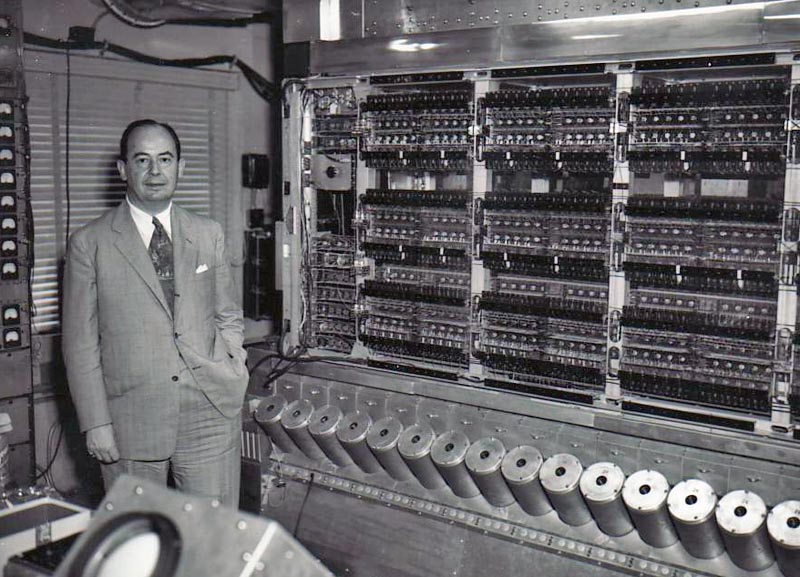
The IAS machine was the first electronic computer built at the Institute for Advanced Study (IAS) in Princeton, New Jersey. It is sometimes called the von Neumann machine, since the paper describing its design was edited by John von Neumann, a mathematics professor at both Princeton University and IAS. The computer was built under his direction, starting in 1946 and finished in 1951.[1] The general organization is called von Neumann architecture, even though it was both conceived and implemented by others.[2] The computer is in the collection of the Smithsonian National Museum of American History but is not currently on display.[3]

History

[edit]
J. Robert Oppenheimer and John von Neumann in front of the IAS machine, 1952

In 1944 summer, John von Neumann met Herman Goldstine, a computer architect and a principle investigator of the ENIAC machine. In this meeting, Goldstine presented the ENIAC project to von Neumann. As the result of this meeting, von Neumann wrote a memo called First Draft of a Report on the EDVAC as the proposed IAS computer project. Goldstine typed the report and made a distribution on June 25, 1945. Von Neumann invited Goldstine to join the IAS project in early 1946, as the assistant director and later the director of the project. Arthur Burks, a senior engineer of the ENIAC project came with Goldstine to work in the IAS project. In early summer of 1946, Julian Bigelow was hired as chief engineer,[4] and three other earlier engineers were James H. Pomerene, Ralph J. Slutz, and Willis Ware.[5] After then, more engineers worked in the IAS computer project, including George W. Brown, Hewitt Crane, Gerald Estrin, and others. The machine was in limited operation in the summer of 1951 and fully operational on June 10, 1952.[6][7][8] It was in operation until July 15, 1958.[9]

Description

[edit]

The IAS machine was a binary computer with a 40-bit word, storing two 20-bit instructions in each word. The memory was 1,024 words (5 kilobytes in modern terminology). Negative numbers were represented in two's complement format. It had two general-purpose registers available: the Accumulator (AC) and Multiplier/Quotient (MQ). It used 1,700 vacuum tubes (triode types: 6J6, 5670, 5687, a few diodes: type 6AL5, 150 pentodes to drive the memory CRTs, and 41 CRTs (type: 5CP1A): 40 used as Williams tubes for memory plus one more to monitor the state of a memory tube).[10] The memory was originally designed for about 2,300 RCA Selectron vacuum tubes. Problems with the development of these complex tubes forced the switch to Williams tubes.

It weighed about 1,000 pounds (450 kg).[11]

It was an asynchronous machine, meaning that there was no central clock regulating the timing of the instructions. One instruction started executing when the previous one finished. The addition time was 62 microseconds and the multiplication time was 713 microseconds.

Although some claim the IAS machine was the first design to mix programs and data in a single memory, that had been implemented four years earlier by the 1948 Manchester Baby.[12] The Soviet MESM also became operational prior to the IAS machine.

Von Neumann showed how the combination of instructions and data in one memory could be used to implement loops, by modifying branch instructions when a loop was completed, for example. The requirement that instructions, data and input/output be accessed via the same bus later came to be known as the Von Neumann bottleneck.

IAS machine derivatives

[edit]

Plans for the IAS machine were widely distributed to any schools, businesses, or companies interested in computing machines, resulting in the construction of several derivative computers referred to as "IAS machines", although they were not software compatible.[13]

Some of these "IAS machines" were:[14]

  • AVIDAC (Argonne National Laboratory)
  • BESK (Stockholm)
  • BESM (Moscow)[13]
  • Circle Computer (Hogan Laboratories, Inc.),[15][16][17] 1954[18][19]
  • CYCLONE (Iowa State University)
  • DASK (Regnecentralen, Copenhagen 1958)
  • GEORGE (Argonne National Laboratory)
  • IBM 701 (19 installations)
  • ILLIAC I (University of Illinois at Urbana–Champaign)
    • MUSASINO-1 (Musashino, Tokyo, Japan)
  • JOHNNIAC (RAND)
  • MANIAC I (Los Alamos National Laboratory)
  • MISTIC (Michigan State University)
  • ORACLE (Oak Ridge National Laboratory)
  • ORDVAC (Aberdeen Proving Ground)
  • PERM (Munich)[20]
  • SARA (SAAB)
  • SEAC (Washington, D.C.)[20]
  • SILLIAC (University of Sydney)
  • SMIL (Lund University)
  • TIFRAC (Tata Institute of Fundamental Research)
  • WEIZAC (Weizmann Institute)

See also

[edit]
  • Von Neumann architecture
  • List of vacuum-tube computers

References

[edit]
  1. ^ "The IAS Computer, 1952". National Museum of American History, Smithsonian Institution.
  2. ^ Deepali A.Godse; Atul P.Godse (2010). Computer Organization. Technical Publications. pp. 3–9. ISBN 978-81-8431-772-5.
  3. ^ Smithsonian IAS webpage
  4. ^ John Markoff (February 22, 2003). "Julian Bigelow, 89, Mathematician and Computer Pioneer". The New York Times.
  5. ^ Bigelow, Julian (1980). "Computer Development at the Institute for Advanced Study". A History of Computing in the Twentieth Century. Academic Press. pp. 291–310.
  6. ^ Goldstein, Herman (1972). The Computer: From Pascal to von Neumann. Princeton, NJ: Princeton University Press. pp. 317–318. ISBN 0-691-02367-0.
  7. ^ Macrae, Norman (1999). John Von Neumann: The Scientific Genius who Pioneered the Modern Computer, Game Theory, Nuclear Deterrence, and Much More. American Mathematical Soc. p. 310. ISBN 9780821826768.
  8. ^ "Automatic Computing Machinery: News - Institute for Advanced Study". Mathematics of Computation. 6 (40): 245–246. Oct 1952. doi:10.1090/S0025-5718-52-99384-8. ISSN 0025-5718.
  9. ^ Dyson, George (March 2003), "George Dyson at the birth of the computer", TED (Technology Entertainment Design) (Video), TED Conferences, LLC, archived from the original on 2012-03-17, retrieved 2012-03-21
  10. ^ The history and development of the electronic computer project at the Institute for Advanced Study. Ware. 1953
  11. ^ Weik, Martin H. (December 1955). "IAS". ed-thelen.org. A Survey of Domestic Electronic Digital Computing Systems.
  12. ^ "Manchester Baby Computer". Archived from the original on 2012-06-04.
  13. ^ a b "Electronic Computer Project". Institute for Advanced Study. Retrieved May 26, 2011.
  14. ^ "The IAS computer family scrapbook | 102693640 | Computer History Museum". www.computerhistory.org. 2003. Retrieved 2018-05-23.
  15. ^
    • Circle Computer: A General-purpose Digital Computer for Science & Engineering. | Selling the Computer Revolution | Computer History Museum.
    • Circle Computer: The low-cost general-purpose computer for science and industry. | Selling the Computer Revolution | Computer History Museum.
  16. ^ "Commercially Available General-Purpose Electronic Digital Computers of Moderate Price: THE CIRCLE COMPUTER".
  17. ^ IAS type machine:
    • "Automatic Computing Machinery: Technical Developments - THE CIRCLE COMPUTER". Mathematics of Computation. 7 (44): 249–255. 1953. doi:10.1090/S0025-5718-53-99352-1. ISSN 0025-5718.
  18. ^ Weik, Martin H. (Dec 1955). "CIRCLE". ed-thelen.org. A Survey of Domestic Electronic Digital Computing Systems.
  19. ^
    • "COMPUTERS: 9. The Circle Computer". Digital Computer Newsletter. 6 (1): 5–6. Jan 1954.
    • "COMPUTERS: 13. Circle Computer". Digital Computer Newsletter. 6 (3): 8–9. Jul 1954.
  20. ^ a b Turing's Cathedral, by George Dyson, 2012, p. 287

Further reading

[edit]
  • Gilchrist, Bruce, "Remembering Some Early Computers, 1948-1960", Columbia University EPIC, 2006, pp. 7–9. (archived 2006) Contains some autobiographical material on Gilchrist's use of the IAS computer beginning in 1952.
  • Dyson, George, Turing's Cathedral, 2012, Pantheon, ISBN 0-307-90706-6 A book about the history of the Institute of Advanced Study around the making of this computer. Chapters 6 onward deal with this computer specifically.
  • "Automatic Computing Machinery: Technical Developments - THE ELECTRONIC COMPUTER AT THE INSTITUTE FOR ADVANCED STUDY". Mathematics of Computation. 7 (42): 108–114. 1953. doi:10.1090/S0025-5718-53-99368-5. ISSN 0025-5718.
  • "Documents related to IAS computer". www.bitsavers.org.

External links

[edit]
  • Oral history interviews concerning the Institute for Advanced Study—see also individual interviews with Willis H. Ware, Arthur Burks, Herman Goldstine, Martin Schwarzschild, and others. Charles Babbage Institute, University of Minnesota.
  • Ware, Willis H. (1953). The History and Development of the Electronic Computer Project at the Institute for Advanced Study (PDF). RAND.
  • First Draft of a Report on the EDVAC – Copy of the original draft by John von Neumann
  • Photos: JvN standing in front of IAS machine and another view of IAS machine from "CPSC 231 -- Mark Smotherman". people.cs.clemson.edu.
  • v
  • t
  • e
Processor technologies
Models
  • Abstract machine
  • Stored-program computer
  • Finite-state machine
    • with datapath
    • Hierarchical
    • Deterministic finite automaton
    • Queue automaton
    • Cellular automaton
    • Quantum cellular automaton
  • Turing machine
    • Alternating Turing machine
    • Universal
    • Post–Turing
    • Quantum
    • Nondeterministic Turing machine
    • Probabilistic Turing machine
    • Hypercomputation
    • Zeno machine
  • Belt machine
  • Stack machine
  • Register machines
    • Counter
    • Pointer
    • Random-access
    • Random-access stored program
Architecture
  • Microarchitecture
  • Von Neumann
  • Harvard
    • modified
  • Dataflow
  • Transport-triggered
  • Cellular
  • Endianness
  • Memory access
    • NUMA
    • HUMA
    • Load–store
    • Register/memory
  • Cache hierarchy
  • Memory hierarchy
    • Virtual memory
    • Secondary storage
  • Heterogeneous
  • Fabric
  • Multiprocessing
  • Cognitive
  • Neuromorphic
Instruction set
architectures
Types
  • Orthogonal instruction set
  • CISC
  • RISC
  • Application-specific
  • EDGE
    • TRIPS
  • VLIW
    • EPIC
  • MISC
  • OISC
  • NISC
  • ZISC
  • VISC architecture
  • Quantum computing
  • Comparison
    • Addressing modes
Instruction
sets
  • Motorola 68000 series
  • VAX
  • PDP-11
  • x86
  • ARM
  • Stanford MIPS
  • MIPS
  • MIPS-X
  • Power
    • POWER
    • PowerPC
    • Power ISA
  • Clipper architecture
  • SPARC
  • SuperH
  • DEC Alpha
  • ETRAX CRIS
  • M32R
  • Unicore
  • Itanium
  • OpenRISC
  • RISC-V
  • MicroBlaze
  • LMC
  • System/3x0
    • S/360
    • S/370
    • S/390
    • z/Architecture
  • Tilera ISA
  • VISC architecture
  • Epiphany architecture
  • Others
Execution
Instruction pipelining
  • Pipeline stall
  • Operand forwarding
  • Classic RISC pipeline
Hazards
  • Data dependency
  • Structural
  • Control
  • False sharing
Out-of-order
  • Scoreboarding
  • Tomasulo's algorithm
    • Reservation station
    • Re-order buffer
  • Register renaming
  • Wide-issue
Speculative
  • Branch prediction
  • Memory dependence prediction
Parallelism
Level
  • Bit
    • Bit-serial
    • Word
  • Instruction
  • Pipelining
    • Scalar
    • Superscalar
  • Task
    • Thread
    • Process
  • Data
    • Vector
  • Memory
  • Distributed
Multithreading
  • Temporal
  • Simultaneous
    • Hyperthreading
    • Simultaneous and heterogenous
  • Speculative
  • Preemptive
  • Cooperative
Flynn's taxonomy
  • SISD
  • SIMD
    • Array processing (SIMT)
    • Pipelined processing
    • Associative processing
    • SWAR
  • MISD
  • MIMD
    • SPMD
Processor
performance
  • Transistor count
  • Instructions per cycle (IPC)
    • Cycles per instruction (CPI)
  • Instructions per second (IPS)
  • Floating-point operations per second (FLOPS)
  • Transactions per second (TPS)
  • Synaptic updates per second (SUPS)
  • Performance per watt (PPW)
  • Cache performance metrics
  • Computer performance by orders of magnitude
Types
  • Central processing unit (CPU)
  • Graphics processing unit (GPU)
    • GPGPU
  • Vector
  • Barrel
  • Stream
  • Tile processor
  • Coprocessor
  • PAL
  • ASIC
  • FPGA
  • FPOA
  • CPLD
  • Multi-chip module (MCM)
  • System in a package (SiP)
  • Package on a package (PoP)
By application
  • Embedded system
  • Microprocessor
  • Microcontroller
  • Mobile
  • Ultra-low-voltage
  • ASIP
  • Soft microprocessor
Systems
on chip
  • System on a chip (SoC)
  • Multiprocessor (MPSoC)
  • Cypress PSoC
  • Network on a chip (NoC)
Hardware
accelerators
  • Coprocessor
  • AI accelerator
  • Graphics processing unit (GPU)
  • Image processor
  • Vision processing unit (VPU)
  • Physics processing unit (PPU)
  • Digital signal processor (DSP)
  • Tensor Processing Unit (TPU)
  • Secure cryptoprocessor
  • Network processor
  • Baseband processor
Word size
  • 1-bit
  • 4-bit
  • 8-bit
  • 12-bit
  • 15-bit
  • 16-bit
  • 24-bit
  • 32-bit
  • 48-bit
  • 64-bit
  • 128-bit
  • 256-bit
  • 512-bit
  • bit slicing
  • others
    • variable
Core count
  • Single-core
  • Multi-core
  • Manycore
  • Heterogeneous architecture
Components
  • Core
  • Cache
    • CPU cache
    • Scratchpad memory
    • Data cache
    • Instruction cache
    • replacement policies
    • coherence
  • Bus
  • Clock rate
  • Clock signal
  • FIFO
Functional
units
  • Arithmetic logic unit (ALU)
  • Address generation unit (AGU)
  • Floating-point unit (FPU)
  • Memory management unit (MMU)
    • Load–store unit
    • Translation lookaside buffer (TLB)
  • Branch predictor
  • Branch target predictor
  • Integrated memory controller (IMC)
    • Memory management unit
  • Instruction decoder
Logic
  • Combinational
  • Sequential
  • Glue
  • Logic gate
    • Quantum
    • Array
Registers
  • Processor register
  • Status register
  • Stack register
  • Register file
  • Memory buffer
  • Memory address register
  • Program counter
Control unit
  • Hardwired control unit
  • Instruction unit
  • Data buffer
  • Write buffer
  • Microcode
  • ROM
  • Counter
Datapath
  • Multiplexer
  • Demultiplexer
  • Adder
  • Multiplier
    • CPU
  • Binary decoder
    • Address decoder
    • Sum-addressed decoder
  • Barrel shifter
Circuitry
  • Integrated circuit
    • 3D
    • Mixed-signal
    • Power management
  • Boolean
  • Digital
  • Analog
  • Quantum
  • Switch
Power
management
  • PMU
  • APM
  • ACPI
  • Dynamic frequency scaling
  • Dynamic voltage scaling
  • Clock gating
  • Performance per watt (PPW)
Related
  • History of general-purpose CPUs
  • Microprocessor chronology
  • Processor design
  • Digital electronics
  • Hardware security module
  • Semiconductor device fabrication
  • Tick–tock model
  • Pin grid array
  • Chip carrier
  • v
  • t
  • e
Mainframe computers
Australia
  • CSIRAC (1949)
  • SILLIAC (1956)
Israel
  • WEIZAC (1955)
Japan
  • FACOM (1954)
  • FUJIC (1949)
Sweden
  • SARA (1957)
  • SMIL (1956)
  • EDB-1 (1957)
  • TRASK (1964)
Soviet Union
  • BESM-6
  • ES-2701 [ru]
  • Mars [ru]
  • PS-2000
  • PS-3000 [ru]
  • SVS [ru]
  • Elbrus
  • Electronika SS VLSI [ru]
  • See also: Soviet computer systems
United States
IAS family
1950s
  • ILLIAC (1952)
  • AVIDAC (1953)
  • BESK (1953)
  • IBM 701 (1953)
  • JOHNNIAC (1953)
  • ORACLE (1953)
  • ORDVAC (1952)
  • WEIZAC (1955)
  • DASK (1955)
  • SARA (1957)
  • SILLIAC (1956)
  • SMIL (1956)
  • MANIAC I (1956)
  • MANIAC II (1956)
  • MISTIC (1957)
  • MUSASINO-1 (1957)
  • EDB-1 (1957)
  • EDB-2/3 (1957)
  • Cyclone (1959)
1960s
  • FACOM 201 (1960)
  • TRASK (1964)
University of Illinois
  • ORDVAC (1952)
  • ILLIAC I (1952)
  • ILLIAC II (1958)
  • ILLIAC III (1966)
  • ILLIAC IV (1965)
  • CEDAR (1988)
  • ILLIAC 6 (2005)
  • Trusted ILLIAC (2006)
Harvard University
  • Harvard Mark I (1944)
  • Harvard Mark II (1947)
  • Harvard Mark III (1949)
  • Harvard Mark IV (1952)
IBM
  • v
  • t
  • e
IBM vacuum tube computers
  • 305 RAMAC
  • 610
  • 650
  • 701
  • 702
  • 704
  • 705
  • 709
SAGE
  • AN/FSQ-7
  • AN/FSQ-8
Mainframes
University of Pennsylvania
  • ENIAC (1945)
EMCC
  • EDVAC (1949)
  • UNIVAC I (1951)
Remington–Sperry Rand
  • UNIVAC II
  • UNIVAC 1101
  • UNIVAC 1103
  • UNIVAC 1105
  • See also: Computers built 1955–1978
Raytheon
  • RAYDAC (1953)
United Kingdom
  • Colossus computer (1943)
Related
  • Transistor computer
    • list
  • Vacuum-tube computer
    • list
  • History of computing hardware
  • History of computing hardware (1960s–present)
  • List of pioneers in computer science
Retrieved from "https://teknopedia.ac.id/w/index.php?title=IAS_machine&oldid=1336101015"
Categories:
  • IAS architecture computers
  • 40-bit computers
  • Vacuum tube computers
Hidden categories:
  • Articles with short description
  • Short description matches Wikidata

  • indonesia
  • Polski
  • العربية
  • Deutsch
  • English
  • Español
  • Français
  • Italiano
  • مصرى
  • Nederlands
  • 日本語
  • Português
  • Sinugboanong Binisaya
  • Svenska
  • Українська
  • Tiếng Việt
  • Winaray
  • 中文
  • Русский
Sunting pranala
url url url url url url url url url url url url url url url url url url url url url url url url url url url url url url url url url url url url url url url url url url url url url url url url url url url url url url url url url url url url url url url url url url url url url url url url url url url url url url url url url url url url url url url url url url url url url url url url url url url url url url url url url url url url url url url url url url url url url url url url url url url url url url url url url url url url url url url url url url url url url url url url url url url url url url url url url url url url url url url url url url url url url url url url url url url url url url url url url url url url url url url url url url url url url url url url url url url url url url url url url url url url url url url url url url url url url url url url url url url url url url url url url url url url url url url url url url url url url url url url url url url url url url url url url url url url url url url url url url url url url url url url url url url url url url url url url url url url url url url url url url url url url url url url url url url url url url url url url url url url url url url url url url url url url url url url url url url url url url url url url url url url url url url url url url url url url url url url url url url url url url url url url url url url url url url url url url url url url url url url url url url url url url url url url url url url url url url url url url url url url url url url url url url url url url url url url url url url url url url url url url url url url url url url url url url url url url url url url url url url url url url url url url url url url url url url url url url url url url url url url url url url url url url url url url url url url url url url url url url url url url url url url url url url url url url url url url url url url url url url url url url url url url url url url url url url url url url url url url url url url url url url url url url url url url url url url url url url url url url url url url url url url url url url url url url url url url url url url url url url url url url url url url url url url url url url url url url url url url url url url url url url url url url url url url url url url url url url url url url url url url url url url url url url url url url url url url url url url url url url url url url url url url url url url url url url url url url url url url url url url url url url url url url url url url url url url url url url url url url url url url url url url url url url url url url url url url url url url url url url url url url url url url url url url url url url url url url url url url url url url url url url url url url url url url url url url url url url url url url url url url url url url url url url url url url url url url url url url url url url url url url url url url url url url url url url url url url url url url url url url url url url url url url url url url url url url url url url url url url url url url url url url url url url url url url url url url url url url url url url url url url url url url url url url url url url url url url url url url url url url url url url url url url url url url url url url url url url url url url url url url url url url url url url url url url url url url url url url url url url url url url url url url url url url url url url url url url url url url url url url url url url url url url url url url url url url url url url url url url url url url url url url url url url url url url url url url url url url url url url url url url url url url url url url url url url url url url url url url url url url url url url url url url url url url url url url url url url url url url url url url url url url url url url url url url url url url url url url url url url url url url url url url url url url url url url url url url url url url url url url url url url url url url url url url url url url url url url url url url url url url url url url url url url url url url url url url url url url url url url url url url url url url url url url url url url url url url url url url url url url url url url url url url url url url url url url url url url url url url url url url url url url url url url url url url url url url url url url url url url url url url url url url url url url url url url url url url url url url url url url url url url url url url url url url url url url url url url url url url url url url url url url url url url url url url url url url url url url url url url url url url url url url url url url url url url url url url url url url url url url url url url url url url url url url url url url url url url url url url url url url url url url url url url url url url url url url url url url url url url url url url url url url url url url url url url url url url url url url url url url url url url url url url url url url url url url url url url url url url url url url url url url url url url url url url url url url url url url url url url url url url url url url url url url url url url url url url url url url url url url url url url url url url url url url url url url url url url url url url url url url url url url url url url url url url url url url url url url url url url url url url url url url url url url url url url url url url url url url url url url url url url url url url url url url url url url url url url url url url url url url url url url url url url url url url url url url url url url url url url url url url url url url url url url url url url url url url url url url url url url url url url url url url url url url url url url url url url url url url url url url url url url url url url url url url url url url url url url url url url url url url url url url url url url url url url url url url url url url url url url url url url url url url url url url url url url url url url url url url url url url url url url url url url url url url url url url url url url url url url url url url url url url url url url url url url url url url url url url url url url url url url url url url url url url url url url url url url url url url url url url url url url url url url url url url url url url url url url url url url url url url url url url url url url url url url url url url url url url url url url url url url url url url url url url url url url url url url url url url url url url url url url url url url url url url url url url url url url url url url url url url url url url url url url url url url url url url url url url url url url url url url url url url url url url url url url url url url url url url url url url url url url url url url url url url url url url url url url url url url url url url url url url url url url url url url url url url url url url url url url url url url url url url url url url url url url url url url url url url url url url url url url url url url url url url url url url url url url url url url url url url url url url url url url url url url url url url url url url url url url url url url url url url url url url url url url url url url url url url url url url url url url url url url url url url url url url url url url url url url url url url url url url url url url url url url url url url url url url url url url url url url url url url url url url url url url url url url url url url url url url url url url url url url url url url url url url url url url url url url url url url url url url url url url url url url url url url url url url url url url url url url url url url url url url url url url url url url url url url url url url url url url url url url url url url url url url url url url url url url url url url url url url url url url url url url url url url url url url url url url url url url url url url url url url url url url url url url url url url url url url url url url url url url url url url url url url url url url url url url url url url url url url url url url url url url url url url url url url url url url url url url url url url url url url url url url url url url url url url url url url url url url url url url url url url url url url url url url url url url url url url url url url url url url url url url url url url url url url url url url url url url url url url url url url url url url url url url url url url url url url url url url url url url url url url url url url url url url url url url url url url url url url url url url url url url url url url url url url url url url url url url url url url url url url url url url url url url url url url url url url url url url url url url url url url url url url url url url url url url url url url url url url url url url url url url url url url url url url url url url url url url url url url url url url url url url url url url url url url url url url url url url url url url url url url url url url url url url url url url url url url url url url url url url url url url url url url url url url url url url url url url url url url url url url url url url url url url url url url url url url url url url url url url url url url url url url url url url url url url url url url url url url url url url url url url url url url url url url url url url url url url url url url url url url url url url url url url url url url url url url url url url url url url url url url url url url url url url url url url url url url url url url url url url url url url url url url url url url url url url url url url url url url url url url url url url url url url url url url url url url url url url url url url url url url url url url url url url url url url url url url url url url url url url url url url url url url url url url url url url url url url
Pusat Layanan

UNIVERSITAS TEKNOKRAT INDONESIA | ASEAN's Best Private University
Jl. ZA. Pagar Alam No.9 -11, Labuhan Ratu, Kec. Kedaton, Kota Bandar Lampung, Lampung 35132
Phone: (0721) 702022
Email: pmb@teknokrat.ac.id