Epstein Files Full PDF

CLICK HERE
Technopedia Center
PMB University Brochure
Faculty of Engineering and Computer Science
S1 Informatics S1 Information Systems S1 Information Technology S1 Computer Engineering S1 Electrical Engineering S1 Civil Engineering

faculty of Economics and Business
S1 Management S1 Accountancy

Faculty of Letters and Educational Sciences
S1 English literature S1 English language education S1 Mathematics education S1 Sports Education
teknopedia

  • Registerasi
  • Brosur UTI
  • Kip Scholarship Information
  • Performance
Flag Counter
  1. World Encyclopedia
  2. Tuple - Wikipedia
Tuple - Wikipedia
From Wikipedia, the free encyclopedia
(Redirected from N-tuple)
Finite ordered list of elements
For the musical term, see Tuplet.
"Octuple" redirects here. For the boat, see Octuple scull.
"Duodecuple" redirects here. For the musical technique, see Twelve-tone technique.
"Sextuple" redirects here. For the sports achievement in association football, see Sextuple (association football).

In mathematics, a tuple is a finite sequence or ordered list of numbers or, more generally, mathematical objects, which are called the elements of the tuple. An n-tuple is a tuple of n elements, where n is a non-negative integer. There is only one 0-tuple, called the empty tuple. A 1-tuple and a 2-tuple are commonly called a singleton and an ordered pair, respectively. The term "infinite tuple" is occasionally used for "infinite sequences".

Tuples are usually written by listing the elements within parentheses "( )" and separated by commas; for example, (2, 7, 4, 1, 7) denotes a 5-tuple. Other types of brackets are sometimes used, although they may have a different meaning.[a]

An n-tuple can be formally defined as the image of a function that has the set of the n first natural numbers as its domain. Tuples may be also defined from ordered pairs by a recurrence starting from an ordered pair; indeed, an n-tuple can be identified with the ordered pair of its (n − 1) first elements and its nth element, for example, ( ( ( 1 , 2 ) , 3 ) , 4 ) = ( 1 , 2 , 3 , 4 ) {\displaystyle \left(\left(\left(1,2\right),3\right),4\right)=\left(1,2,3,4\right)} {\displaystyle \left(\left(\left(1,2\right),3\right),4\right)=\left(1,2,3,4\right)}.

In computer science, tuples come in many forms. Most typed functional programming languages implement tuples directly as product types,[1] tightly associated with algebraic data types, pattern matching, and destructuring assignment.[2] Many programming languages offer an alternative to tuples, known as record types, featuring unordered elements accessed by label.[3] A few programming languages combine ordered tuple product types and unordered record types into a single construct, as in C structs and Haskell records. Relational databases may formally identify their rows (records) as tuples.

Tuples also occur in relational algebra; when programming the semantic web with the Resource Description Framework (RDF); in linguistics;[4] and in philosophy.[5]

Etymology

[edit]

The term originated as an abstraction of the sequence: single, couple/double, triple, quadruple, quintuple, sextuple, septuple, octuple, ..., n‑tuple, ..., where the prefixes are taken from the Latin names of the numerals. The unique 0-tuple is called the null tuple or empty tuple. A 1‑tuple is called a single (or singleton), a 2‑tuple is called an ordered pair or couple, and a 3‑tuple is called a triple (or triplet). The number n can be any nonnegative integer. For example, a complex number can be represented as a 2‑tuple of reals, a quaternion can be represented as a 4‑tuple, an octonion can be represented as an 8‑tuple, and a sedenion can be represented as a 16‑tuple.

Although these uses treat ‑tuple as the suffix, the original suffix was ‑ple as in "triple" (three-fold) or "decuple" (ten‑fold). This originates from medieval Latin plus (meaning "more") related to Greek ‑πλοῦς, which replaced the classical and late antique ‑plex (meaning "folded"), as in "duplex".[6][b]

Properties

[edit]

The general rule for the identity of two n-tuples is

( a 1 , a 2 , … , a n ) = ( b 1 , b 2 , … , b n ) {\displaystyle (a_{1},a_{2},\ldots ,a_{n})=(b_{1},b_{2},\ldots ,b_{n})} {\displaystyle (a_{1},a_{2},\ldots ,a_{n})=(b_{1},b_{2},\ldots ,b_{n})} if and only if a 1 = b 1 ,   a 2 = b 2 ,   … ,   a n = b n {\displaystyle a_{1}=b_{1},{\text{ }}a_{2}=b_{2},{\text{ }}\ldots ,{\text{ }}a_{n}=b_{n}} {\displaystyle a_{1}=b_{1},{\text{ }}a_{2}=b_{2},{\text{ }}\ldots ,{\text{ }}a_{n}=b_{n}}.

Thus a tuple has properties that distinguish it from a set:

  1. A tuple may contain multiple instances of the same element, so
    tuple ( 1 , 2 , 2 , 3 ) ≠ ( 1 , 2 , 3 ) {\displaystyle (1,2,2,3)\neq (1,2,3)} {\displaystyle (1,2,2,3)\neq (1,2,3)}; but set { 1 , 2 , 2 , 3 } = { 1 , 2 , 3 } {\displaystyle \{1,2,2,3\}=\{1,2,3\}} {\displaystyle \{1,2,2,3\}=\{1,2,3\}}.
  2. Tuple elements are ordered: tuple ( 1 , 2 , 3 ) ≠ ( 3 , 2 , 1 ) {\displaystyle (1,2,3)\neq (3,2,1)} {\displaystyle (1,2,3)\neq (3,2,1)}, but set { 1 , 2 , 3 } = { 3 , 2 , 1 } {\displaystyle \{1,2,3\}=\{3,2,1\}} {\displaystyle \{1,2,3\}=\{3,2,1\}}.
  3. A tuple has a finite number of elements, while a set or a multiset may have an infinite number of elements.


Definitions

[edit]

There are several definitions of tuples that give them the properties described in the previous section.

Tuples as functions

[edit]

The 0 {\displaystyle 0} {\displaystyle 0}-tuple may be identified as the empty function. For n ≥ 1 , {\displaystyle n\geq 1,} {\displaystyle n\geq 1,} the n {\displaystyle n} {\displaystyle n}-tuple ( a 1 , … , a n ) {\displaystyle \left(a_{1},\ldots ,a_{n}\right)} {\displaystyle \left(a_{1},\ldots ,a_{n}\right)} may be identified with the surjective function

F   :   { 1 , … , n }   →   { a 1 , … , a n } {\displaystyle F~:~\left\{1,\ldots ,n\right\}~\to ~\left\{a_{1},\ldots ,a_{n}\right\}} {\displaystyle F~:~\left\{1,\ldots ,n\right\}~\to ~\left\{a_{1},\ldots ,a_{n}\right\}}

with domain

domain ⁡ F = { 1 , … , n } = { i ∈ N : 1 ≤ i ≤ n } {\displaystyle \operatorname {domain} F=\left\{1,\ldots ,n\right\}=\left\{i\in \mathbb {N} :1\leq i\leq n\right\}} {\displaystyle \operatorname {domain} F=\left\{1,\ldots ,n\right\}=\left\{i\in \mathbb {N} :1\leq i\leq n\right\}}

and with codomain

codomain ⁡ F = { a 1 , … , a n } , {\displaystyle \operatorname {codomain} F=\left\{a_{1},\ldots ,a_{n}\right\},} {\displaystyle \operatorname {codomain} F=\left\{a_{1},\ldots ,a_{n}\right\},}

that is defined at i ∈ domain ⁡ F = { 1 , … , n } {\displaystyle i\in \operatorname {domain} F=\left\{1,\ldots ,n\right\}} {\displaystyle i\in \operatorname {domain} F=\left\{1,\ldots ,n\right\}} by

F ( i ) := a i . {\displaystyle F(i):=a_{i}.} {\displaystyle F(i):=a_{i}.}

That is, F {\displaystyle F} {\displaystyle F} is the function defined by

1 ↦ a 1 ⋮ n ↦ a n {\displaystyle {\begin{alignedat}{3}1\;&\mapsto &&\;a_{1}\\\;&\;\;\vdots &&\;\\n\;&\mapsto &&\;a_{n}\\\end{alignedat}}} {\displaystyle {\begin{alignedat}{3}1\;&\mapsto &&\;a_{1}\\\;&\;\;\vdots &&\;\\n\;&\mapsto &&\;a_{n}\\\end{alignedat}}}

in which case the equality

( a 1 , a 2 , … , a n ) = ( F ( 1 ) , F ( 2 ) , … , F ( n ) ) {\displaystyle \left(a_{1},a_{2},\dots ,a_{n}\right)=\left(F(1),F(2),\dots ,F(n)\right)} {\displaystyle \left(a_{1},a_{2},\dots ,a_{n}\right)=\left(F(1),F(2),\dots ,F(n)\right)}

necessarily holds.

Tuples as sets of ordered pairs

Functions are commonly identified with their graphs, which is a certain set of ordered pairs. Indeed, many authors use graphs as the definition of a function. Using this definition of "function", the above function F {\displaystyle F} {\displaystyle F} can be defined as:

F   :=   { ( 1 , a 1 ) , … , ( n , a n ) } . {\displaystyle F~:=~\left\{\left(1,a_{1}\right),\ldots ,\left(n,a_{n}\right)\right\}.} {\displaystyle F~:=~\left\{\left(1,a_{1}\right),\ldots ,\left(n,a_{n}\right)\right\}.}

Tuples as nested ordered pairs

[edit]

Another way of modeling tuples in set theory is as nested ordered pairs. This approach assumes that the notion of ordered pair has already been defined.

  1. The 0-tuple (i.e. the empty tuple) is represented by the empty set ∅ {\displaystyle \emptyset } {\displaystyle \emptyset }.
  2. An n-tuple, with n > 0, can be defined as an ordered pair of its first entry and an (n − 1)-tuple (which contains the remaining entries when n > 1):
    ( a 1 , a 2 , a 3 , … , a n ) = ( a 1 , ( a 2 , a 3 , … , a n ) ) {\displaystyle (a_{1},a_{2},a_{3},\ldots ,a_{n})=(a_{1},(a_{2},a_{3},\ldots ,a_{n}))} {\displaystyle (a_{1},a_{2},a_{3},\ldots ,a_{n})=(a_{1},(a_{2},a_{3},\ldots ,a_{n}))}

This definition can be applied recursively to the (n − 1)-tuple:

( a 1 , a 2 , a 3 , … , a n ) = ( a 1 , ( a 2 , ( a 3 , ( … , ( a n , ∅ ) … ) ) ) ) {\displaystyle (a_{1},a_{2},a_{3},\ldots ,a_{n})=(a_{1},(a_{2},(a_{3},(\ldots ,(a_{n},\emptyset )\ldots ))))} {\displaystyle (a_{1},a_{2},a_{3},\ldots ,a_{n})=(a_{1},(a_{2},(a_{3},(\ldots ,(a_{n},\emptyset )\ldots ))))}

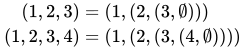
Thus, for example:

( 1 , 2 , 3 ) = ( 1 , ( 2 , ( 3 , ∅ ) ) ) ( 1 , 2 , 3 , 4 ) = ( 1 , ( 2 , ( 3 , ( 4 , ∅ ) ) ) ) {\displaystyle {\begin{aligned}(1,2,3)&=(1,(2,(3,\emptyset )))\\(1,2,3,4)&=(1,(2,(3,(4,\emptyset ))))\\\end{aligned}}} {\displaystyle {\begin{aligned}(1,2,3)&=(1,(2,(3,\emptyset )))\\(1,2,3,4)&=(1,(2,(3,(4,\emptyset ))))\\\end{aligned}}}

A variant of this definition starts "peeling off" elements from the other end:

  1. The 0-tuple is the empty set ∅ {\displaystyle \emptyset } {\displaystyle \emptyset }.
  2. For n > 0:
    ( a 1 , a 2 , a 3 , … , a n ) = ( ( a 1 , a 2 , a 3 , … , a n − 1 ) , a n ) {\displaystyle (a_{1},a_{2},a_{3},\ldots ,a_{n})=((a_{1},a_{2},a_{3},\ldots ,a_{n-1}),a_{n})} {\displaystyle (a_{1},a_{2},a_{3},\ldots ,a_{n})=((a_{1},a_{2},a_{3},\ldots ,a_{n-1}),a_{n})}

This definition can be applied recursively:

( a 1 , a 2 , a 3 , … , a n ) = ( ( … ( ( ( ∅ , a 1 ) , a 2 ) , a 3 ) , … ) , a n ) {\displaystyle (a_{1},a_{2},a_{3},\ldots ,a_{n})=((\ldots (((\emptyset ,a_{1}),a_{2}),a_{3}),\ldots ),a_{n})} {\displaystyle (a_{1},a_{2},a_{3},\ldots ,a_{n})=((\ldots (((\emptyset ,a_{1}),a_{2}),a_{3}),\ldots ),a_{n})}

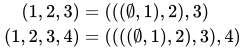
Thus, for example:

( 1 , 2 , 3 ) = ( ( ( ∅ , 1 ) , 2 ) , 3 ) ( 1 , 2 , 3 , 4 ) = ( ( ( ( ∅ , 1 ) , 2 ) , 3 ) , 4 ) {\displaystyle {\begin{aligned}(1,2,3)&=(((\emptyset ,1),2),3)\\(1,2,3,4)&=((((\emptyset ,1),2),3),4)\\\end{aligned}}} {\displaystyle {\begin{aligned}(1,2,3)&=(((\emptyset ,1),2),3)\\(1,2,3,4)&=((((\emptyset ,1),2),3),4)\\\end{aligned}}}

Tuples as nested sets

[edit]

Using Kuratowski's representation for an ordered pair, the second definition above can be reformulated in terms of pure set theory:

  1. The 0-tuple (i.e. the empty tuple) is represented by the empty set ∅ {\displaystyle \emptyset } {\displaystyle \emptyset };
  2. Let x {\displaystyle x} {\displaystyle x} be an n-tuple ( a 1 , a 2 , … , a n ) {\displaystyle (a_{1},a_{2},\ldots ,a_{n})} {\displaystyle (a_{1},a_{2},\ldots ,a_{n})}, and let x → b ≡ ( a 1 , a 2 , … , a n , b ) {\displaystyle x\rightarrow b\equiv (a_{1},a_{2},\ldots ,a_{n},b)} {\displaystyle x\rightarrow b\equiv (a_{1},a_{2},\ldots ,a_{n},b)}. Then, x → b ≡ { { x } , { x , b } } {\displaystyle x\rightarrow b\equiv \{\{x\},\{x,b\}\}} {\displaystyle x\rightarrow b\equiv \{\{x\},\{x,b\}\}}. (The right arrow, → {\displaystyle \rightarrow } {\displaystyle \rightarrow }, could be read as "adjoined with".)

In this formulation:
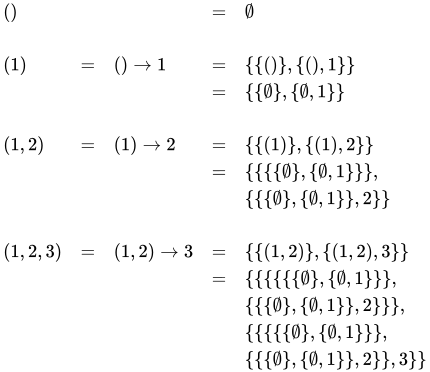
( ) = ∅ ( 1 ) = ( ) → 1 = { { ( ) } , { ( ) , 1 } } = { { ∅ } , { ∅ , 1 } } ( 1 , 2 ) = ( 1 ) → 2 = { { ( 1 ) } , { ( 1 ) , 2 } } = { { { { ∅ } , { ∅ , 1 } } } , { { { ∅ } , { ∅ , 1 } } , 2 } } ( 1 , 2 , 3 ) = ( 1 , 2 ) → 3 = { { ( 1 , 2 ) } , { ( 1 , 2 ) , 3 } } = { { { { { { ∅ } , { ∅ , 1 } } } , { { { ∅ } , { ∅ , 1 } } , 2 } } } , { { { { { ∅ } , { ∅ , 1 } } } , { { { ∅ } , { ∅ , 1 } } , 2 } } , 3 } } {\displaystyle {\begin{array}{lclcl}()&&&=&\emptyset \\&&&&\\(1)&=&()\rightarrow 1&=&\{\{()\},\{(),1\}\}\\&&&=&\{\{\emptyset \},\{\emptyset ,1\}\}\\&&&&\\(1,2)&=&(1)\rightarrow 2&=&\{\{(1)\},\{(1),2\}\}\\&&&=&\{\{\{\{\emptyset \},\{\emptyset ,1\}\}\},\\&&&&\{\{\{\emptyset \},\{\emptyset ,1\}\},2\}\}\\&&&&\\(1,2,3)&=&(1,2)\rightarrow 3&=&\{\{(1,2)\},\{(1,2),3\}\}\\&&&=&\{\{\{\{\{\{\emptyset \},\{\emptyset ,1\}\}\},\\&&&&\{\{\{\emptyset \},\{\emptyset ,1\}\},2\}\}\},\\&&&&\{\{\{\{\{\emptyset \},\{\emptyset ,1\}\}\},\\&&&&\{\{\{\emptyset \},\{\emptyset ,1\}\},2\}\},3\}\}\\\end{array}}} {\displaystyle {\begin{array}{lclcl}()&&&=&\emptyset \\&&&&\\(1)&=&()\rightarrow 1&=&\{\{()\},\{(),1\}\}\\&&&=&\{\{\emptyset \},\{\emptyset ,1\}\}\\&&&&\\(1,2)&=&(1)\rightarrow 2&=&\{\{(1)\},\{(1),2\}\}\\&&&=&\{\{\{\{\emptyset \},\{\emptyset ,1\}\}\},\\&&&&\{\{\{\emptyset \},\{\emptyset ,1\}\},2\}\}\\&&&&\\(1,2,3)&=&(1,2)\rightarrow 3&=&\{\{(1,2)\},\{(1,2),3\}\}\\&&&=&\{\{\{\{\{\{\emptyset \},\{\emptyset ,1\}\}\},\\&&&&\{\{\{\emptyset \},\{\emptyset ,1\}\},2\}\}\},\\&&&&\{\{\{\{\{\emptyset \},\{\emptyset ,1\}\}\},\\&&&&\{\{\{\emptyset \},\{\emptyset ,1\}\},2\}\},3\}\}\\\end{array}}}

n-tuples of m-sets

[edit]

In discrete mathematics, especially combinatorics and finite probability theory, n-tuples arise in the context of various counting problems and are treated more informally as ordered lists of length n.[7] n-tuples whose entries come from a set of m elements are also called arrangements with repetition, permutations of a multiset and, in some non-English literature, variations with repetition. The number of n-tuples of an m-set is mn. This follows from the combinatorial rule of product.[8] If S is a finite set of cardinality m, this number is the cardinality of the n-fold Cartesian power S × S × ⋯ × S. Tuples are elements of this product set.

Type theory

[edit]
Main article: Product type

In type theory, commonly used in programming languages, a tuple has a product type; this fixes not only the length, but also the underlying types of each component. Formally:

( x 1 , x 2 , … , x n ) : T 1 × T 2 × … × T n {\displaystyle (x_{1},x_{2},\ldots ,x_{n}):{\mathsf {T}}_{1}\times {\mathsf {T}}_{2}\times \ldots \times {\mathsf {T}}_{n}} {\displaystyle (x_{1},x_{2},\ldots ,x_{n}):{\mathsf {T}}_{1}\times {\mathsf {T}}_{2}\times \ldots \times {\mathsf {T}}_{n}}

and the projections are term constructors:

π 1 ( x ) : T 1 ,   π 2 ( x ) : T 2 ,   … ,   π n ( x ) : T n {\displaystyle \pi _{1}(x):{\mathsf {T}}_{1},~\pi _{2}(x):{\mathsf {T}}_{2},~\ldots ,~\pi _{n}(x):{\mathsf {T}}_{n}} {\displaystyle \pi _{1}(x):{\mathsf {T}}_{1},~\pi _{2}(x):{\mathsf {T}}_{2},~\ldots ,~\pi _{n}(x):{\mathsf {T}}_{n}}

The tuple with labeled elements used in the relational model has a record type. Both of these types can be defined as simple extensions of the simply typed lambda calculus.[9]

The notion of a tuple in type theory and that in set theory are related in the following way: If we consider the natural model of a type theory, and use the Scott brackets to indicate the semantic interpretation, then the model consists of some sets S 1 , S 2 , … , S n {\displaystyle S_{1},S_{2},\ldots ,S_{n}} {\displaystyle S_{1},S_{2},\ldots ,S_{n}} (note: the use of italics here that distinguishes sets from types) such that:

[ [ T 1 ] ] = S 1 ,   [ [ T 2 ] ] = S 2 ,   … ,   [ [ T n ] ] = S n {\displaystyle [\![{\mathsf {T}}_{1}]\!]=S_{1},~[\![{\mathsf {T}}_{2}]\!]=S_{2},~\ldots ,~[\![{\mathsf {T}}_{n}]\!]=S_{n}} {\displaystyle [\![{\mathsf {T}}_{1}]\!]=S_{1},~[\![{\mathsf {T}}_{2}]\!]=S_{2},~\ldots ,~[\![{\mathsf {T}}_{n}]\!]=S_{n}}

and the interpretation of the basic terms is:

[ [ x 1 ] ] ∈ [ [ T 1 ] ] ,   [ [ x 2 ] ] ∈ [ [ T 2 ] ] ,   … ,   [ [ x n ] ] ∈ [ [ T n ] ] {\displaystyle [\![x_{1}]\!]\in [\![{\mathsf {T}}_{1}]\!],~[\![x_{2}]\!]\in [\![{\mathsf {T}}_{2}]\!],~\ldots ,~[\![x_{n}]\!]\in [\![{\mathsf {T}}_{n}]\!]} {\displaystyle [\![x_{1}]\!]\in [\![{\mathsf {T}}_{1}]\!],~[\![x_{2}]\!]\in [\![{\mathsf {T}}_{2}]\!],~\ldots ,~[\![x_{n}]\!]\in [\![{\mathsf {T}}_{n}]\!]}.

The n-tuple of type theory has the natural interpretation as an n-tuple of set theory:[10]

[ [ ( x 1 , x 2 , … , x n ) ] ] = ( [ [ x 1 ] ] , [ [ x 2 ] ] , … , [ [ x n ] ] ) {\displaystyle [\![(x_{1},x_{2},\ldots ,x_{n})]\!]=(\,[\![x_{1}]\!],[\![x_{2}]\!],\ldots ,[\![x_{n}]\!]\,)} {\displaystyle [\![(x_{1},x_{2},\ldots ,x_{n})]\!]=(\,[\![x_{1}]\!],[\![x_{2}]\!],\ldots ,[\![x_{n}]\!]\,)}

The unit type has as semantic interpretation the 0-tuple.

For a list of tuple types in programming languages, see Product type#Product types in programming languages.

See also

[edit]
  • Arity
  • Coordinate vector
  • Exponential object
  • Formal language
  • Multidimensional Expressions (OLAP)
  • Prime k-tuple
  • Relation (mathematics)
  • Sequence
  • Tuplespace
  • Tuple Names

Notes

[edit]
  1. ^ Square brackets are used for matrices, including row vectors. Braces are used for sets. Each programming language has its own convention for the different brackets.
  2. ^ Compare the etymology of ploidy, from the Greek for -fold.

References

[edit]
  1. ^ "Algebraic data type - HaskellWiki". wiki.haskell.org.
  2. ^ "Destructuring assignment". MDN Web Docs. 18 April 2023.
  3. ^ "Does JavaScript Guarantee Object Property Order?". Stack Overflow.
  4. ^ Matthews, P. H., ed. (January 2007). "N-tuple". The Concise Oxford Dictionary of Linguistics. Oxford University Press. ISBN 9780199202720. Retrieved 1 May 2015.
  5. ^ Blackburn, Simon (1994). "ordered n-tuple". The Oxford Dictionary of Philosophy. Oxford guidelines quick reference (3 ed.). Oxford: Oxford University Press (published 2016). p. 342. ISBN 9780198735304. Retrieved 2017-06-30. ordered n-tuple[:] A generalization of the notion of an [...] ordered pair to sequences of n objects.
  6. ^ OED, s.v. "triple", "quadruple", "quintuple", "decuple"
  7. ^ D'Angelo & West 2000, p. 9
  8. ^ D'Angelo & West 2000, p. 101
  9. ^ Pierce, Benjamin (2002). Types and Programming Languages. MIT Press. pp. 126–132. ISBN 0-262-16209-1.
  10. ^ Steve Awodey, From sets, to types, to categories, to sets, 2009, preprint

Sources

[edit]
  • D'Angelo, John P.; West, Douglas B. (2000), Mathematical Thinking/Problem-Solving and Proofs (2nd ed.), Prentice-Hall, ISBN 978-0-13-014412-6
  • Keith Devlin, The Joy of Sets. Springer Verlag, 2nd ed., 1993, ISBN 0-387-94094-4, pp. 7–8
  • Abraham Adolf Fraenkel, Yehoshua Bar-Hillel, Azriel Lévy, Foundations of school Set Theory, Elsevier Studies in Logic Vol. 67, 2nd Edition, revised, 1973, ISBN 0-7204-2270-1, p. 33
  • Gaisi Takeuti, W. M. Zaring, Introduction to Axiomatic Set Theory, Springer GTM 1, 1971, ISBN 978-0-387-90024-7, p. 14
  • George J. Tourlakis, Lecture Notes in Logic and Set Theory. Volume 2: Set Theory, Cambridge University Press, 2003, ISBN 978-0-521-75374-6, pp. 182–193

External links

[edit]
  • The dictionary definition of tuple at Wiktionary
  • v
  • t
  • e
Set theory
Overview
  • Set (mathematics)
Venn diagram of set intersection
Axioms
  • Adjunction
  • Choice
    • countable
    • dependent
    • global
  • Constructibility (V=L)
  • Determinacy
    • projective
  • Extensionality
  • Infinity
  • Limitation of size
  • Pairing
  • Power set
  • Regularity
  • Union
  • Martin's axiom
  • Axiom schema
    • replacement
    • specification
Operations
  • Cartesian product
  • Complement (i.e. set difference)
  • De Morgan's laws
  • Disjoint union
  • Identities
  • Intersection
  • Power set
  • Symmetric difference
  • Union
  • Concepts
  • Methods
  • Almost
  • Cardinality
  • Cardinal number (large)
  • Class
  • Constructible universe
  • Continuum hypothesis
  • Diagonal argument
  • Element
    • ordered pair
    • tuple
  • Family
  • Forcing
  • One-to-one correspondence
  • Ordinal number
  • Set-builder notation
  • Transfinite induction
  • Venn diagram
Set types
  • Amorphous
  • Countable
  • Empty
  • Finite (hereditarily)
  • Filter
    • base
    • subbase
    • Ultrafilter
  • Fuzzy
  • Infinite (Dedekind-infinite)
  • Recursive
  • Singleton
  • Subset · Superset
  • Transitive
  • Uncountable
  • Universal
Theories
  • Alternative
  • Axiomatic
  • Naive
  • Cantor's theorem
  • Zermelo
    • General
  • Principia Mathematica
    • New Foundations
  • Zermelo–Fraenkel
    • von Neumann–Bernays–Gödel
      • Morse–Kelley
    • Kripke–Platek
    • Tarski–Grothendieck
  • Paradoxes
  • Problems
  • Russell's paradox
  • Suslin's problem
  • Burali-Forti paradox
Set theorists
  • Paul Bernays
  • Georg Cantor
  • Paul Cohen
  • Richard Dedekind
  • Abraham Fraenkel
  • Kurt Gödel
  • Thomas Jech
  • John von Neumann
  • Willard Quine
  • Bertrand Russell
  • Thoralf Skolem
  • Ernst Zermelo
Authority control databases Edit this at Wikidata
  • GND
Retrieved from "https://teknopedia.ac.id/w/index.php?title=Tuple&oldid=1330982643"
Categories:
  • Data management
  • Mathematical notation
  • Sequences and series
  • Basic concepts in set theory
  • Type theory
Hidden categories:
  • Articles with short description
  • Short description matches Wikidata

  • indonesia
  • Polski
  • العربية
  • Deutsch
  • English
  • Español
  • Français
  • Italiano
  • مصرى
  • Nederlands
  • 日本語
  • Português
  • Sinugboanong Binisaya
  • Svenska
  • Українська
  • Tiếng Việt
  • Winaray
  • 中文
  • Русский
Sunting pranala
url url url url url url url url url url url url url url url url url url url url url url url url url url url url url url url url url url url url url url url url url url url url url url url url url url url url url url url url url url url url url url url url url url url url url url url url url url url url url url url url url url url url url url url url url url url url url url url url url url url url url url url url url url url url url url url url url url url url url url url url url url url url url url url url url url url url url url url url url url url url url url url url url url url url url url url url url url url url url url url url url url url url url url url url url url url url url url url url url url url url url url url url url url url url url url url url url url url url url url url url url url url url url url url url url url url url url url url url url url url url url url url url url url url url url url url url url url url url url url url url url url url url url url url url url url url url url url url url url url url url url url url url url url url url url url url url url url url url url url url url url url url url url url url url url url url url url url url url url url url url url url url url url url url url url url url url url url url url url url url url url url url url url url url url url url url url url url url url url url url url url url url url url url url url url url url url url url url url url url url url url url url url url url url url url url url url url url url url url url url url url url url url url url url url url url url url url url url url url url url url url url url url url url url url url url url url url url url url url url url url url url url url url url url url url url url url url url url url url url url url url url url url url url url url url url url url url url url url url url url url url url url url url url url url url url url url url url url url url url url url url url url url url url url url url url url url url url url url url url url url url url url url url url url url url url url url url url url url url url url url url url url url url url url url url url url url url url url url url url url url url url url url url url url url url url url url url url url url url url url url url url url url url url url url url url url url url url url url url url url url url url url url url url url url url url url url url url url url url url url url url url url url url url url url url url url url url url url url url url url url url url url url url url url url url url url url url url url url url url url url url url url url url url url url url url url url url url url url url url url url url url url url url url url url url url url url url url url url url url url url url url url url url url url url url url url url url url url url url url url url url url url url url url url url url url url url url url url url url url url url url url url url url url url url url url url url url url url url url url url url url url url url url url url url url url url url url url url url url url url url url url url url url url url url url url url url url url url url url url url url url url url url url url url url url url url url url url url url url url url url url url url url url url url url url url url url url url url url url url url url url url url url url url url url url url url url url url url url url url url url url url url url url url url url url url url url url url url url url url url url url url url url url url url url url url url url url url url url url url url url url url url url url url url url url url url url url url url url url url url url url url url url url url url url url url url url url url url url url url url url url url url url url url url url url url url url url url url url url url url url url url url url url url url url url url url url url url url url url url url url url url url url url url url url url url url url url url url url url url url url url url url url url url url url url url url url url url url url url url url url url url url url url url url url url url url url url url url url url url url url url url url url url url url url url url url url url url url url url url url url url url url url url url url url url url url url url url url url url url url url url url url url url url url url url url url url url url url url url url url url url url url url url url url url url url url url url url url url url url url url url url url url url url url url url url url url url url url url url url url url url url url url url url url url url url url url url url url url url url url url url url url url url url url url url url url url url url url url url url url url url url url url url url url url url url url url url url url url url url url url url url url url url url url url url url url url url url url url url url url url url url url url url url url url url url url url url url url url url url url url url url url url url url url url url url url url url url url url url url url url url url url url url url url url url url url url url url url url url url url url url url url url url url url url url url url url url url url url url url url url url url url url url url url url url url url url url url url url url url url url url url url url url url url url url url url url url url url url url url url url url url url url url url url url url url url url url url url url url url url url url url url url url url url url url url url url url url url url url url url url url url url url url url url url url url url url url url url url url url url url url url url url url url url url url url url url url url url url url url url url url url url url url url url url url url url url url url url url url url url url url url url url url url url url url url url url url url url url url url url url url url url url url url url url url url url url url url url url url url url url url url url url url url url url url url url url url url url url url url url url url url url url url url url url url url url url url url url url url url url url url url url url url url url url url url url url url url url url url url url url url url url url url url url url url url url url url url url url url url url url url url url url url url url url url url url url url url url url url url url url url url url url url url url url url url url url url url url url url url url url url url url url url url url url url url url url url url url url url url url url url url url url url url url url url url url url url url url url url url url url url url url url url url url url url url url url url url url url url url url url url url url url url url url url url url url url url url url url url url url url url url url url url url url url url url url url url url url url url url url url url url url url url url url url url url url url url url url url url url url url url url url url url url url url url url url url url url url url url url url url url url url url url url url url url url url url url url url url url url url url url url url url url url url url url url url url url url url url url url url url url url url url url url url url url url url url url url url url url url url url url url url url url url url url url url url url url url url url url url url url url url url url url url url url url url url url url url url url url url url url url url url url url url url url url url url url url url url url url url url url url url url url url url url url url url url url url url url url url url url url url url url url url url url url url url url url url url url url url url url url url url url url url url url url url url url url url url url url url url url url url url url url url url url url url url url url url url url url url url url url url url url url url url url url url url url url url url url url url url url url url url url url url url url url url url url url url url url url url url url url url url url url url url url url url url url url url url url url url url url url url url url url url url url url url url url url url url url url url url url url url url url url url url url url url url url url url url url url url url url url url url url url url url url url url url url url url url url url url url url url url url url url url url url url url url url url url url url url url url url url url url url url url url url url url url url url url url url url url url url url url url url url url url url url url url url url url url url url url url url url url url url url url url url url url url url url url url url url url url url url url url url url url url url url url url url url url url url url url url url url url url url url url url url url url url url url url url url url url url url url url url url url url url url url url url url url url url url url url url url url url url url url url url url url url url url url url url url url url url url url url url url url url url url url url url url url url url url url url url url url url url url url url url url url url url url url url url url url url url url url url url url url url url url url url url url url url url url url url url url url url url url url url url url url url url url url url url url url url url url url url url url url url url url url url url url url url url url url url url url url url url url url url url url url url url url url url url url url url url url url url url url url url url url url url url url url url url url url url url url url url url url url url url url url url url url url url url url url url url url url url url url url url url url url url url url url url url url url url url url url url url url url url url url url url url url url url url url url url url url url url url url url url url url url url url url url url url url url url url url url url url url url
Pusat Layanan

UNIVERSITAS TEKNOKRAT INDONESIA | ASEAN's Best Private University
Jl. ZA. Pagar Alam No.9 -11, Labuhan Ratu, Kec. Kedaton, Kota Bandar Lampung, Lampung 35132
Phone: (0721) 702022
Email: pmb@teknokrat.ac.id