

 | You can help expand this article with text translated from the corresponding article in Chinese. (December 2019) Click [show] for important translation instructions.
|
 | This article should specify the language of its non-English content using {{lang}} or {{langx}}, {{transliteration}} for transliterated languages, and {{IPA}} for phonetic transcriptions, with an appropriate ISO 639 code. Wikipedia's multilingual support templates may also be used. (September 2024) |
| Yi | |
|---|---|
 nuosu bburma or Yi script | |
| Script type | Syllabary in modern form;
Logographic in archaic variations |
Period | Since at least 15th century (earliest attestation) to present, syllabic version established in 1974 |
| Direction | Left-to-right  |
| Languages | various Yi languages |
| Related scripts | |
Parent systems | |
| ISO 15924 | |
| ISO 15924 | Yiii (460), Yi |
| Unicode | |
Unicode alias | Yi |

The Yi scripts (Yi: ꆈꌠꁱꂷ, romanized: nuosu bburma; Chinese: 彝文; pinyin: Yí wén) are two scripts used to write the Yi languages; Classical Yi (an ideographic script), and the later Yi syllabary. The script is historically known in Chinese as Cuan Wen (Chinese: 爨文; pinyin: Cuàn wén) or Wei Shu (simplified Chinese: 韪书; traditional Chinese: 韙書; pinyin: Wéi shū) and various other names (夷字、倮語、倮倮文、畢摩文), among them "tadpole writing" (蝌蚪文).[1]
This is to be distinguished from romanized Yi (文羅馬拼音 Yíwén Luómǎ pīnyīn) which was a system (or systems) invented by missionaries and intermittently used afterwards by some government institutions (and still used outside Sichuan province for non-Nuosu Yi languages, but adapted from the standard Han Pinyin system and used to romanize another syllabary based on a subset of simplified Han ideograms).[2][3] There was also the alphasyllabary (or abugida) devised by Sam Pollard, the Pollard script for the Miao language spoken in Yunnan province, which he adapted for the Nasu language as well.[4] Present day traditional Yi writing can be sub-divided into five main varieties, namely, Nuosu (the prestige form of the Yi language centred on the Liangshan area), Nasu (including the Wusa), Nisu (Southern Yi), Sani (撒尼) and Azhe (阿哲).[5][6]
Classical Yi
Classical Yi or Traditional Yi is a syllabic logographic system that was reputedly devised, according to Nuosu mythology, during the Tang dynasty (618–907) by a Nuosu hero called Aki (Chinese: 阿畸; pinyin: Āqí).[7] However, the earliest surviving examples of the Yi script date back to only the late 15th century and early 16th century, the earliest dated example being an inscription on a bronze bell dated to 1485.[8] There are tens of thousands of manuscripts in the Yi script, dating back several centuries, although most are undated. In recent years a number of Yi manuscript texts written in traditional Yi script have been published.
The original script is said to have comprised 1,840 characters,[citation needed] but over the centuries widely divergent glyph forms have developed in different Yi-speaking areas, an extreme example being the character for "stomach" which exists in some forty glyph variants. Due to this regional variation as many as 90,000 different Yi glyphs are known from manuscripts and inscriptions.[citation needed] Although similar to Chinese in function, the glyphs are independent in form, with little to suggest that they are directly related.[citation needed] However, there are some borrowings from Chinese, such as the characters for numbers used in some Yi script traditions.
Languages written with the classical script included Nuosu, Nisu, Wusa Nasu, and Mantsi. It was traditionally written on manuscripts vertically from top to bottom (see the gallery below), in columns stacking from right to left, but some modern transcriptions are showing it horizontally from left to right (glyphs are then rotated 90 degrees anticlockwise, in opposition to what is done for modern usage of Chinese characters that preserve their orientation), in lines stacking from top to bottom.
-
 A Yi manuscript from 1814.
 -
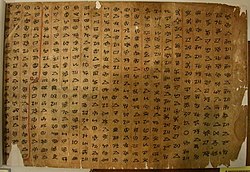 A classical Yi manuscript.


Modern Yi
The Modern Yi script (ꆈꌠꁱꂷ nuosu bburma [nɔ̄sβ̩ bβ̠̩mā] 'Nuosu script') is a standardized syllabary derived from the classic script in 1974 by the local Ethnic Affairs Commission in Sichuan.
In 1980, it was ratified by the State Council as the official script of the Liangshan dialect of the Nuosu Yi language of Liangshan Yi Autonomous Prefecture, and consequently is known as Liangshan Standard Yi Script (涼山規範彝文 Liángshān guīfàn Yíwén). There are 756 basic glyphs based on the Liangshan dialect, plus 63 for syllables used only for words borrowed from Chinese.
Yunnan did not officially adopt the Liangshan script, but developed its own Yunnan Standard Yi Script (云南规范彝文方案 Yúnnán Guīfàn Yíwén Fāng'àn) on different principles, which emphasized cross-dialect intelligibility, as well as retention of shared logographic forms. The Yunnan script has 2,608 glyphs, of which 2,258 are logographic, plus 350 phonetic glyphs. The Yunnan script was ratified by the provincial government in Yunnan in 1987. Guizhou published a dictionary in 1991 which identified standard and variant forms of traditional Yi logographs used in Nasu area.
The native syllabary represents vowel and consonant-vowel syllables, formed of 43 consonants and 8 vowels that can occur with any of three tones, plus two "buzzing" vowels that can only occur as mid tone. Not all combinations are possible.
Although the Liangshan dialect has four tones (and others have more), only three tones (high, mid, low) have separate glyphs. The fourth tone (rising) may sometimes occur as a grammatical inflection of the mid tone, so it is written with the mid-tone glyph plus a diacritic mark (a superscript arc). Counting syllables with this diacritic, the script represents 1,164 syllables. In addition, there is a syllable iteration mark, ꀕ (represented as w in Yi pinyin), that is used to reduplicate a preceding syllable.
Yi in pinyin

Only the Northern Yi (Nuosu) language spoken in Sichuan is currently standardized and officialized using the modern Yi syllabary. The syllabary may be used as well for other Lolo languages elsewhere in China, notably for the Hani (Southern Yi) dialect spoken in Yunnan Province, where it is used on some public displays (along with romanizations or Han transcriptions), but their Pinyin romanization uses a different system, based on Chinese Pinyin, which may offer additional phonetic distinctions that are still not representable in the standard Yi syllabary.
The expanded Sichuan Yi Pinyin letters used to write Nuosu (Northern Yi) in Sichuan Province are:
Consonants
The consonant series are tenuis stop, aspirate, voiced, prenasalized, voiceless nasal, voiced nasal, voiceless fricative, voiced fricative, respectively. In addition, hl, l are laterals, and hx is [h]. v, w, ss, r, y are the voiced fricatives. With stops and affricates (as well as s), voicing is shown by doubling the letter.
- Plosive series
- Affricate and fricative series
Vowels
| Sichuan Yi Pinyin transliteration | i | ie | a | uo | o | e | u | ur | y | yr |
|---|---|---|---|---|---|---|---|---|---|---|
| IPA transcription (for Nuosu) | [i] or [e̝] | [ɛ] | [a] or [a̠] | [ɔ] or [ɔ̠] | [o] or [o̝] | [ɯ] or [ɤ̝] | [u] or [v̩ʷ] | [u̠] or [v̠̩ʷ] | [z̩] | [z̠̩] |
The two "buzzing" vowels Romanized in Pinyin as 'ur' and 'yr' (occurring only with the mid tone in the standard Nuosu dialect) are transcribed distinctly in IPA notations using a subscripted minus sign below the base vowel; this minus sign diacritic is optional in phonologic transcriptions below the base vowel [a] or [ɔ] as it is not distinctive. The other alternate transcriptions using an "up tack" diacritic below the base vowel are only phonetic for some Nuosu dialects, but not needed in phonologic transcriptions.
All IPA transcriptions may vary with sources and authors, depending on dialects or when representing local accents more precisely than the simplified phonology. The last two base vowels romanized in Pinyin as 'u' or 'y' may also be transcribed in IPA using a Latin consonant [v] or [z] but with an additional vertical tick below (to distinguish them from normal leading consonants, notably when multisyllabic Yi terms are transcribed phonetically without separating spaces between syllables).
Tones
An unmarked Pinyin syllable has mid-level tone (33), i.e. [ā] (or alternatively [a³³] or [a˧]). Other tones are represented in Sichuan Yi Pinyin by appending a basic Latin consonant, and transcribed in IPA by appending modifier digits or IPA tone symbols, or by adding an accent diacritic above the base vowel symbol:
- t : high level tone (55), i.e. [a̋] (or alternatively [a⁵⁵] or [a˥])
- x : high rising tone (34), i.e. [ǎ] or [á] (or alternatively [a³⁴] or [a˧˦])
- p : low falling tone (21), i.e. [â] (or alternatively [a²¹] or [a˨˩])
Syllabary
The syllabary of standard modern Yi is illustrated in the two tables below. The consonant sound represented in each column comes first before the vowel and tone sound represented in each row; the top-right cell (highlighted with a pink background in the table below) shows the additional syllable iteration mark (in standard Sichuan Yi Pinyin, it is romanized as 'w', but its actual phonetic value is variable and comes directly from the syllable written just before it).
Syllables represented for the rising (-x) tone are highlighted with a pale yellow background, and are based on the glyph for the mid tone (or the low tone if there's no syllable represented for the mid tone), with an additional stroke for the superscript arc. The three glyphs for ꅷ, ꋺ, ꃲ, 'hnox, nzox, vex' syllables with the rising tone (highlighted with a plain yellow background in the two tables below), are composed differently from other syllables with the rising tone: as the root syllable (i.e. 'hno, nzo, ve') for their characters does not have a form in the normal mid tone (on the next row), they use the low tone character (-p, shown two rows below) with the arc diacritic (-x) noting the rising tone. (view table as an image):[9]

| – | b [p] |
p [pʰ] |
bb [b] |
nb [ᵐb] |
hm [m̥] |
m [m] |
f [f] |
v [v] |
d [t] |
t [tʰ] |
dd [d] |
nd [ⁿd] |
hn [n̥] |
n [n] |
hl [l̥] |
l [l] |
g [k] |
k [kʰ] |
gg [ɡ] |
mg [ᵑɡ] |
hx [h] |
ng [ŋ] |
h [x] |
w [ɣ] |
ꀕ | |
|---|---|---|---|---|---|---|---|---|---|---|---|---|---|---|---|---|---|---|---|---|---|---|---|---|---|---|
| it [e̝̋] |
ꀀ | ꀖ | ꀸ | ꁖ | ꁶ | ꂑ | ꂮ | ꃍ | ꃢ | ꄀ | ꄚ | ꄶ | ꅑ | ꅨ | ꅽ | ꆗ | ꆷ | ꇚ | ꇸ | ꈔ | ꉆ | ꉮ | it [e̝̋] | |||
| ix [é̝] |
ꀁ | ꀗ | ꀹ | ꁗ | ꁷ | ꂒ | ꂯ | ꃎ | ꃣ | ꄁ | ꄛ | ꄷ | ꅒ | ꅩ | ꅾ | ꆘ | ꆸ | ꇛ | ꇹ | ꈕ | ꉇ | ix [é̝] | ||||
| i [ē̝] |
ꀂ | ꀘ | ꀺ | ꁘ | ꁸ | ꂓ | ꂰ | ꃏ | ꃤ | ꄂ | ꄜ | ꄸ | ꅓ | ꅪ | ꅿ | ꆙ | ꆹ | ꇜ | ꇺ | ꈖ | ꉈ | i [ē̝] | ||||
| ip [ê̝] |
ꀃ | ꀙ | ꀻ | ꁙ | ꁹ | ꂔ | ꂱ | ꃐ | ꃥ | ꄃ | ꄝ | ꄹ | ꅔ | ꅫ | ꆀ | ꆚ | ꆺ | ꇝ | ꇻ | ꉉ | ip [ê̝] | |||||
| iet [ɛ̠̋] |
ꀄ | ꀚ | ꁚ | ꃦ | ꅬ | ꆻ | ꇞ | ꉊ | iet [ɛ̠̋] | |||||||||||||||||
| iex [ɛ̠́] |
ꀅ | ꀛ | ꀼ | ꁛ | ꁺ | ꂕ | ꂲ | ꃧ | ꄄ | ꄞ | ꄺ | ꅕ | ꅭ | ꆁ | ꆛ | ꆼ | ꇟ | ꇼ | ꈗ | ꈰ | ꉋ | ꉝ | ꉯ | iex [ɛ̠́] | ||
| ie [ɛ̠̄] |
ꀆ | ꀜ | ꀽ | ꁜ | ꁻ | ꂖ | ꂳ | ꃨ | ꄅ | ꄟ | ꄻ | ꅖ | ꅮ | ꆂ | ꆜ | ꆽ | ꇠ | ꇽ | ꈘ | ꈱ | ꉌ | ꉞ | ꉰ | ie [ɛ̠̄] | ||
| iep [ɛ̠̂] |
ꀇ | ꀝ | ꀾ | ꁝ | ꁼ | ꂗ | ꂴ | ꃩ | ꄆ | ꄠ | ꄼ | ꅯ | ꆃ | ꆝ | ꆾ | ꇡ | ꇾ | ꈙ | ꉍ | ꉟ | iep [ɛ̠̂] | |||||
| at [a̠̋] |
ꀈ | ꀞ | ꀿ | ꁞ | ꁽ | ꂘ | ꂵ | ꃑ | ꃪ | ꄇ | ꄡ | ꄽ | ꅗ | ꅰ | ꆞ | ꆿ | ꇢ | ꇿ | ꈚ | ꈲ | ꉎ | ꉠ | ꉱ | ꊀ | at [a̠̋] | |
| ax [á̠] |
ꀉ | ꀟ | ꁀ | ꁟ | ꁾ | ꂙ | ꂶ | ꃒ | ꃫ | ꄈ | ꄢ | ꄾ | ꅘ | ꅱ | ꆄ | ꆟ | ꇀ | ꇣ | ꈀ | ꈛ | ꈳ | ꉏ | ꉡ | ꉲ | ꊁ | ax [á̠] |
| a [ā̠] |
ꀊ | ꀠ | ꁁ | ꁠ | ꁿ | ꂚ | ꂷ | ꃓ | ꃬ | ꄉ | ꄣ | ꄿ | ꅙ | ꅲ | ꆅ | ꆠ | ꇁ | ꇤ | ꈁ | ꈜ | ꈴ | ꉐ | ꉢ | ꉳ | ꊂ | a [ā̠] |
| ap [â̠] |
ꀋ | ꀡ | ꁂ | ꁡ | ꂀ | ꂛ | ꂸ | ꃔ | ꃭ | ꄊ | ꄤ | ꅀ | ꅚ | ꅳ | ꆆ | ꆡ | ꇂ | ꇥ | ꈂ | ꈝ | ꈵ | ꉑ | ꉣ | ꉴ | ꊃ | ap [â̠] |
| uot [ɔ̠̋] |
ꂹ | ꄥ | ꇃ | ꇦ | ꈞ | ꉒ | ꉤ | ꉵ | uot [ɔ̠̋] | |||||||||||||||||
| uox [ɔ̠́] |
ꀌ | ꀢ | ꁃ | ꁢ | ꂜ | ꂺ | ꄋ | ꄦ | ꅁ | ꅴ | ꆇ | ꆢ | ꇄ | ꇧ | ꈃ | ꈟ | ꈶ | ꉓ | ꉥ | ꉶ | ꊄ | uox [ɔ̠́] | ||||
| uo [ɔ̠̄] |
ꀍ | ꀣ | ꁄ | ꁣ | ꂝ | ꂻ | ꄌ | ꄧ | ꅂ | ꅵ | ꆈ | ꆣ | ꇅ | ꇨ | ꈄ | ꈠ | ꈷ | ꉔ | ꉦ | ꉷ | ꊅ | uo [ɔ̠̄] | ||||
| uop [ɔ̠̂] |
ꀎ | ꀤ | ꁅ | ꁤ | ꂞ | ꂼ | ꄨ | ꅃ | ꆉ | ꆤ | ꇆ | ꇩ | ꈅ | ꈡ | ꈸ | ꉕ | ꉸ | ꊆ | uop [ɔ̠̂] | |||||||
| ot [ő̝] |
ꀏ | ꀥ | ꁆ | ꁥ | ꂁ | ꂟ | ꂽ | ꃮ | ꄍ | ꄩ | ꅄ | ꅛ | ꅶ | ꆊ | ꇇ | ꇪ | ꈆ | ꈢ | ꈹ | ꉖ | ꉧ | ꉹ | ot [ő̝] | |||
| ox [ó̝] |
ꀐ | ꀦ | ꁇ | ꁦ | ꂂ | ꂠ | ꂾ | ꃕ | ꃯ | ꄎ | ꄪ | ꅅ | ꅜ | ꅷ | ꆋ | ꆥ | ꇈ | ꇫ | ꈇ | ꈣ | ꈺ | ꉗ | ꉨ | ꉺ | ꊇ | ox [ó̝] |
| o [ō̝] |
ꀑ | ꀧ | ꁈ | ꁧ | ꂃ | ꂡ | ꂿ | ꃖ | ꃰ | ꄏ | ꄫ | ꅆ | ꅝ | ꆌ | ꆦ | ꇉ | ꇬ | ꈈ | ꈤ | ꈻ | ꉘ | ꉩ | ꉻ | ꊈ | o [ō̝] | |
| op [ô̝] |
ꀒ | ꀨ | ꁉ | ꁨ | ꂄ | ꂢ | ꃀ | ꃗ | ꃱ | ꄐ | ꄬ | ꅇ | ꅞ | ꅸ | ꆍ | ꆧ | ꇊ | ꇭ | ꈉ | ꈥ | ꈼ | ꉙ | ꉪ | ꉼ | ꊉ | op [ô̝] |
| – | b [p] |
p [pʰ] |
bb [b] |
nb [ᵐb] |
hm [m̥] |
m [m] |
f [f] |
v [v] |
d [t] |
t [tʰ] |
dd [d] |
nd [ⁿd] |
hn [n̥] |
n [n] |
hl [l̥] |
l [l] |
g [k] |
k [kʰ] |
gg [ɡ] |
mg [ᵑɡ] |
hx [h] |
ng [ŋ] |
h [x] |
w [ɣ] |
||
| et [ɤ̝̋] |
ꇮ | ꈊ | ꈦ | et [ɤ̝̋] | ||||||||||||||||||||||
| ex [ɤ̝́] |
ꀓ | ꀩ | ꁩ | ꃁ | ꃲ | ꄑ | ꄭ | ꅈ | ꅟ | ꅹ | ꆎ | ꆨ | ꇋ | ꇯ | ꈋ | ꈧ | ꈽ | ꉚ | ꉫ | ꉽ | ꊊ | ex [ɤ̝́] | ||||
| e [ɤ̝̄] |
ꀔ | ꀪ | ꁪ | ꃂ | ꄒ | ꄮ | ꅉ | ꅠ | ꅺ | ꆏ | ꆩ | ꇌ | ꇰ | ꈌ | ꈨ | ꈾ | ꉛ | ꉬ | ꉾ | ꊋ | e [ɤ̝̄] | |||||
| ep [ɤ̝̂] |
ꀫ | ꁫ | ꃳ | ꄓ | ꄯ | ꅊ | ꅡ | ꅻ | ꆐ | ꆪ | ꇍ | ꇱ | ꈍ | ꈩ | ꈿ | ꉜ | ꉭ | ꉿ | ꊌ | ep [ɤ̝̂] | ||||||
| ut [v̩̋ʷ] |
ꀬ | ꁊ | ꁬ | ꂅ | ꂣ | ꃃ | ꃘ | ꃴ | ꄔ | ꄰ | ꅋ | ꅢ | ꅼ | ꆑ | ꆫ | ꇎ | ꇲ | ꈎ | ꈪ | ꉀ | ut [v̩̋ʷ] | |||||
| ux [v̩́ʷ] |
ꀭ | ꁋ | ꁭ | ꂆ | ꂤ | ꃄ | ꃙ | ꃵ | ꄕ | ꄱ | ꅌ | ꅣ | ꆒ | ꆬ | ꇏ | ꇳ | ꈏ | ꈫ | ꉁ | ux [v̩́ʷ] | ||||||
| u [v̩̄ʷ] |
ꀮ | ꁌ | ꁮ | ꂇ | ꂥ | ꃅ | ꃚ | ꃶ | ꄖ | ꄲ | ꅍ | ꅤ | ꆓ | ꆭ | ꇐ | ꇴ | ꈐ | ꈬ | ꉂ | u [v̩̄ʷ] | ||||||
| up [v̩̂ʷ] |
ꀯ | ꁍ | ꁯ | ꂈ | ꂦ | ꃆ | ꃛ | ꃷ | ꄗ | ꄳ | ꅎ | ꅥ | ꆔ | ꆮ | ꇑ | ꇵ | ꈑ | ꈭ | ꉃ | up [v̩̂ʷ] | ||||||
| urx [v̠̩́ʷ] |
ꀰ | ꁎ | ꁰ | ꂉ | ꂧ | ꃇ | ꃜ | ꃸ | ꄘ | ꄴ | ꅏ | ꅦ | ꆕ | ꆯ | ꇒ | ꇶ | ꈒ | ꈮ | ꉄ | urx [v̠̩́ʷ] | ||||||
| ur [v̠̩̄ʷ] |
ꀱ | ꁏ | ꁱ | ꂊ | ꂨ | ꃈ | ꃝ | ꃹ | ꄙ | ꄵ | ꅐ | ꅧ | ꆖ | ꆰ | ꇓ | ꇷ | ꈓ | ꈯ | ꉅ | ur [v̠̩̄ʷ] | ||||||
| yt [z̩̋] |
ꀲ | ꁐ | ꁲ | ꂋ | ꃉ | ꃞ | ꃺ | ꆱ | ꇔ | yt [z̩̋] | ||||||||||||||||
| yx [ź̩] |
ꀳ | ꁑ | ꁳ | ꂌ | ꂩ | ꃊ | ꃟ | ꃻ | ꆲ | ꇕ | yx [ź̩] | |||||||||||||||
| y [z̩̄] |
ꀴ | ꁒ | ꁴ | ꂍ | ꂪ | ꃋ | ꃠ | ꃼ | ꆳ | ꇖ | y [z̩̄] | |||||||||||||||
| yp [ẑ̩] |
ꀵ | ꁓ | ꁵ | ꂎ | ꂫ | ꃌ | ꃡ | ꃽ | ꆴ | ꇗ | yp [ẑ̩] | |||||||||||||||
| yrx [ź̠̩] |
ꀶ | ꁔ | ꂏ | ꂬ | ꃾ | ꆵ | ꇘ | yrx [ź̠̩] | ||||||||||||||||||
| yr [z̠̩̄] |
ꀷ | ꁕ | ꂐ | ꂭ | ꃿ | ꆶ | ꇙ | yr [z̠̩̄] | ||||||||||||||||||
| – | b [p] |
p [pʰ] |
bb [b] |
nb [ᵐb] |
hm [m̥] |
m [m] |
f [f] |
v [v] |
d [t] |
t [tʰ] |
dd [d] |
nd [ⁿd] |
hn [n̥] |
n [n] |
hl [l̥] |
l [l] |
g [k] |
k [kʰ] |
gg [ɡ] |
mg [ᵑɡ] |
hx [h] |
ng [ŋ] |
h [x] |
w |
| z [t͡s] |
c [t͡sʰ] |
zz [d͡z] |
nz [ⁿd͡z] |
s [s] |
ss [z] |
zh [t͡ʂ] |
ch [t͡ʂʰ] |
rr [d͡ʐ] |
nr [ⁿd͡ʐ] |
sh [ʂ] |
r [ʐ] |
j [t͡ɕ] |
q [t͡ɕʰ] |
jj [d͡ʑ] |
nj [ⁿd͡ʑ] |
ny [ɲ] |
x [ɕ] |
y [ʑ] |
||
|---|---|---|---|---|---|---|---|---|---|---|---|---|---|---|---|---|---|---|---|---|
| it [e̝̋] |
ꊍ | ꊮ | ꋐ | ꋭ | ꌉ | ꌪ | ꏠ | ꏼ | ꐘ | ꐱ | ꑊ | ꑝ | ꑱ | it [e̝̋] | ||||||
| ix [é̝] |
ꊎ | ꊯ | ꋑ | ꋮ | ꌊ | ꌫ | ꏡ | ꏽ | ꐙ | ꐲ | ꑋ | ꑞ | ꑲ | ix [é̝] | ||||||
| i [ē̝] |
ꊏ | ꊰ | ꋒ | ꋯ | ꌋ | ꌬ | ꏢ | ꏾ | ꐚ | ꐳ | ꑌ | ꑟ | ꑳ | i [ē̝] | ||||||
| ip [ê̝] |
ꊐ | ꊱ | ꋓ | ꋰ | ꌌ | ꌭ | ꏣ | ꏿ | ꐛ | ꐴ | ꑍ | ꑠ | ꑴ | ip [ê̝] | ||||||
| iet [ɛ̠̋] |
ꊲ | ꋔ | ꏤ | ꐀ | ꐜ | ꐵ | ꑎ | ꑡ | ꑵ | iet [ɛ̠̋] | ||||||||||
| iex [ɛ̠́] |
ꊑ | ꊳ | ꋕ | ꋱ | ꌍ | ꌮ | ꏥ | ꐁ | ꐝ | ꐶ | ꑏ | ꑢ | ꑶ | iex [ɛ̠́] | ||||||
| ie [ɛ̠̄] |
ꊒ | ꊴ | ꋖ | ꋲ | ꌎ | ꌯ | ꏦ | ꐂ | ꐞ | ꐷ | ꑐ | ꑣ | ꑷ | ie [ɛ̠̄] | ||||||
| iep [ɛ̠̂] |
ꊓ | ꊵ | ꋗ | ꋳ | ꌏ | ꌰ | ꏧ | ꐃ | ꐟ | ꐸ | ꑑ | ꑤ | ꑸ | iep [ɛ̠̂] | ||||||
| at [a̠̋] |
ꊔ | ꊶ | ꋘ | ꋴ | ꌐ | ꌱ | ꍆ | ꍡ | ꎔ | ꎫ | ꏆ | at [a̠̋] | ||||||||
| ax [á̠] |
ꊕ | ꊷ | ꋙ | ꋵ | ꌑ | ꌲ | ꍇ | ꍢ | ꍼ | ꎕ | ꎬ | ꏇ | ax [á̠] | |||||||
| a [ā̠] |
ꊖ | ꊸ | ꋚ | ꋶ | ꌒ | ꌳ | ꍈ | ꍣ | ꍽ | ꎖ | ꎭ | ꏈ | a [ā̠] | |||||||
| ap [â̠] |
ꊗ | ꊹ | ꋛ | ꋷ | ꌓ | ꌴ | ꍉ | ꍤ | ꎗ | ꎮ | ꏉ | ap [â̠] | ||||||||
| uot [ɔ̠̋] |
ꍥ | ꏨ | ꐄ | ꑹ | uot [ɔ̠̋] | |||||||||||||||
| uox [ɔ̠́] |
ꊘ | ꊺ | ꋸ | ꌔ | ꍊ | ꍦ | ꍾ | ꎯ | ꏊ | ꏩ | ꐅ | ꐠ | ꐹ | ꑒ | ꑥ | ꑺ | uox [ɔ̠́] | |||
| uo [ɔ̠̄] |
ꊙ | ꊻ | ꋹ | ꌕ | ꍋ | ꍧ | ꍿ | ꎰ | ꏋ | ꏪ | ꐆ | ꐡ | ꐺ | ꑓ | ꑦ | ꑻ | uo [ɔ̠̄] | |||
| uop [ɔ̠̂] |
ꊚ | ꊼ | ꌖ | ꍌ | ꍨ | ꎱ | ꏌ | ꏫ | ꐇ | ꐢ | ꑔ | ꑼ | uop [ɔ̠̂] | |||||||
| ot [ő̝] |
ꊛ | ꊽ | ꌗ | ꌵ | ꍍ | ꍩ | ꎀ | ꎲ | ꏍ | ꏬ | ꐈ | ꐣ | ꐻ | ꑕ | ꑧ | ꑽ | ot [ő̝] | |||
| ox [ó̝] |
ꊜ | ꊾ | ꋜ | ꋺ | ꌘ | ꌶ | ꍎ | ꍪ | ꎁ | ꎘ | ꎳ | ꏎ | ꏭ | ꐉ | ꐤ | ꐼ | ꑖ | ꑨ | ꑾ | ox [ó̝] |
| o [ō̝] |
ꊝ | ꊿ | ꋝ | ꌙ | ꌷ | ꍏ | ꍫ | ꎂ | ꎙ | ꎴ | ꏏ | ꏮ | ꐊ | ꐥ | ꐽ | ꑗ | ꑩ | ꑿ | o [ō̝] | |
| op [ô̝] |
ꊞ | ꋀ | ꋞ | ꋻ | ꌚ | ꌸ | ꍐ | ꍬ | ꎃ | ꎚ | ꎵ | ꏐ | ꏯ | ꐋ | ꐦ | ꐾ | ꑘ | ꑪ | ꒀ | op [ô̝] |
| z [t͡s] |
c [t͡sʰ] |
zz [d͡z] |
nz [ⁿd͡z] |
s [s] |
ss [z] |
zh [t͡ʂ] |
ch [t͡ʂʰ] |
rr [d͡ʐ] |
nr [ⁿd͡ʐ] |
sh [ʂ] |
r [ʐ] |
j [t͡ɕ] |
q [t͡ɕʰ] |
jj [d͡ʑ] |
nj [ⁿd͡ʑ] |
ny [ɲ] |
x [ɕ] |
y [ʑ] |
||
| et [ɤ̝̋] |
ꍑ | ꍭ | ꎄ | ꎛ | ꎶ | et [ɤ̝̋] | ||||||||||||||
| ex [ɤ̝́] |
ꊟ | ꋁ | ꋟ | ꋼ | ꌛ | ꌹ | ꍒ | ꍮ | ꎅ | ꎜ | ꎷ | ꏑ | ex [ɤ̝́] | |||||||
| e [ɤ̝̄] |
ꊠ | ꋂ | ꋠ | ꋽ | ꌜ | ꌺ | ꍓ | ꍯ | ꎆ | ꎝ | ꎸ | ꏒ | e [ɤ̝̄] | |||||||
| ep [ɤ̝̂] |
ꊡ | ꋃ | ꋡ | ꌝ | ꌻ | ꍔ | ꍰ | ꎇ | ꎞ | ꎹ | ꏓ | ep [ɤ̝̂] | ||||||||
| ut [v̩̋ʷ] |
ꊢ | ꋄ | ꌞ | ꌼ | ꍕ | ꎈ | ꎟ | ꎺ | ꏔ | ꏰ | ꐌ | ꐧ | ꑙ | ꒁ | ut [v̩̋ʷ] | |||||
| ux [v̩́ʷ] |
ꊣ | ꋅ | ꋢ | ꋾ | ꌟ | ꌽ | ꍖ | ꍱ | ꎉ | ꎠ | ꎻ | ꏕ | ꏱ | ꐍ | ꐨ | ꐿ | ꑚ | ꒂ | ux [v̩́ʷ] | |
| u [v̩̄ʷ] |
ꊤ | ꋆ | ꋣ | ꋿ | ꌠ | ꌾ | ꍗ | ꍲ | ꎊ | ꎡ | ꎼ | ꏖ | ꏲ | ꐎ | ꐩ | ꑀ | ꑛ | ꒃ | u [v̩̄ʷ] | |
| up [v̩̂ʷ] |
ꊥ | ꋇ | ꋤ | ꌀ | ꌡ | ꌿ | ꍘ | ꍳ | ꎋ | ꎢ | ꎽ | ꏗ | ꏳ | ꐏ | ꐪ | ꑁ | ꑜ | ꒄ | up [v̩̂ʷ] | |
| urx [v̠̩́ʷ] |
ꊦ | ꋈ | ꋥ | ꌁ | ꌢ | ꍙ | ꍴ | ꎌ | ꎣ | ꎾ | ꏘ | ꏴ | ꐐ | ꐫ | ꑂ | ꒅ | urx [v̠̩́ʷ] | |||
| ur [v̠̩̄ʷ] |
ꊧ | ꋉ | ꋦ | ꌂ | ꌣ | ꍚ | ꍵ | ꎍ | ꎤ | ꎿ | ꏙ | ꏵ | ꐑ | ꐬ | ꑃ | ꒆ | ur [v̠̩̄ʷ] | |||
| yt [z̩̋] |
ꊨ | ꋊ | ꋧ | ꌃ | ꌤ | ꍀ | ꍛ | ꍶ | ꎎ | ꎥ | ꏀ | ꏚ | ꏶ | ꐒ | ꐭ | ꑄ | ꑫ | ꒇ | yt [z̩̋] | |
| yx [ź̩] |
ꊩ | ꋋ | ꋨ | ꌄ | ꌥ | ꍁ | ꍜ | ꍷ | ꎏ | ꎦ | ꏁ | ꏛ | ꏷ | ꐓ | ꐮ | ꑅ | ꑬ | ꒈ | yx [ź̩] | |
| y [z̩̄] |
ꊪ | ꋌ | ꋩ | ꌅ | ꌦ | ꍂ | ꍝ | ꍸ | ꎐ | ꎧ | ꏂ | ꏜ | ꏸ | ꐔ | ꐯ | ꑆ | ꑭ | ꒉ | y [z̩̄] | |
| yp [ẑ̩] |
ꊫ | ꋍ | ꋪ | ꌆ | ꌧ | ꍃ | ꍞ | ꍹ | ꎑ | ꎨ | ꏃ | ꏝ | ꏹ | ꐕ | ꐰ | ꑇ | ꑮ | ꒊ | yp [ẑ̩] | |
| yrx [ź̠̩] |
ꊬ | ꋎ | ꋫ | ꌇ | ꌨ | ꍄ | ꍟ | ꍺ | ꎒ | ꎩ | ꏄ | ꏞ | ꏺ | ꐖ | ꑈ | ꑯ | ꒋ | yrx [ź̠̩] | ||
| yr [z̠̩̄] |
ꊭ | ꋏ | ꋬ | ꌈ | ꌩ | ꍅ | ꍠ | ꍻ | ꎓ | ꎪ | ꏅ | ꏟ | ꏻ | ꐗ | ꑉ | ꑰ | ꒌ | yr [z̠̩̄] | ||
| z [t͡s] |
c [t͡sʰ] |
zz [d͡z] |
nz [ⁿd͡z] |
s [s] |
ss [z] |
zh [t͡ʂ] |
ch [t͡ʂʰ] |
rr [d͡ʐ] |
nr [ⁿd͡ʐ] |
sh [ʂ] |
r [ʐ] |
j [t͡ɕ] |
q [t͡ɕʰ] |
jj [d͡ʑ] |
nj [ⁿd͡ʑ] |
ny [ɲ] |
x [ɕ] |
y [ʑ] |
Unicode
The Unicode block for Modern Yi is Yi syllables (U+A000 to U+A48C), and comprises 1,164 syllables (syllables with a diacritical arc mark are encoded separately only in precomposed form, they are not canonically decomposable into a syllable plus a combining diacritical arc mark) and one syllable iteration mark (U+A015, incorrectly named YI SYLLABLE WU). In addition, a set of 55 radicals for use in dictionary classification are encoded at U+A490 to U+A4C6 (Yi Radicals).[10] Yi syllables and Yi radicals were added as new blocks to Unicode Standard with version 3.0.[11]
Classical Yi – which is an ideographic script like the Chinese characters, but with a very different origin – has not yet been encoded in Unicode, but a proposal to encode 88,613 Classical Yi characters was made in 2007 (including many variants for specific regional dialects or historical evolutions). They are based on an extended set of radicals (there are about 109 known radicals shared across at least nine of ten Nusuo dialects, more than those used in the Modern Yi syllabary, and in rare cases some glyphs were borrowed from Chinese, not necessarily with any semantic or phonologic similarity).[12]
See also
References
- ^ 中国少数民族文化遗产集粹 (in Chinese), 2006, p. 9,
... 汉文史料中分别称彝文为"夷字"、"爨文"、"韪书"、"蝌蚪文"、"倮倮文"、"毕摩文"等,中华人民共和国成立后随族称的规范,统称为彝族文字,简称为彝文。
- ^ 秦和平 基督宗教在西南民族地区的传播史 (in Chinese), 2003, p. 49,
另外,基督教之所以能够传播于民族地区,民族文字的创制及使用起到关键作用。据调查,传教士创制的文字有苗文、摆夷(傣)文、傈僳文、怒文、景颇文、佤文、彝文、拉祜文等等。它们利用罗马拼音字母系统对该民族语言或文字加以注音所产生,...
- ^ Benoît Vermander (2007), L'enclos à moutons: un village nuosu au sud-ouest de la Chine (in French), p. 8,
Si les Nuosu vivent sur le territoire chinois, s'ils sont citoyens chinois et gouvernés de fait par le Parti-État chinois, l'univers culturel dans lequel ... Par ailleurs, un système de transcription formé sur l'alphabet latin a été également mis au point ...
- ^ Annual report of the American Bible Society American Bible Society. Vol. 133. 1949. p. 248.
In the Nasu New Testament the so-called "Pollard" Script is used. Its alphabet was invented by the late Mr. Pollard, a British missionary, who worked in Yunnan and Kweichow Provinces.
- ^ Wasilewska, Halina (2012). Hill, Nathan (ed.). Medieval Tibeto-Burman Languages. Vol. 4. p. 449.
... the writing as the basis and which corresponds to the classification of the Yi languages, present day traditional Yi writing can be sub-divided into five main varieties (Huáng Jiànmíng 1993), i.e. the Nuosu, Nasu, Nisu, Sani and Azhe varieties.
- ^ Huáng Jiànmíng (黄建明) (1993). Outline of classical literature of Yi nationality 彝族古籍文献概要 [Yizu guji wenxian gaiyao]. Yunnan Nationalities Publishing House.
- ^ Wu Zili (武自立) (1991). "Chuantong Yiwen" 传统彝文 [Traditional Yi Script]. Zhongguo Shaoshu Minzu Wenzi (in Chinese). Beijing: Chinese Academy of Social Sciences.
- ^ Ma Xueliang (马学良) (1991). Han Zang Yu Gailun 汉藏语概论 [A General Introduction to Sino-Tibetan Languages] (in Chinese). Beijing: Publishing House of Minority Nationalities. p. 568.
- ^ Liangshan Yiyu Yuyan Gailun 凉山彝语语言概论. Chengdu: Sichuan Nationalities Publishing House. 1983.
- ^ Unicode Demystified: A Practical Programmer's Guide. 2003. p. 402.
The Yi language is related to Tibetan and Burmese and is written with its own script, called, not surprisingly, the Yi script, but sometimes known as Cuan or Wei.23 Classical Yi is an ideographic script, like the Chinese characters. 23. My sources for this section are the Unicode standard and Dingxu Shi, "The Yi Script," in The World's Writing Systems, pp. 239-243.
- ^ Deitsch, Andy; Czarnecki, David (2001). Java Internationalization. p. 352.
Table 12-1. Additional Blocks Added to the Unicode Standard Version 3.0 Block Name Description ... Yi syllables - The Yi syllabary used to write the Yi language spoken in Western China. Yi radicals - The radicals that make up the Yi syllabary.
- ^ "Preliminary Proposal to encode Classical Yi Characters (134 MB)" (PDF). Archived from the original (PDF) on 4 November 2023.
Further reading
- Miyake, Marc. 2011. Yi romanization. (Parts 1-5, 6.)
External links
- Dr Halina Wasilewska -- The Yi writing system and its position among the scripts of East Asia
- Dr Kazue Iwasa -- Geolinguistical approach to the analysis of Yi characters and current findings
- "Proposal to add Sichuan Yi (ii) indexing to Unicode"
- "Introduction to encode Yi Ideographs in UCS"
- Yi script and language at Omniglot
- Pronunciation of Yi Consonant and Vowel
- Yi People.com Official Yi language version of the People's Daily website
- All Yi characters with audio at Zwordy.com


