Epstein Files Full PDF

CLICK HERE
Technopedia Center
PMB University Brochure
Faculty of Engineering and Computer Science
S1 Informatics S1 Information Systems S1 Information Technology S1 Computer Engineering S1 Electrical Engineering S1 Civil Engineering

faculty of Economics and Business
S1 Management S1 Accountancy

Faculty of Letters and Educational Sciences
S1 English literature S1 English language education S1 Mathematics education S1 Sports Education
teknopedia

  • Registerasi
  • Brosur UTI
  • Kip Scholarship Information
  • Performance
Flag Counter
  1. World Encyclopedia
  2. Nepalese scripts - Wikipedia
Nepalese scripts - Wikipedia
From Wikipedia, the free encyclopedia
Alphabetic writing systems for Nepal Bhasa
This article is about the script used to write Nepal Bhasa. For the script used to write Nepali language in modern-era, see Devanagari.
Nepalese scripts
Script type
Abugida
DirectionLeft-to-right Edit this on Wikidata
RegionNepal and India
LanguagesNepal Bhasa
Related scripts
Parent systems
Proto-Sinaitic script
  • Phoenician alphabet
    • Aramaic script
      • Brāhmī
        • Gupta
          • Siddham
            • Gaudi[1]
              • Nepalese scripts
Child systems
Ranjana, Bhujimol, Newar
 This article contains phonetic transcriptions in the International Phonetic Alphabet (IPA). For an introductory guide on IPA symbols, see Help:IPA. For the distinction between [ ], / / and ⟨ ⟩, see IPA § Brackets and transcription delimiters.
Brahmic scripts
The Brahmi script and its descendants
Northern Brahmic
  • Gupta
    • Sharada
      • Landa
        • Gurmukhi
        • Khojki
        • Khudabadi
        • Multani
        • Mahajani
      • Takri
        • Dogri
    • Kamarupi
    • Siddham
      • Nagari
        • Devanagari
          • Gujarati
          • Modi
        • Nandinagari
        • Kaithi
          • Sylheti Nagri
      • Gaudi
        • Bengali–Assamese
          • Bengali
          • Assamese
        • Tirhuta
        • Odia
        • Nepalese
          • Newar
          • Bhujimol
          • Ranjana
            • Soyombo
    • Tibetan
      • Meitei
      • Lepcha
        • Limbu
      • Khema
      • Phagspa
        • Zanabazar square
      • Marchen
        • Marchung
        • Pungs-chen
        • Pungs-chung
        • Drusha
      • Tamyig
    • Kalinga
    • Bhaiksuki
  • Tocharian
Southern Brahmic
  • Bhattiprolu
  • Tamil-Brahmi
    • Pallava
      • Tamil
      • Grantha
        • Malayalam
        • Tigalari
        • Dhives Akuru
        • Saurashtra
        • Sinhala
      • Khmer
        • Khom Thai
        • Proto-Tai script?
          • Sukhothai
            • Thai
            • Fakkham
              • Thai Noi
                • Lao
          • Tai Viet
          • Dai Don
          • Lai Tay
          • Lai Pao
      • Cham
      • Kawi
        • Balinese
        • Batak
        • Buda
        • Javanese
        • Old Sundanese
          • Sundanese
        • Lontara
        • Makasar
        • Ulu scripts
          • Incung
          • Lampung
          • Lembak
          • Ogan
          • Pasemah
          • Rejang
          • Serawai
        • Baybayin
          • Buhid
          • Hanunoo
          • Tagbanwa
          • Kulitan
      • Mon–Burmese
        • Burmese
          • Chakma
          • Western Pwo Karen
          • S'gaw Karen
          • Shan
          • Tanchangya
          • Lik-Tai scripts
            • Ahom
            • Khamti
            • Tai Le
          • Modern Mon
        • Tai Tham
          • New Tai Lue
      • Pyu
    • Vatteluttu
      • Kolezhuthu
      • Malayanma
  • Kadamba
    • Telugu-Kannada
      • Kannada
        • Goykanadi
      • Telugu
  • v
  • t
  • e

Nepalese scripts (Nepal Lipi: 𑐣𑐾𑐥𑐵𑐮 𑐁𑐏𑐮, Devanagari: नेपाल आखल) are a family of alphabetic writing systems employed historically in Nepal Mandala by the indigenous Newar people for primarily writing Nepal Bhasa. It is also used for transcribing Sanskrit and Pali.[2] There are also some claims they have also been used to write the Parbatiya (Khas) language.[3][dubious – discuss]

These scripts were in widespread use from the 10th to the early 20th-century, but have since been largely supplanted by the modern script known as Devanagari. Of the older scripts, about 50,000 manuscripts written in Nepal Lipi have been archived.[4]

History

[edit]
Prayer wheels with the mantra "Om mani padme hum" in Ranjana script at Swayambhu, Kathmandu.
The coin reads "Shree Shree Jaya Bhupatindra Malla Dev 816" (1696 AD) in Newar script.
Letter in Nepal Bhasa and Newar script dated 7 May 1924 sent from Lhasa to Kathmandu.
Newar script used on letterhead of Nepalese business house in Lhasa dated 1958.
Rañjanā "Oṃ" syllables surrounding the implements of the Four Heavenly Kings. Jing'an Temple, Shanghai, China.

Pre development

[edit]

Prior to development of Nepal Scripts, people in the Nepal Mandala used the following scripts which are shared within the South Asian region.[5][6]

  • Brāhmī script – Ashoka period
  • Purva Licchavi Script[a] – prior Licchavi period
  • Uttara Licchavi Script[b] – later Licchavi period (6th–11th or 12th century)

Early usage and development

[edit]

The 'Nepal Script' or 'Nepalese script'[10] appeared in the 10th century. The earliest instance is a manuscript entitled Lankavatara Sutra dated Nepal Era 28 (908 AD). Another early specimen is a palm-leaf manuscript of a Buddhist text the Prajnaparamita, dated Nepal Era 40 (920 AD).[11] One of the oldest manuscript of Ramayana, preserved till date, was written in Nepal Script in 1041.[12]

The script has been used on stone and copper plate inscriptions, coins (Nepalese mohar), palm-leaf documents and Hindu and Buddhist manuscripts.[13][14]

Among the famed historical texts written in Nepal Lipi are Gopalarajavamsavali, a history of Nepal, which appeared in 1389 AD,[15] the Nepal-Tibet treaty of Nepal Era 895 (1775 AD) and a letter dated Nepal Era 535 (1415 AD) sent by Chinese Emperor Tai Ming to Shakti-simha-rama, a feudatory of Banepa.[16][17]

Besides the Kathmandu Valley and the Himalayan region in Nepal, the Ranjana script is used for sacred purposes in Tibet, China, Japan, Korea, Mongolia, Bhutan, Sikkim and Ladakh.[18]

The Jokhang Temple in Lhasa, Tibet is ornamented with mantras embossed in Ranjana script, and the panels under the eaves are numbered using Nepal Lipi.[19]

Decline

[edit]

In 1906, the Rana regime banned Nepal Bhasa, Nepal Era and Nepal Lipi from official use as part of its policy to subdue them, and the script fell into decline. Authors were also encouraged to switch to Devanagari to write Nepal Bhasa because of the availability of moveable type for printing, and Nepal Lipi was pushed further into the background.[20] However, the script continued to be used for religious and ceremonial purposes till the 1950s.

Revival

[edit]

After the Rana dynasty was overthrown and democracy established in 1951,[21] restrictions on Nepal Bhasa were lifted. Attempts were made to study and revive the old scripts,[22] and alphabet books were published. Hemraj Shakyavamsha published an alphabet book of 15 types of Nepalese alphabets including Ranjana, Bhujimol and Pachumol.[23]

In 1952, a pressman Pushpa Ratna Sagar of Kathmandu had moveable type of Nepal script made in India. The metal type was used to print the dateline and the titles of the articles in Thaunkanhe monthly.[24]

In 1989, the first book to be printed using a computer typeface of Nepal script, Prasiddha Bajracharyapinigu Sanchhipta Bibaran ("Profiles of Renowned Bajracharyas") by Badri Ratna Bajracharya, was published.

Types

[edit]

The scripts known to have been used by the Newar people of pre-Gorkha Nepal (i.e., Nepala Mandala) or dynasties that ruled over them in history are as follows:[5][6]

  • Rañjana style
    • Rañjana script
  • Flat-headed style
    • Newar script
    • Pāchūmol script
    • Hiṁmol script
    • Kuṁmol script
  • Curve-headed style
    • Bhujiṁmol script
    • Golmol script
    • Kveṁmol script
    • Litumol script

Among the different scripts based on Nepal script, Ranjana (meaning "delightful"), Bhujinmol ("fly-headed") and Newar ("ordinary") are the most common.[25][26] Ranjana is the most ornate among the scripts. It is most commonly used to write Buddhist texts and inscribe mantras on prayer wheels, shrines, temples, and monasteries. The popular Buddhist mantra Om mani padme hum (meaning ("Hail to the jewel in the lotus" in Sanskrit) is often written in Ranjana.

Description

[edit]

Consonants

[edit]
Newar Rañjanā Dev. Rom.
क ka
ख kha
ग ga
घ gha
ङ ṅa
ह्ङ ṅha
च ca
छ cha
ज ja
झ jha
ञ ña
ह्ञ् ñha
Newar Rañjanā Dev. Rom.
ट ṭa
ठ ṭha
ड ḍa
ढ ḍha
ण ṇa
ह्ण ṇha
त ta
थ tha
द da
ध dha
न na
ह्न nha
Newar Rañjanā Dev. Rom.
प pa
फ pha
ब ba
भ bha
म ma
ह्म mha
य ya
र ra
ह्र rha
ल la
ह्ल lha
व va
Newar Rañjanā Dev. Rom.
श śa
ष ṣa
स sa
ह ha
क्ष kṣa
त्र tra
ज्ञ jña

The compound letters kṣa, tra and jña are often regarded as separate letters that are taught together with the other letters. Since the Newari language lacks retroflex consonants, the letters ṭa, ṭha, ḍa, ḍha, ṇa and ṣa are used only in loanwords. The same applies to the letter śa. Newari, on the other hand, has a number of sonorant consonants that are pronounced with creaky voice (ṅha, ñha, ṇha, nha, mha, rha and lha). They are written in compound letters consisting of "ha" combined with the letter for the corresponding modal sonorant.[27]

Contextual forms

[edit]
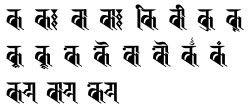
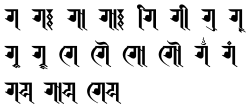
Letters with alternative forms (bha and ha) and letters that form ligatures together with the vowel u (ja and ra ). Also note that "u" changes shape when combined with "bha".

Some letters have alternative forms that are used when combined with certain vowel diacritics or included in a consonant cluster.[28]

  • Letter bha and ha changes appearance when combined with any of the vowel diacritics u, ū, ṛ, ṝ, ḷ and ḹ.
  • Letter ja and ra forms ligatures together with the vowels u and ū.
  • Vowels u changes appearance when combined with the letters ga, ta, bha and śa.

Compound letters

[edit]
Example of how the letters ka and ya are written together to form the letter kya. When ka is in the initial position and is followed by a letter with two bars, extend ka to the right so that it overlaps the following letter

Consonant clusters are written by writing several consonant letters together in complex ligatures. How they are written depends on the shape of the letters and some letters have alternative shapes that are used depending on their position in the cluster.[28]

Vowels

[edit]
Newar Rañjanā Dev. Rom.
अ a
आ ā
इ i
ई ī
उ u
ऊ ū
Newar Rañjanā Dev. Rom.
ऋ ṛ
ॠ ṝ
ए e
ऐ ai
ओ o
औ au
Newar Rañjanā Dev. Rom.
अय् ay
आय् āy
एय् ey

The vowel ṛ which in Sanskrit stands for syllable forming [ṛ] is used in Newar script to write the syllable ri.

In Newari, the vowels a and ā are pronounced with different vowel qualities. In order to write their long equivalents, some diacritics have been given partially different properties than what is otherwise usual in Brahmic scripts.

Letter Name Transcription Description
Newar Rañjanā Sanskrit Newari Dev. Rom.
visarga lyuphuti अः aḥ Usually used to indicate that a vowel is followed by an h-sound. In Newari it is used instead of marking a long vowel.
candrabindu milaphuti अँ am̐ Marks a nasal vowel.
anusvāra sinhaphuti अं aṃ In other words, it can be seen as a combination of visarga and chandrabindu.

Vowel diacritics

[edit]
Newar
[edit]

Some of the vowel diacritics have different appearances depending on whether the consonant has a top line or not. There are seven consonants without top lines: ga, ña, ṭha, ṇa, tha, dha and śa.[28]

a aḥ ā āḥ i ī u ū ṛ ṝ e ai o au am̐ aṃ
क
ka
ग
ga
Rañjanā
[edit]

The vowel diacritics can have up to three different appearances depending on which consonant they are combined with.[29] The rules for ka are also used for ja, kṣa and jña. The rules for ga also apply to kha, ña, ṭha, ṇa, tha, dha and sha. The rules for ba are used for other letters.

  • Rules for क ka
    Rules for क ka
  • Rules for ग ga
    Rules for ग ga
  • Rules for ब ba
    Rules for ब ba

Current use

[edit]

Newar script is available in Unicode as Newa script. It is the official script used to write Nepal Bhasa. Ranjana script has been proposed for encoding in Unicode.[30]

The letter heads of Kathmandu Metropolitan City,[31] Lalitpur Metropolitan City,[32] Bhaktapur Municipality,[33] Madhyapur Thimi Municipality[34] ascribes its names in Ranjana Script.

In India, the official script for Newar language is Newar script.[35]

Gallery

[edit]
  • Invitation card.
    Invitation card.
  • Thaunkanhe monthly.
    Thaunkanhe monthly.
  • Sandhya Times daily.
    Sandhya Times daily.
  • Copper inscription from 1952 AD.
    Copper inscription from 1952 AD.
  • Stone inscription from 1654 AD.
    Stone inscription from 1654 AD.
  • Embossed lettering from 1877 AD.
    Embossed lettering from 1877 AD.
  • Sanskrit Buddhist manuscript in Nepal script from 1869 AD.
    Sanskrit Buddhist manuscript in Nepal script from 1869 AD.
  • Table of Prachalit Nepal script.
    Table of Prachalit Nepal script.
  • An inscription from Bhaktapur in the Pracalit script dated February 1711 AD.
    An inscription from Bhaktapur in the Pracalit script dated February 1711 AD.

See also

[edit]
  • flagNepal portal
  • Nepal Bhasa literature
  • Nepal Bhasa renaissance

External links

[edit]
  • Nepal Lipi Prakash
  • Nepalese Alphabets – Nepal Lipi Samgraha
  • Nepal Lipi Varnamala
  • Sankshipta Nepal Lipi Parichaya
  • Table of Evolution of Nepali Scripts
  • Nepal Lipi Vikas
  • Nepal Lipi Vigyan Samanya Parichaya
  • Nepalma Prachalit Lipiko Parichaya

Notes

[edit]
  1. ^ It is also named Pro-Licchavi or Pre-Licchavi. The Purva Licchavi script is closely related to the Gupta script.[7] The Purva Licchavi Script – see Purva Licchavi.
  2. ^ It is also named Uttar-Licchavi, Post-Licchavi or Kuṭila (the regional variants of the Siddham script).[8][9] The Kuṭila script – see Category:Kutila script.

References

[edit]
  1. ^ Masica, Colin (1993). The Indo-Aryan languages. p. 143.
  2. ^ Tuladhar, Prem Shanti (2000). Nepal Bhasa Sahityaya Itihas: The History of Nepalbhasa Literature. Kathmandu: Nepal Bhasa Academy. ISBN 99933-56-00-X. Page 306.
  3. ^ Lienhard, Siegfried (1984). Songs of Nepal. Hawaii: Center for Asian and Pacific Studies, University of Hawaii, University of Hawaii Press. pp. 2, 14. ISBN 0-8248-0680-8. Retrieved 30 September 2013.
  4. ^ Nepal-German Manuscript Cataloguing Project
  5. ^ a b Shakyavansha, Hemraj (1993, eighth edition). Nepalese Alphabet. Kathmandu: Mandas Lumanti Prakashan.
  6. ^ a b "Roadmapping the scripts of Nepal" (PDF). 2009-09-28. Retrieved 9 October 2020. {{cite journal}}: Cite journal requires |journal= (help)
  7. ^ "Purva Licchavi – omniglot".
  8. ^ Rajan, Vinodh. "Commentsonnamingthe"Siddham"encoding" (PDF).
  9. ^ Pandey, Anshuman. "Proposal to Encode the Siddham Script in ISO/IEC 10646" (PDF). The encoding for Siddham is to serve as a unifying block for all regional variants of the script, such as 'Siddhamātṛkā' and 'Kuṭila'. The representative glyphs are based upon Japanese forms of Siddham characters on account of active usage of the script by Japanese Buddhist communities
  10. ^ Sakya, Hemaraj (2004) Svayambhū Mahācaitya: The self-arisen great Caitya of Nepal. Svayambhu Vikash Mandal. ISBN 99933-864-0-5, ISBN 978-99933-864-0-7. Page 607. Retrieved 29 March 2012.
  11. ^ Shrestha, Rebati Ramanananda (2001). Newah. Lalitpur: Sahityaya Mulukha. Page 86.
  12. ^ Institute of Scientific Research on Vedas
  13. ^ Bendall, Cecil (1883). Catalogue of the Buddhist Sanskrit Manuscripts in the University Library, Cambridge. Cambridge: At the University Press. p. 301. Retrieved 21 August 2012.{{cite book}}: CS1 maint: publisher location (link)
  14. ^ "Nepalese Inscriptions in the Rubin Collection". Retrieved 30 September 2013.
  15. ^ Vajracarya, Dhanavajra and Malla, Kamal P. (1985). The Gopalarajavamsavali. Franz Steiner Verlag Wiesbaden GmbH.
  16. ^ Tamot, Kashinath (2009). Sankhadharkrit Nepal Sambat. Nepal Mandala Research Guthi. ISBN 978-9937209441. Pages 68–69.
  17. ^ Rolamba. April–June 1983. {{cite news}}: Missing or empty |title= (help)
  18. ^ "Ranjana Alphabet". Lipi Thapu Guthi. 1995.
  19. ^ Tuladhar, Kamal Ratna (second edition 2011). Caravan to Lhasa: A Merchant of Kathmandu in Traditional Tibet. Kathmandu: Lijala and Tisa. ISBN 99946-58-91-3. Page 115.
  20. ^ Tuladhar, Prem Shanti (2000). Nepal Bhasa Sahityaya Itihas: The History of Nepalbhasa Literature. Kathmandu: Nepal Bhasa Academy. ISBN 99933-56-00-X. Page 14.
  21. ^ Brown, T. Louise (1996). The Challenge to Democracy in Nepal: A Political History. Routledge. ISBN 0-415-08576-4, ISBN 978-0-415-08576-2. Page 21.
  22. ^ Sada, Ivan (March 2006). "Interview: Hem Raj Shakya". ECS Nepal. Archived from the original on 26 January 2012. Retrieved 23 February 2012.
  23. ^ "Nepal Lipi Sangraha" (PDF). Gorkhapatra. 20 April 1953. Retrieved 7 May 2012.[permanent dead link] Page 3.
  24. ^ Tuladhar, Kamal Ratna (22 March 2009). "A man of letters". The Kathmandu Post. Archived from the original on 29 September 2011. Retrieved 23 February 2012.
  25. ^ Lienhard, Siegfried (1984). Songs of Nepal. Hawaii: Center for Asian and Pacific Studies, University of Hawaii, University of Hawaii Press. p. 2. ISBN 0-8248-0680-8. Retrieved 30 September 2013.
  26. ^ Shrestha, Bal Gopal (January 1999). "The Newars: The Indigenous Population of the Kathmandu Valley in the Modern State of Nepal)" (PDF). CNAS Journal. Retrieved 23 March 2012. Page 87.
  27. ^ Manandhar, Dev Dass (5 February 2012). "Proposal for Nepālalipi Script in the Universal Character Set for inclusion in the Unicode Standard" (PDF). Retrieved 15 September 2015.
  28. ^ a b c Pandey, Anshuman (29 February 2012). "Proposal to Encode the Newar Script in ISO/IEC 10646" (PDF). Retrieved 15 September 2015.
  29. ^ Everson, Michael (4 May 2009). "Preliminary proposal for encoding the Rañjana script in the SMP of the UCS" (PDF). Retrieved 15 September 2015.
  30. ^ Pandey, Anshuman (2023-01-05). "L2/23-028: Preliminary proposal to encode Ranjana in Unicode" (PDF).
  31. ^ "कोभिड-१९ विरुद्धको Verocell दोश्रो मात्राको खोप लगाउन आउने बारे सूचना !". Kathmandu Metropolitan City. Retrieved 30 October 2021.An example of a letter head in Kathmandu Metropolitan City
  32. ^ "प्रेस विज्ञप्ति". Lalitpur Metropolitan City. Retrieved 30 October 2021.An example of a letter head in Lalitpur Metropolitan City
  33. ^ "आधारभूत तह (कक्षा ८) उत्तीर्ण परीक्षा २०७७ को नतिजा प्रकाशनसम्बन्धी सूचना !". Bhaktapur Municipality. Retrieved 30 October 2021.An example of a letter head in Bhaktapur Municipality
  34. ^ "Notice for non-governmental social organizations". Madhyapur Thimi Municipality. Retrieved 30 October 2021.An example of a letter head in Madhyapur Thimi Municipality
  35. ^ "𑐳𑐶𑐎𑑂𑐎𑐶𑐩 𑐴𑐾𑐬𑐮𑑂𑐜" (PDF). Government of Sikkim. Retrieved 1 November 2021.
  • v
  • t
  • e
Topics of Newar people
Music
  • Gunla Bajan
  • Dhimay
  • Dhaa
  • Bhusyah
Cuisine
  • Ailaa
  • Momo
  • Baji
  • Chataamari
  • Chuchumari
  • Yomari
  • Choila
  • Jaa
  • Kachilaa
  • Lakhamari
  • Takha
  • Sanyaa
  • Sanyaakhunya
  • Thwon
Festival
  • Gunla
  • Sa Paru
  • Yenya
  • Mohani
  • Swanti
  • Pahan Charhe
  • Bhairab Naach
  • Samyak
  • Jana Baha Dyah Jatra
  • Bunga Dyah Jatra
Rituals
  • Ihi
  • Bahra ceremony
  • Jankwa
  • Jaa Nakigu
  • Iihipaa
  • Sagan
  • Mha Puja
Architecture
  • Stupa
  • Pagoda
  • Vihara
  • Chaitya
  • Newar window
Language
  • Literature
  • Nepal Bhasa renaissance
  • Nepal Bhasa movement
Deities
  • Swayambhunath
  • Pashupati
  • Lokeshwar
  • Lakhey
  • Majipa Lakhey
  • Ajima
  • Matrikas
  • Kumari
Castes
  • Newar caste system
  • Shrestha
  • Chitrakar
  • Maharjan
  • Ranjitkar
  • Tuladhar
  • Sthapit
  • Kansakar
Misc
  • Newa dance
  • Nepal Sambat
  • Kathmandu
  • Patan
  • Bhaktapur
Religion
  • Newar Hinduism
  • Newar Buddhism
  • Category
  • v
  • t
  • e
Types of writing systems
Overview
  • History of writing
  • Grapheme
Lists
  • Writing systems
    • undeciphered
    • inventors
    • constructed
  • Languages by writing system / by first written accounts
Types
Abjads
  • Numerals
  • Aramaic
    • Hatran
  • Arabic
    • Elifba
  • Egyptian hieroglyphs
  • Elymaic
  • Hebrew
    • Ashuri
    • Cursive
    • Rashi
    • Solitreo
  • Tifinagh
  • Mandaic
  • Manichaean
  • Nabataean
  • Ancient North Arabian
  • Pahlavi
    • Book
    • Inscriptional
    • Inscriptional Parthian
    • Psalter
  • Pegon
  • Phoenician
    • Paleo-Hebrew
  • Pitman shorthand
  • Proto-Sinaitic
  • Punic
  • Samaritan
  • South Arabian
    • Zabur
    • Musnad
  • Sogdian
  • Syriac
    • ʾEsṭrangēlā
    • Serṭā
    • Maḏnḥāyā
  • Teeline Shorthand
  • Ugaritic
Abugidas
Brahmic
Northern
  • Bengali–Assamese
  • Bhaiksuki
  • Brahmi script
  • Devanagari
  • Dogri
  • Gujarati
  • Gupta
  • Gurmukhi
  • Kaithi
  • Kalinga
  • Khema
  • Khojki
  • Khudabadi
  • Laṇḍā
  • Lepcha
  • Mahajani
  • Marchen
  • Meitei
  • Modi
  • Multani
  • Nagari
  • Nandinagari
  • Nepalese scripts
    • Bhujimol
    • Golmol
    • Himmol
    • Kummol
    • Kvemmol
    • Pachumol
    • Newar
    • Ranjana
    • Tamyig
    • Tirhuta
    • Limbu
    • Litumol
  • Odia
    • Karani
  • ʼPhags-pa
  • Sharada
  • Siddhaṃ
  • Soyombo
  • Sylheti Nagri
  • Takri
  • Tibetan
    • Uchen
    • Umê
  • Tocharian
  • Zanabazar square
Southern
  • Ahom
  • Balinese
  • Batak
  • Baybayin
  • Bhattiprolu
  • Buda
  • Buhid
  • Chakma
  • Cham
  • Fakkham
  • Grantha
  • Goykanadi
  • Hanunoo
  • Javanese
  • Kadamba
  • Kannada
  • Karen
  • Kawi
  • Khmer
    • Khom Thai
  • Kulitan
  • Lanna
  • Langdi
  • Lao
  • Leke
  • Lontara
    • Bilang-bilang
  • Makasar
  • Malayalam
  • Old Maldivian
    • Dhives Akuru
    • Eveyla Akuru
  • Mon–Burmese
  • Pallava
  • Pyu
  • Saurashtra
  • Shan
  • Sinhala
  • Sukhothai
  • Sundanese
    • Old Sundanese
  • Tagbanwa
  • Tai Le
  • New Tai Lue
  • Tai Noi
  • Tai Tham
  • Tai Viet
  • Lai Tay
  • Tamil
  • Tamil-Brahmi
  • Tanchangya
  • Telugu
  • Thai
  • Tigalari
  • Ulu scripts
    • Incung
    • Lampung
    • Lembak
    • Ogan
    • Pasemah
    • Rejang
    • Serawai
  • Vatteluttu
    • Kolezhuthu
    • Malayanma
Others
  • Bharati
  • Boyd's syllabic shorthand
  • Canadian syllabics
    • Blackfoot
    • Déné syllabics
  • Dham
  • Fox I
  • Geʽez
  • Gunjala Gondi
  • Japanese Braille
  • Sarati
  • Jenticha
  • Kharosthi
  • Mandombe
  • Masaram Gondi
  • Meroitic
  • Miao
  • Mwangwego
  • Pahawh Hmong
  • Sorang Sompeng
  • Tengwar
  • Thaana
  • Thomas Natural Shorthand
  • Warang Citi
  • Rma
Alphabets
Linear
  • Adlam
  • Ariyaka
  • Armenian
  • Avestan
    • Pazend
  • Avoiuli
  • Bassa Vah
  • Carian
  • Caucasian Albanian
  • Cirth
  • Coelbren
  • Coorgi–Cox alphabet
  • Coptic
  • Cyrillic
    • Serbian
    • Early
  • Deseret
  • Duployan shorthand
    • Chinook
  • Eclectic shorthand
  • Elbasan
  • Enochian
  • Etruscan
  • Formosan
  • Fox II
  • Fraser
  • Gabelsberger shorthand
  • Gadabuursi
  • Garay alphabet
  • Georgian
    • Asomtavruli
    • Nuskhuri
    • Mkhedruli
  • Veso Bey
  • Glagolitic
  • Gothic
  • Gregg shorthand
  • Greek (Archaic)
  • Greco-Iberian alphabet
  • Hangul
  • Hanifi
  • Hurûf-ı munfasıla
  • Sunuwar
  • Kaddare
  • Kayah Li
  • Klingon
  • Latin
    • Beneventan
    • Blackletter
    • Carolingian minuscule
    • Fraktur
    • Gaelic
    • Insular
    • IPA
    • Kurrent
    • Merovingian
    • Sigla
    • Sütterlin
    • Tironian notes
    • Visigothic
  • Luo
  • Lycian
  • Lydian
  • Manchu
  • Medefaidrin
  • Molodtsov
  • Mru
  • Mundari Bani
  • N'Ko
  • Ogham
  • Ol Chiki
  • Old Hungarian
  • Old Italic
  • Old Permic
  • Orkhon
  • Old Uyghur
    • Mongolian
      • Evenki
      • Galik alphabet
      • Manchu
      • Oirat
      • Vagindra
  • Ol Onal
  • Osage
  • Osmanya
  • Pau Cin Hau
  • Phrygian
  • Pisidian
  • Runic
    • Anglo-Saxon
    • Cipher
    • Dalecarlian
    • Elder Futhark
    • Younger Futhark
    • Gothic
    • Marcomannic
    • Medieval
    • Staveless
  • Shavian
  • Sidetic
  • Sorang Sompeng
  • Sunuwar
  • Tifinagh
  • Todhri
  • Tolong Siki
  • Vellara
  • Visible Speech
  • Vithkuqi
  • Wancho
  • Warang Citi
  • Yezidi
  • Zaghawa
Non-linear
  • Braille
  • Maritime flags
  • Telegraph code
  • New York Point
  • Flag semaphore
  • Moon type
Ideograms
  • Adinkra
  • Aztec
  • Blissymbols
  • Dongba
  • Ersu Shaba
  • Emoji
  • Isotype
  • Kaidā
  • Miꞌkmaw
  • Mixtec
  • New Epoch Notation Painting
  • Nsibidi
  • Anishinaabewibii'iganan
  • Olmec
  • Siglas poveiras
  • Testerian
  • Yerkish
  • Zapotec
Logograms
Chinese family of scripts
Chinese characters
  • Simplified
  • Traditional
  • Oracle bone script
  • Bronze scripts
  • Seal script
    • large
    • small
    • bird-worm
  • Hanja
  • Kanji
  • Chữ Nôm
  • Sawndip
  • Bowen
Chinese-influenced
  • Jurchen
  • Khitan large script
  • Sui
  • Tangut
Cuneiform
  • Akkadian
  • Assyrian
  • Elamite
  • Hittite
  • Luwian
  • Sumerian
Other logosyllabic
  • Anatolian
  • Bagam
  • Cretan
  • Isthmian
  • Maya
  • Proto-Elamite
  • Tenevil
  • Wiigwaasabak
  • Yi (Classical)
Logoconsonantal
  • Demotic
  • Hieratic
  • Hieroglyphs
Numerals
  • Hindu-Arabic
  • Abjad
  • Attic (Greek)
  • Muisca
  • Roman
Other
  • Sitelen Pona
Semi-syllabaries
Full
  • Linear Elamite
  • Celtiberian
  • Iberian
    • Northeastern
    • Southeastern
  • Khom
  • Dunging
Redundant
  • Espanca script
  • Pahawh Hmong
  • Khitan small script
  • Southwest Paleohispanic
  • Bopomofo
  • Quốc Âm Tân Tự
Sign languages
  • ASLwrite
  • SignWriting
  • si5s
  • Stokoe notation
Syllabaries
  • Afaka
  • Bamum
  • Bété
  • Byblos
  • Canadian Aboriginal
  • Cherokee
  • Cypriot
  • Cypro-Minoan
  • Ditema tsa Dinoko
  • Eskayan
  • Geba
  • Great Lakes Algonquian
  • Iban
  • Idu
  • Kana
    • Hiragana
    • Katakana
    • Man'yōgana
    • Hentaigana
    • Sōgana
    • Jindai moji
  • Kikakui
  • Kpelle
  • Linear B
  • Linear Elamite
  • Lisu
  • Loma
  • Nüshu
  • Nwagu Aneke script
  • Old Persian cuneiform
  • Sumerian
  • Vai
  • Woleai
  • Yi
  • Yugtun
  • v
  • t
  • e
Braille ⠃⠗⠁⠊⠇⠇⠑
Braille cell
  • 1829 braille
  • International uniformity
  • ASCII braille
  • Unicode braille patterns
Braille scripts
French-ordered
  • Albanian
  • Azerbaijani
  • Cantonese
  • Catalan
  • Chinese (mainland Mandarin) (largely reassigned)
  • Czech
  • Dutch
    • 6-dot
    • 8-dot
  • English (Unified English)
  • Esperanto
  • French
  • German
  • Ghanaian
  • Guarani
  • Hawaiian
  • Hungarian
  • Iñupiaq
  • IPA
  • Irish
  • Italian
  • Latvian
  • Lithuanian
  • Luxembourgish (extended to 8-dot)
  • Maltese
  • Māori
  • Navajo
  • Nigerian
  • Philippine
  • Polish
  • Portuguese
  • Romanian
  • Samoan
  • Slovak
  • South African
  • Spanish
  • Taiwanese Mandarin (largely reassigned)
  • Turkish
  • Vietnamese
  • Welsh
  • Yugoslav
  • Zambian
Nordic family
  • Estonian
  • Faroese
  • Icelandic
  • Scandinavian
    • Danish
    • Finnish
    • Greenlandic
    • Northern Sámi
    • Norwegian
    • Swedish
Russian lineage family
i.e. Cyrillic-mediated scripts
  • Belarusian
  • Bulgarian
  • Kazakh
  • Kyrgyz
  • Mongolian
  • Russian
  • Tatar
  • Ukrainian
Egyptian lineage family
i.e. Arabic-mediated scripts
  • Arabic
  • Persian
  • Urdu (Pakistan)
Indian lineage family
i.e. Bharati Braille
  • Devanagari (Hindi / Marathi / Nepali)
  • Bengali (Bangla / Assamese)
  • Gujarati
  • Kannada
  • Malayalam
  • Odia
  • Punjabi
  • Sinhala
  • Tamil
  • Telugu
  • Urdu (India)
Other scripts
  • Amharic
  • Armenian
  • Burmese
  • Dzongkha (Bhutanese)
  • Georgian
  • Greek
  • Hebrew
  • Inuktitut (reassigned vowels)
  • Khmer
  • Thai and Lao (Japanese vowels)
  • Tibetan
Reordered
  • Algerian Braille (obsolete)
Frequency-based
  • American Braille (obsolete)
Independent
  • Chinese semi-syllabaries
    • Cantonese
    • Mainland Chinese Mandarin
    • Taiwanese Mandarin
    • Two-cell Chinese (Shuangpin)
  • Japanese
  • Korean
Eight-dot
  • Dutch
  • Luxembourgish
  • Kanji
  • Gardner–Salinas braille codes (GS8)
Symbols in braille
  • Braille music
  • Canadian currency marks
  • Computer Braille Code
  • Gardner–Salinas braille codes (science; GS8/GS6)
  • International Phonetic Alphabet (IPA)
  • Nemeth braille code
Braille technology
  • Braille e-book
  • Braille embosser
  • Braille translator
  • Braille watch
  • Mountbatten Brailler
  • Optical braille recognition
  • Perforation
  • Perkins Brailler
  • Refreshable braille display
  • Slate and stylus
  • Braigo
People
  • Louis Braille
  • Charles Barbier
  • Róża Czacka
  • Valentin Haüy
  • Harris Mowbray
  • Thakur Vishva Narain Singh
  • Sabriye Tenberken
  • William Bell Wait
Organisations
  • Braille Institute of America
  • Braille Without Borders
  • Japan Braille Library
  • National Braille Association
  • Blindness organizations
  • Schools for the blind
  • American Printing House for the Blind
Other tactile alphabets
  • Decapoint
  • Moon type
  • New York Point
  • Night writing
  • Vibratese
Related topics
  • Accessible publishing
  • Braille literacy
  • RoboBraille
Retrieved from "https://teknopedia.ac.id/w/index.php?title=Nepalese_scripts&oldid=1341263252"
Categories:
  • Newar
  • Brahmic scripts
  • Writing systems of Newar language
  • Newar language
Hidden categories:
  • CS1 errors: missing periodical
  • CS1 maint: publisher location
  • CS1 errors: missing title
  • All articles with dead external links
  • Articles with dead external links from February 2018
  • Articles with permanently dead external links
  • Articles with short description
  • Short description is different from Wikidata
  • Pages with plain IPA
  • All accuracy disputes
  • Articles with disputed statements from May 2018

  • indonesia
  • Polski
  • العربية
  • Deutsch
  • English
  • Español
  • Français
  • Italiano
  • مصرى
  • Nederlands
  • 日本語
  • Português
  • Sinugboanong Binisaya
  • Svenska
  • Українська
  • Tiếng Việt
  • Winaray
  • 中文
  • Русский
Sunting pranala
url url url url url url url url url url url url url url url url url url url url url url url url url url url url url url url url url url url url url url url url url url url url url url url url url url url url url url url url url url url url url url url url url url url url url url url url url url url url url url url url url url url url url url url url url url url url url url url url url url url url url url url url url url url url url url url url url url url url url url url url url url url url url url url url url url url url url url url url url url url url url url url url url url url url url url url url url url url url url url url url url url url url url url url url url url url url url url url url url url url url url url url url url url url url url url url url url url url url url url url url url url url url url url url url url url url url url url url url url url url url url url url url url url url url url url url url url url url url url url url url url url url url url url url url url url url url url url url url url url url url url url url url url url url url url url url url url url url url url url url url url url url url url url url url url url url url url url url url url url url url url url url url url url url url url url url url url url url url url url url url url url url url url url url url url url url url url url url url url url url url url url url url url url url url url url url url url url url url url url url url url url url url url url url url url url url url url url url url url url url url url url url url url url url url url url url url url url url url url url url url url url url url url url url url url url url url url url url url url url url url url url url url url url url url url url url url url url url url url url url url url url url url url url url url url url url url url url url url url url url url url url url url url url url url url url url url url url url url url url url url url url url url url url url url url url url url url url url url url url url url url url url url url url url url url url url url url url url url url url url url url url url url url url url url url url url url url url url url url url url url url url url url url url url url url url url url url url url url url url url url url url url url url url url url url url url url url url url url url url url url url url url url url url url url url url url url url url url url url url url url url url url url url url url url url url url url url url url url url url url url url url url url url url url url url url url url url url url url url url url url url url url url url url url url url url url url url url url url url url url url url url url url url url url url url url url url url url url url url url url url url url url url url url url url url url url url url url url url url url url url url url url url url url url url url url url url url url url url url url url url url url url url url url url url url url url url url url url url url url url url url url url url url url url url url url url url url url url url url url url url url url url url url url url url url url url url url url url url url url url url url url url url url url url url url url url url url url url url url url url url url url url url url url url url url url url url url url url url url url url url url url url url url url url url url url url url url url url url url url url url url url url url url url url url url url url url url url url url url url url url url url url url url url url url url url url url url url url url url url url url url url url url url url url url url url url url url url url url url url url url url url url url url url url url url url url url url url url url url url url url url url url url url url url url url url url url url url url url url url url url url url url url url url url url url url url url url url url url url url url url url url url url url url url url url url url url url url url url url url url url url url url url url url url url url url url url url url url url url url url url url url url url url url url url url url url url url url url url url url url url url url url url url url url url url url url url url url url url url url url url url url url url url url url url url url url url url url url url url url url url url url url url url url url url url url url url url url url url url url url url url url url url url url url url url url url url url url url url url url url url url url url url url url url url url url url url url url url url url url url url url url url url url url url url url url url url url url url url url url url url url url url url url url url url url url url url url url url url url url url url url url url url url url url url url url url url url url url url url url url url url url url url url url url url url url url url url url url url url url url url url url url url url url url url url url url url url url url url url url url url url url url url url url url url url url url url url url url url url url url url url url url url url url url url url url url url url url url url url url url url url url url url url url url url url url url url url url url url url url url url url url url url url url url url url url url url url url url url url url url url url url url url url url url url url url url url url url url url url url url url url url url url url url url url url url url url url url url url url url url url url url url url url url url url url url url url url url url url url url url url url url url url url url url url url url url url url url url url url url url url url url url url url url url url url url url url url url url url url url url url url url url url url url url url url url url url url url url url url url url url url url url url url url url url url url url url url url url url url url url url url url url url url url url url url url url url url url url url url url url url url url url url url url url url url url url url url url url url url url url url url url url url url url url url url url url url url url url url url url url url url url url url url url url url url url url url url url url url url url url url url url url url url url url url url url url url url url url url url url url url url url url url url url url url url url url url url url url url url url url url url url url url url url url url url url url url url url url url url url url url url url url url url url url url url url url url url url url url url url url url url url url url url url url url url url url url url url url url url url url url url url url url url url url url url url url url url url url url url url url url url url url url url url url url url url url url url url url url url url url url url url url url url url url url url url url url url url url url url url url url url url url url url url url url url url url url url url url url url url url url url url url url url url url url url url url url url url url url url url url url url url url url url url url url url url url url url url url url url url url url url url url url url url url url url url url url url url url url url url url url url url url url url url url url url url url url url url url url url url url url url url url url url url url url url url url url url url url url url url url url url url url url url url url url url url url url url url url url url url url url url url url url url url url url url url url url url url url url url url url url url url url url url url url url url url url url url url url url url url url url url url url url url url url url url url url url url url url url url url url url url url url url url url url url url url url url url url url url url url url url url url url url url url url url url url url url url url url url url url url url url url url url url url url url url url url url url url url url url url url url url url url url url url url url url url url url url url url url url url url url url url url url url url url url url url url url url url url url url url url url url url url url url url url url url url url url url url url url url url url url url url url url url url url url url url url url url url url url url url url url url url url url url url url url url url url url url url url url url url url url url url url url url url url url url url url url url url url url url url url url url url url url url url url url url url url url url url url url url url url url url url url url url url url url url url url url url url url url url url url url url url url url url url url url url url url url url url url url url url url url url url url url url url url url url url url url url url url url url url url url url url url url url url url url url url url url url url url url url url url url url url url url url url url url url url url url url url url url url url url url url url url url url url url url url url url url url url url url url url url url url url url url url url url url url url url url url url url url url url url url url url url url url url url url url url url url url url url url url url url url url url url url url url url url url url url url url url url url url url url url url url url url url url url url url url url url url url url url url url url url url url url url url url url url url url url url url url url url url url url url url url url url url url url url url url url url url url url url url url url url url url url url url url url url url url url url url url url url url url url url url url url url url url url url url url url url url url url url url url url url url url url url url url url url url url url url url url url url url url url url url url url url url url url url url url url url url url url url url url url url url url url url url url url url url url url url url url url url url url url url url url url url
Pusat Layanan

UNIVERSITAS TEKNOKRAT INDONESIA | ASEAN's Best Private University
Jl. ZA. Pagar Alam No.9 -11, Labuhan Ratu, Kec. Kedaton, Kota Bandar Lampung, Lampung 35132
Phone: (0721) 702022
Email: pmb@teknokrat.ac.id