Epstein Files Full PDF

CLICK HERE
Technopedia Center
PMB University Brochure
Faculty of Engineering and Computer Science
S1 Informatics S1 Information Systems S1 Information Technology S1 Computer Engineering S1 Electrical Engineering S1 Civil Engineering

faculty of Economics and Business
S1 Management S1 Accountancy

Faculty of Letters and Educational Sciences
S1 English literature S1 English language education S1 Mathematics education S1 Sports Education
teknopedia

  • Registerasi
  • Brosur UTI
  • Kip Scholarship Information
  • Performance
Flag Counter
  1. World Encyclopedia
  2. Arity - Wikipedia
Arity - Wikipedia
From Wikipedia, the free encyclopedia
(Redirected from Arities)
Number of arguments required by a function
"Adicity" redirects here. Not to be confused with Acidity.

In logic, mathematics, and computer science, arity (/ˈærɪti/ ⓘ) is the number of arguments or operands taken by a function, operation or relation. In mathematics, arity may also be called rank,[1][2] but this word can have many other meanings. In logic and philosophy, arity may also be called adicity and degree.[3][4] In linguistics, it is usually named valency.[5]

Examples

[edit]

In general, functions or operators with a given arity follow the naming conventions of n-based numeral systems, such as binary and hexadecimal. A Latin prefix is combined with the -ary suffix. For example:

  • A nullary function takes no arguments.
    • Example: f ( ) = 2 {\displaystyle f()=2} {\displaystyle f()=2}
  • A unary function takes one argument.
    • Example: f ( x ) = 2 x {\displaystyle f(x)=2x} {\displaystyle f(x)=2x}
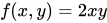
  • A binary function takes two arguments.
    • Example: f ( x , y ) = 2 x y {\displaystyle f(x,y)=2xy} {\displaystyle f(x,y)=2xy}
  • A ternary function takes three arguments.
    • Example: f ( x , y , z ) = 2 x y z {\displaystyle f(x,y,z)=2xyz} {\displaystyle f(x,y,z)=2xyz}
  • An n-ary function takes n arguments.
    • Example: f ( x 1 , x 2 , … , x n ) = 2 ∏ i = 1 n x i {\textstyle f(x_{1},x_{2},\ldots ,x_{n})=2\prod _{i=1}^{n}x_{i}} {\textstyle f(x_{1},x_{2},\ldots ,x_{n})=2\prod _{i=1}^{n}x_{i}}

Nullary

[edit]

A constant can be treated as the output of an operation of arity 0, called a nullary operation.

Also, outside of functional programming, a function without arguments can be meaningful and not necessarily constant (due to side effects). Such functions may have some hidden input, such as global variables or the whole state of the system (time, free memory, etc.).

Unary

[edit]

Examples of unary operators in mathematics and in programming include the unary minus and plus, the increment and decrement operators in C-style languages (not in logical languages), and the successor, factorial, reciprocal, floor, ceiling, fractional part, sign, absolute value, square root (the principal square root), complex conjugate (unary of "one" complex number, that however has two parts at a lower level of abstraction), and norm functions in mathematics. In programming the two's complement, address reference, and the logical NOT operators are examples of unary operators.

All functions in lambda calculus and in some functional programming languages (especially those descended from ML) are technically unary, but see n-ary below.

According to Quine, the Latin distributives being singuli, bini, terni, and so forth, the term "singulary" is the correct adjective, rather than "unary".[6] Abraham Robinson follows Quine's usage.[7]

In philosophy, the adjective monadic is sometimes used to describe a one-place relation such as 'is square-shaped' as opposed to a two-place relation such as 'is the sister of'.

Binary

[edit]

Most operators encountered in programming and mathematics are of the binary form. For both programming and mathematics, these include the multiplication operator, the radix operator, the often omitted exponentiation operator, the logarithm operator, the addition operator, and the division operator. Logical predicates such as OR, XOR, AND, IMP are typically used as binary operators with two distinct operands. In CISC architectures, it is common to have two source operands (and store result in one of them).

Ternary

[edit]

Most modern CPUs provide a ternary fused multiply–add (FMA) instruction for floating-point numbers, which multiplies two numbers and adds the result to a third number, only rounding once at the end. This avoids the inaccuracy resulting from rounding the multiplication and addition operations separately.

The computer programming language C and its various descendants (including C++, C#, Java, Julia, Perl, and others) provide the ternary conditional operator ?:. The first operand (the condition) is evaluated, and if it is true, the result of the entire expression is the value of the second operand, otherwise it is the value of the third operand. This operator has a lazy or 'shortcut' evaluation strategy that does not evaluate whichever of the second and third arguments is not used. Some functional programming languages, such as Agda, have such an evaluation strategy for all functions and consequently implement if...then...else as an ordinary function; several others, such as Haskell, can do this but for syntactic, performance or historical reasons choose to define keywords instead.

The Python language has a ternary conditional expression, x if C else y. In Elixir the equivalent would be if(C, do: x, else: y).

The Forth language also contains a ternary operator, */, which multiplies the first two (one-cell) numbers, dividing by the third, with the intermediate result being a double cell number. This is used when the intermediate result would overflow a single cell.

The Unix dc calculator has several ternary operators, such as |, which will pop three values from the stack and efficiently compute x y mod z {\textstyle x^{y}{\bmod {z}}} {\textstyle x^{y}{\bmod {z}}} with arbitrary precision.

Many (RISC) assembly language instructions are ternary (as opposed to only two operands specified in CISC); or higher, such as MOV %AX, (%BX, %CX), which will load (MOV) into register AX the contents of a calculated memory location that is the sum (parenthesis) of the registers BX and CX.

n-ary

[edit]

The arithmetic mean of n real numbers is an n-ary function: x ¯ = 1 n ( ∑ i = 1 n x i ) = x 1 + x 2 + ⋯ + x n n {\displaystyle {\bar {x}}={\frac {1}{n}}\left(\sum _{i=1}^{n}{x_{i}}\right)={\frac {x_{1}+x_{2}+\dots +x_{n}}{n}}} {\displaystyle {\bar {x}}={\frac {1}{n}}\left(\sum _{i=1}^{n}{x_{i}}\right)={\frac {x_{1}+x_{2}+\dots +x_{n}}{n}}}

Similarly, the geometric mean of n positive real numbers is an n-ary function: ( ∏ i = 1 n a i ) 1 n =   a 1 a 2 ⋯ a n n . {\displaystyle \left(\prod _{i=1}^{n}a_{i}\right)^{\frac {1}{n}}=\ {\sqrt[{n}]{a_{1}a_{2}\cdots a_{n}}}.} {\displaystyle \left(\prod _{i=1}^{n}a_{i}\right)^{\frac {1}{n}}=\ {\sqrt[{n}]{a_{1}a_{2}\cdots a_{n}}}.} Note that a logarithm of the geometric mean is the arithmetic mean of the logarithms of its n arguments

From a mathematical point of view, a function of n arguments can always be considered as a function of a single argument that is an element of some product space. However, it may be convenient for notation to consider n-ary functions, as for example multilinear maps (which are not linear maps on the product space, if n ≠ 1).

The same is true for programming languages, where functions taking several arguments could always be defined as functions taking a single argument of some composite type such as a tuple, or in languages with higher-order functions, by currying.

Varying arity

[edit]

In computer science, a function that accepts a variable number of arguments is called variadic. In logic and philosophy, predicates or relations accepting a variable number of arguments are called multigrade, anadic, or variably polyadic.[8]

Terminology

[edit]

Latinate names are commonly used for specific arities, primarily based on Latin distributive numbers meaning "in group of n", though some are based on Latin cardinal numbers or ordinal numbers. For example, 1-ary is based on cardinal unus, rather than from distributive singulī that would result in singulary.

n-ary Arity (Latin based) Adicity (Greek based) Example in mathematics Example in computer science
0-ary nullary (from nūllus) niladic a constant a function without arguments, True, False
1-ary unary monadic additive inverse logical NOT operator
2-ary binary dyadic addition logical OR, XOR, AND operators
3-ary ternary triadic triple product of vectors ternary conditional operator
4-ary quaternary tetradic
5-ary quinary pentadic
6-ary senary hexadic
7-ary septenary hebdomadic
8-ary octonary ogdoadic
9-ary novenary (alt. nonary) enneadic
10-ary denary (alt. decenary) decadic
more than 2-ary multary and multiary polyadic
varying variadic sum; e.g., Σ variadic function, reduce

n-ary means having n operands (or parameters), but is often used as a synonym of "polyadic".

These words are often used to describe anything related to that number (e.g., undenary chess is a chess variant with an 11×11 board, or the Millenary Petition of 1603).

The arity of a relation (or predicate) is the dimension of the domain in the corresponding Cartesian product. (A function of arity n thus has arity n+1 considered as a relation.)

In computer programming, there is often a syntactical distinction between operators and functions; syntactical operators usually have arity 1, 2, or 3 (the ternary operator ?: is also common). Functions vary widely in the number of arguments, though large numbers can become unwieldy. Some programming languages also offer support for variadic functions, i.e., functions syntactically accepting a variable number of arguments.

See also

[edit]
  • iconMathematics portal
  • Philosophy portal
  • Logic of relatives
  • Binary relation
  • Ternary relation
  • Theory of relations
  • Signature (logic)
  • Parameter
  • p-adic number
  • Cardinality
  • Valency (linguistics)
  • n-ary code
  • n-ary group
  • Function prototype – Declaration of a function's name and type signature but not body
  • Type signature – Defines the inputs and outputs for a function, subroutine or method
  • Univariate and multivariate
  • Finitary

References

[edit]
  1. ^ Hazewinkel, Michiel (2001). Encyclopaedia of Mathematics, Supplement III. Springer. p. 3. ISBN 978-1-4020-0198-7.
  2. ^ Schechter, Eric (1997). Handbook of Analysis and Its Foundations. Academic Press. p. 356. ISBN 978-0-12-622760-4.
  3. ^ Detlefsen, Michael; McCarty, David Charles; Bacon, John B. (1999). Logic from A to Z. Routledge. p. 7. ISBN 978-0-415-21375-2.
  4. ^ Cocchiarella, Nino B.; Freund, Max A. (2008). Modal Logic: An Introduction to its Syntax and Semantics. Oxford University Press. p. 121. ISBN 978-0-19-536658-7.
  5. ^ Crystal, David (2008). Dictionary of Linguistics and Phonetics (6th ed.). John Wiley & Sons. p. 507. ISBN 978-1-405-15296-9.
  6. ^ Quine, W. V. O. (1940), Mathematical logic, Cambridge, Massachusetts: Harvard University Press, p. 13
  7. ^ Robinson, Abraham (1966), Non-standard Analysis, Amsterdam: North-Holland, p. 19
  8. ^ Oliver, Alex (2004). "Multigrade Predicates". Mind. 113 (452): 609–681. doi:10.1093/mind/113.452.609.

External links

[edit]
Look up Appendix:English arities and adicities in Wiktionary, the free dictionary.

A monograph available free online:

  • Burris, Stanley N., and H.P. Sankappanavar, H. P., 1981. A Course in Universal Algebra. Springer-Verlag. ISBN 3-540-90578-2. Especially pp. 22–24.
  • v
  • t
  • e
Mathematical logic
General
  • Axiom
    • list
  • Cardinality
  • First-order logic
  • Formal proof
  • Formal semantics
  • Foundations of mathematics
  • Information theory
  • Lemma
  • Logical consequence
  • Model
  • Theorem
  • Theory
  • Type theory
Theorems
(list),
paradoxes
  • Gödel's completeness – incompleteness theorems
  • Tarski's undefinability
  • Banach–Tarski paradox
  • Cantor's theorem – paradox – diagonal argument
  • Compactness
  • Halting problem
  • Lindström's
  • Löwenheim–Skolem
  • Russell's paradox
Logics
Traditional
  • Classical logic
  • Logical truth
  • Tautology
  • Proposition
  • Inference
  • Logical equivalence
  • Consistency
    • Equiconsistency
  • Argument
  • Soundness
  • Validity
  • Syllogism
  • Square of opposition
  • Venn diagram
Propositional
  • Boolean algebra
  • Boolean functions
  • Logical connectives
  • Propositional calculus
  • Propositional formula
  • Truth tables
  • Many-valued logic
    • 3
    • finite
    • ∞
Predicate
  • First-order
    • list
  • Second-order
    • Monadic
  • Higher-order
  • Fixed-point
  • Free
  • Quantifiers
  • Predicate
  • Monadic predicate calculus
Set theory
  • Set
    • hereditary
  • Class
  • (Ur-)Element
  • Ordinal number
  • Extensionality
  • Forcing
  • Relation
    • equivalence
    • partition
  • Set operations:
    • intersection
    • union
    • complement
    • Cartesian product
    • power set
    • identities
Types
of sets
  • Countable
  • Uncountable
  • Empty
  • Inhabited
  • Singleton
  • Finite
  • Infinite
  • Transitive
  • Ultrafilter
  • Recursive
  • Fuzzy
  • Universal
  • Universe
    • constructible
    • Grothendieck
    • Von Neumann
Maps,
cardinality
  • Function/Map
    • domain
    • codomain
    • image
  • In/Sur/Bi-jection
  • Schröder–Bernstein theorem
  • Isomorphism
  • Gödel numbering
  • Enumeration
  • Large cardinal
    • inaccessible
  • Aleph number
  • Operation
    • binary
Theories
  • Zermelo–Fraenkel
    • axiom of choice
    • continuum hypothesis
  • General
  • Kripke–Platek
  • Morse–Kelley
  • Naive
  • New Foundations
  • Tarski–Grothendieck
  • Von Neumann–Bernays–Gödel
  • Ackermann
  • Constructive
Formal
systems

(list),
language,
syntax
  • Alphabet
  • Arity
  • Automata
  • Axiom schema
  • Expression
    • ground
  • Extension
    • by definition
    • conservative
  • Relation
  • Formation rule
  • Grammar
  • Formula
    • atomic
    • closed
    • ground
    • open
  • Free/bound variable
  • Language
  • Metalanguage
  • Logical connective
    • ¬
    • ∨
    • ∧
    • →
    • ↔
    • =
  • Predicate
    • functional
    • variable
    • propositional variable
  • Proof
  • Quantifier
    • ∃
    • !
    • ∀
    • rank
  • Sentence
    • atomic
    • spectrum
  • Signature
  • String
  • Substitution
  • Symbol
    • function
    • logical/constant
    • non-logical
    • variable
  • Term
  • Theory
    • list
Example
axiomatic
systems

(list)
  • of true arithmetic
    • Peano
    • second-order
    • elementary function
    • primitive recursive
    • Robinson
    • Skolem
  • of the real numbers
    • Tarski's axiomatization
  • of Boolean algebras
    • canonical
    • minimal axioms
  • of geometry
    • Euclidean
      • Elements
      • Hilbert's
      • Tarski's
    • non-Euclidean
  • Principia Mathematica
Proof theory
  • Formal proof
  • Natural deduction
  • Logical consequence
  • Rule of inference
  • Sequent calculus
  • Theorem
  • Systems
    • axiomatic
    • deductive
    • Hilbert
      • list
  • Complete theory
  • Independence (from ZFC)
  • Proof of impossibility
  • Ordinal analysis
  • Reverse mathematics
  • Self-verifying theories
Model theory
  • Interpretation
    • function
    • of models
  • Model
    • atomic
    • equivalence
    • finite
    • prime
    • saturated
    • spectrum
    • submodel
  • Non-standard model
    • of non-standard arithmetic
  • Diagram
    • elementary
  • Categorical theory
  • Model complete theory
  • Satisfiability
  • Semantics of logic
  • Strength
  • Theories of truth
    • semantic
    • Tarski's
    • Kripke's
  • T-schema
  • Transfer principle
  • Truth predicate
  • Truth value
  • Type
  • Ultraproduct
  • Validity
Computability
theory
  • Church encoding
  • Church–Turing thesis
  • Computably enumerable
  • Computable function
  • Computable set
  • Decision problem
    • decidable
    • undecidable
    • P
    • NP
    • P versus NP problem
  • Kolmogorov complexity
  • Lambda calculus
  • Primitive recursive function
  • Recursion
  • Recursive set
  • Turing machine
  • Type theory
Related
  • Abstract logic
  • Algebraic logic
  • Automated theorem proving
  • Category theory
  • Concrete/Abstract category
  • Category of sets
  • History of logic
  • History of mathematical logic
    • timeline
  • Logicism
  • Mathematical object
  • Philosophy of mathematics
  • Supertask
icon Mathematics portal
Retrieved from "https://teknopedia.ac.id/w/index.php?title=Arity&oldid=1337351999"
Categories:
  • Abstract algebra
  • Universal algebra
Hidden categories:
  • Pages using the Phonos extension
  • Articles with short description
  • Short description is different from Wikidata
  • Pages including recorded pronunciations

  • indonesia
  • Polski
  • العربية
  • Deutsch
  • English
  • Español
  • Français
  • Italiano
  • مصرى
  • Nederlands
  • 日本語
  • Português
  • Sinugboanong Binisaya
  • Svenska
  • Українська
  • Tiếng Việt
  • Winaray
  • 中文
  • Русский
Sunting pranala
url url url url url url url url url url url url url url url url url url url url url url url url url url url url url url url url url url url url url url url url url url url url url url url url url url url url url url url url url url url url url url url url url url url url url url url url url url url url url url url url url url url url url url url url url url url url url url url url url url url url url url url url url url url url url url url url url url url url url url url url url url url url url url url url url url url url url url url url url url url url url url url url url url url url url url url url url url url url url url url url url url url url url url url url url url url url url url url url url url url url url url url url url url url url url url url url url url url url url url url url url url url url url url url url url url url url url url url url url url url url url url url url url url url url url url url url url url url url url url url url url url url url url url url url url url url url url url url url url url url url url url url url url url url url url url url url url url url url url url url url url url url url url url url url url url url url url url url url url url url url url url url url url url url url url url url url url url url url url url url url url url url url url url url url url url url url url url url url url url url url url url url url url url url url url url url url url url url url url url url url url url url url url url url url url url url url url url url url url url url url url url url url url url url url url url url url url url url url url url url url url url url url url url url url url url url url url url url url url url url url url url url url url url url url url url url url url url url url url url url url url url url url url url url url url url url url url url url url url url url url url url url url url url url url url url url url url url url url url url url url url url url url url url url url url url url url url url url url url url url url url url url url url url url url url url url url url url url url url url url url url url url url url url url url url url url url url url url url url url url url url url url url url url url url url url url url url url url url url url url url url url url url url url url url url url url url url url url url url url url url url url url url url url url url url url url url url url url url url url url url url url url url url url url url url url url url url url url url url url url url url url url url url url url url url url url url url url url url url url url url url url url url url url url url url url url url url url url url url url url url url url url url url url url url url url url url url url url url url url url url url url url url url url url url url url url url url url url url url url url url url url url url url url url url url url url url url url url url url url url url url url url url url url url url url url url url url url url url url url url url url url url url url url url url url url url url url url url url url url url url url url url url url url url url url url url url url url url url url url url url url url url url url url url url url url url url url url url url url url url url url url url url url url url url url url url url url url url url url url url url url url url url url url url url url url url url url url url url url url url url url url url url url url url url url url url url url url url url url url url url url url url url url url url url url url url url url url url url url url url url url url url url url url url url url url url url url url url url url url url url url url url url url url url url url url url url url url url url url url url url url url url url url url url url url url url url url url url url url url url url url url url url url url url url url url url url url url url url url url url url url url url url url url url url url url url url url url url url url url url url url url url url url url url url url url url url url url url url url url url url url url url url url url url url url url url url url url url url url url url url url url url url url url url url url url url url url url url url url url url url url url url url url url url url url url url url url url url url url url url url url url url url url url url url url url url url url url url url url url url url url url url url url url url url url url url url url url url url url url url url url url url url url url url url url url url url url url url url url url url url url url url url url url url url url url url url url url url url url url url url url url url url url url url url url url url url url url url url url url url url url url url url url url url url url url url url url url url url url url url url url url url url url url url url url url url url url url url url url url url url url url url url url url url url url url url url url url url url url url url url url url url url url url url url url url url url url url url url url url url url url url url url url url url url url url url url url url url url url url url url url url url url url url url url url url url url url url url url url url url url url url url url url url url url url url url url url url url url url url url url url url url url url url url url url url url url url url url url url url url url url url url url url url url url url url url url url url url url url url url url url url url url url url url url url url url url url url url url url url url url url url url url url url url url url url url url url url url url url url url url url url url url url url url url url url url url url url url url url url url url url url url url url url url url url url url url url url url url url url url url url url url url url url url url url url url url url url url url url url url url url url url url url url url url url url url url url url url url url url url url url url url url url url url url url url url url url url url url url url url url url url url url url url url url url url url url url url url url url url url url url url url url url url url url url url url url url url url url url url url url url url url url url url url url url url url url url url url url url url url url url url url url url url url url url url url url url url url url url url url url url url url url url url url url url url url url url url url url url url url url url url url url url url url url url url url url url url url url url url url url url url url url url url url url url url url url url url url url url url url url url url url url url url url url url url url url url url url url url url url url url url url url url url url url url url url url url url url url url url url url url url url url url url url url url url url url url url url url url url url url url url url url url url url url url url url url url url url url url url url url url url url url url url url url url url url url url url url url url url url url url url url url url url url url url url url url url url url url url url url url url url url url url url url url url url url url url url url url url url url url url url url url url url url url url url url url url url url url url url url url url url url url url url url url url url url url url url url url url url url url url url url url url url url url url url url url url url url url url url url url url url url url url url url url url url url url url url url url url url url url url url url url url url url url url url url url url url url url url url url url url url url url url url url url url url url url url url url url url url url url url url url url url url url url url url url url url url url url url url url url url url url url url url url url url url url url url url url url url url url url url url url url url url url url url url url url url url url url url url url url url url url url url url url url url url url url url url url url url url url url url url url url url url url url url url url url url url url url url url url url url url url url url url url url url url url url url url url url url url url url url url url url url url url url url url url url url url url url url url url url url url url url url url url url url url url url url url url url url url url url url url url url url url url url url url url url url url url url url url url url url url url url url url url url url url url url url url url url url url url url url url url url url url url url url url url url url url url url url url url url url url url url url url url url url url url url url url url url url url url url url url url url url url url url url url url url url url url url url url url url url url url url url url url url url url url url url url url url url url url url url url url url url url url url url url url url url url url url url url url url url url url url url url url url url url url url url url url url url url url url url url url url url url url url url url url url url url url url url url url url url url url url url url url url url url url url url url url url url url url url url url url url url url url url url url url url url url url url url url url url url url url url url url url url url url url url url url url url url url url url url url url url url url url url url url url url url url url url url url url url url url url url url url url url url url url url url url url url url url url url url url url url url url url url url url url url url url url url url url url url url url url url url url url url url url url url url url url url url url url url url url url url url url url url url url url url url url url url url url url url url url url url url url url url url url url url url url url url url url url url url url url url url url url url url url url url url url url url url url url url url url url url
Pusat Layanan

UNIVERSITAS TEKNOKRAT INDONESIA | ASEAN's Best Private University
Jl. ZA. Pagar Alam No.9 -11, Labuhan Ratu, Kec. Kedaton, Kota Bandar Lampung, Lampung 35132
Phone: (0721) 702022
Email: pmb@teknokrat.ac.id