

| Bengali | |
|---|---|
| বাংলা (Bangla) | |
 The word "Bangla" in the Bengali-Assamese script (Bengali alphabet) | |
| Pronunciation | [ˈbaŋlaˑ] ⓘ |
| Native to | Bangladesh and India |
| Region |
|
| Ethnicity | Bengalis |
| Speakers | L1: 242 million (2011–2023)[1][2] L2: 43 million (2011–2023)[1] Total: 284 million (2011–2023)[1] |
Early forms | Magadhi Prakrit
|
| Dialects |
|
| Official status | |
Official language in |
|
| Regulated by |
|
| Language codes | |
| ISO 639-1 | bn |
| ISO 639-2 | ben |
| ISO 639-3 | ben |
| Glottolog | beng1280 |
| Linguasphere | 59-AAF-u |
 Geographical distribution of the Bengali language. Darker shades imply a greater percentage of native speakers. | |

| Part of a series on |
| Bengalis |
|---|
 |
Bengali,[a] also known by its endonym Bangla,[b] is a classical Indo-Aryan language belonging to the Indo-Iranian branch of the Indo-European language family. It is primarily spoken by the Bengali people, native to the Bengal region (Bangladesh, India's West Bengal, Tripura and parts of Southern Assam). With over 242 million native speakers and another 43 million as second language speakers as of 2025,[1] Bengali is the sixth most spoken native language and the seventh most spoken language by the total number of speakers in the world.[7][8]
Bengali is the official, national, and most widely spoken language of Bangladesh,[9][10][11] with 98% of Bangladeshis using Bengali as their first language.[12][13] It is the second-most widely spoken language in India. It is the official language of the Indian states of West Bengal, Tripura and the Barak Valley region of the state of Assam. It is also the second official language of the Indian state of Jharkhand since September 2011.[3] It is the most widely spoken language in the Andaman and Nicobar Islands in the Bay of Bengal,[14] and is spoken by significant populations in other states including Bihar, Arunachal Pradesh, Delhi, Chhattisgarh, Meghalaya, Mizoram, Nagaland, Odisha and Uttarakhand.[15] Bengali is also spoken by the Bengali diasporas (Bangladeshi diaspora and Indian Bengalis) across Europe, North America, the Middle East and other regions.[16]
Bengali was accorded the status of a classical language by the Government of India on 3 October 2024.[17][18] It is the second most spoken and fifth fastest growing language in India, following Hindi, Kashmiri, Gujarati, and Meitei (Manipuri), according to the 2011 census of India.[19]
Bengali has developed over more than 1,400 years. Bengali literature, with its millennium-old literary history, was extensively developed during the Bengali Renaissance and is one of the most prolific and diverse literary traditions in Asia. The Bengali language movement from 1948 to 1956 demanding that Bengali be an official language of Pakistan fostered Bengali nationalism in East Bengal leading to the emergence of Bangladesh in 1971. In 1999, UNESCO recognised 21 February as International Mother Language Day in recognition of the language movement.[20][21]

History
-
 Indo-Iranian languagesBengali
 -
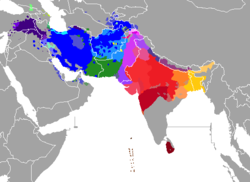
 The descent of proto-Gauda, the ancestor of the modern Bengali language, from the proto-Gauda-Kamarupa line of the proto-Magadhan (Magadhi Prakrit).[22]


Ancient
With the advent of the Indo-Aryans in the 3rd century BCE, Bengal was gradually being Sanskritised.[23] The varieties of Prakrit spoken in Bengal region were generally referred to as "eastern Magadhi Prakrit", as coined by linguist Suniti Kumar Chatterji,[24] as the Middle Indo-Aryan dialects were influential in the first millennium when Bengal was a part of the Greater Magadhan realm. Muhammad Shahidullah attempted to trace the origin of Bengali to Old Indo-Aryan through the Gaudi Prakrit; his findings were later supported by A. B. Keith and others.[25]
The local varieties had no official status during the Gupta Empire, and with Bengal increasingly becoming a hub of Sanskrit literature for Hindu priests and Buddhist Acharyas, the vernacular of Bengal gained much influence from Sanskrit.[26][23] Magadhi Prakrit was also spoken in modern-day Bihar and Assam, and this vernacular eventually evolved into Ardha Magadhi.[27][28] Ardha Magadhi began to give way to what is known as Apabhraṃśa, by the end of the first millennium. The Bengali language evolved as a distinct language over the course of time.[29]
Early
A Sanskrit-Chinese dictionary compiled by the Chinese poet Li-Yen in 782 AD shows the presence of Bengali. A research document Classical Bangla published in 2024 by the Kolkata-based institute "Institute of Language Studies and Research" (ILSR), mentions the presence of 51 Bengali words in the dictionary. The lexicon strongly supports the existence of Old Bengali in the 8th century or earlier.[30][31]
Though some archaeologists claim that some 10th-century texts were in Bengali, it is not certain whether they represent a differentiated language or whether they represent a stage when Eastern Indo-Aryan languages were differentiating.[32] The local Apabhraṃśa of the eastern subcontinent, Purbi Apabhraṃśa or Abahatta (lit. 'meaningless sounds'), eventually evolved into regional dialects, which in turn formed three groups, the Bengali–Assamese languages, the Bihari languages, and the Odia language.
The language was not static: different varieties coexisted and authors often wrote in multiple dialects in this period. For example, Ardhamagadhi is believed to have evolved into Abahatta around the 6th century, which competed with the ancestor of Bengali for some time.[33][better source needed] The ancestor of Bengali was the language of the Pala Empire and the Sena dynasty.[34][35]
Medieval


During the medieval period, Middle Bengali was characterised by the elision of the word-final অ ô and the spread of compound verbs, which originated from the Sanskrit schwa. Slowly, the word-final ô disappeared from many words influenced by the Arabic, Persian, and Turkic languages.[citation needed] The arrival of merchants and traders from the Middle East and Turkestan into the Buddhist-ruling Pala Empire, from as early as the 7th century, gave birth to Islamic influence in the region.[citation needed]
In the 13th century, subsequent Arab Muslim and Turco-Persian expeditions to Bengal heavily influenced the local vernacular by settling among the native population.[36][37] Bengali absorbed Arabic and Persian influences in its vocabulary and dialect, including the development of Dobhashi.[36]
Bengali acquired prominence, over Persian, in the court of the Sultans of Bengal with the ascent of Jalaluddin Muhammad Shah.[38] Subsequent Muslim rulers actively promoted the literary development of Bengali,[39] allowing it to become the most spoken vernacular language in the Sultanate.[40] Bengali adopted many words from Arabic and Persian, which was a manifestation of Islamic culture on the language. Major texts of Middle Bengali (1400–1800) include Yusuf-Zulekha by Shah Muhammad Sagir and Srikrishna Kirtana by the Chandidas poets. Court support for Bengali culture and language waned when the Mughal Empire conquered Bengal in the late 16th and early 17th century.[41]
Modern
The standard literary form of Modern Bengali was developed during the 19th and early 20th centuries based on the west-central dialect spoken in Shantipur region of the Nadia district. Modern Bengali shows a high degree of diglossia, with the literary and standard form differing greatly from the colloquial speech of the regions that identify with the language.[42] Modern Bengali vocabulary is based on words inherited from Magadhi Prakrit and Pali, along with tatsamas and reborrowings from Sanskrit and borrowings from Persian, Arabic, Austroasiatic languages and other languages with which it has historically been in contact.
In the 19th and 20th centuries, there were two standard forms of written Bengali:
- চলিতভাষা Chôlitôbhasha, a colloquial form of Bengali using simplified inflections.
- সাধুভাষা Sadhubhasha, a formal and genteel form of Bengali.[43][44]
In 1948, the government of Pakistan tried to impose Urdu as the sole state language in Pakistan, giving rise to the Bengali language movement.[45] This was a popular ethnolinguistic movement in the former East Bengal (today Bangladesh), which arose as a result of the strong linguistic consciousness of the Bengalis and their desire to promote and protect spoken and written Bengali's recognition as a state language of the then Dominion of Pakistan. On 21 February 1952, five students and political activists were killed during protests near the campus of the University of Dhaka; they were the first ever martyrs to die for their right to speak their mother tongue. In 1956, Bengali was made a state language of Pakistan.[45] 21 February has since been observed as Language Movement Day in Bangladesh and has also been commemorated as International Mother Language Day by UNESCO every year since 2000.
In 2010, the parliament of Bangladesh and the legislative assembly of West Bengal proposed that Bengali be made an official UN language.[46] As of January 2023, no further action has been yet taken on this matter. However, in 2022, the UN did adopt Bangla as an unofficial language, after a resolution tabled by India.[47]
In 2024, the government of India conferred Bengali with the status of classical language.[17][18]


Geographical distribution
- Bangladesh or Bangladeshi origin[48][49][50] (68.0%)
- India or Indian origin (32.0%)

Besides the native region it is also spoken by the Bengalis living in Tripura, southern Assam and the Bengali population in the Indian union territory of Andaman and Nicobar Islands. Bengali is also spoken in the neighbouring states of Odisha, Bihar, and Jharkhand, and sizeable minorities of Bengali speakers reside in Indian cities outside Bengal, including Delhi, Mumbai, Thane, Varanasi, and Vrindavan. There are also significant Bengali-speaking communities in the Middle East,[52][53][54] the United States,[55] Singapore,[56] Malaysia, Australia, Canada, the United Kingdom, and Italy.
Official status
The 3rd article of the Constitution of Bangladesh states Bengali to be the sole official language of Bangladesh.[11] The Bengali Language Implementation Act, 1987, made it mandatory to use Bengali in all records and correspondences, laws, proceedings of court and other legal actions in all courts, government or semi-government offices, and autonomous institutions in Bangladesh.[9] It is also the de facto national language of the country.
In India, Bengali is one of the 22 official languages.[57] It is the official language of the Indian states of West Bengal, Tripura and in Barak Valley of Assam.[58][59] Bengali has been a second official language of the Indian state of Jharkhand since September 2011.
In Pakistan, Bengali is a recognised secondary language in the city of Karachi[60][61][62] mainly spoken by stranded Bengalis of Pakistan. The Department of Bengali in the University of Karachi (established by East Pakistani politicians before Independence of Bangladesh) also offers regular programs of studies at the Bachelors and at the Masters levels for Bengali Literature.[63]
The national anthems of both Bangladesh (Amar Sonar Bangla) and India (Jana Gana Mana) were written in Bengali by the Bengali Nobel laureate Rabindranath Tagore.[64] Notuner Gaan known as "Chol Chol Chol" is Bangladesh's national march, written by The National Poet Kazi Nazrul Islam in Bengali in 1928. It was adopted as the national marching song by the Bangladeshi government in 1972. Additionally, the first two verses of Vande Mataram, a patriotic song written in Bengali by Bankim Chandra Chatterjee, was adopted as the "national song" of India in both the colonial period and later in 1950 in independent India. Furthermore, it is believed by many that the national anthem of Sri Lanka (Sri Lanka Matha) was inspired by a Bengali poem written by Rabindranath Tagore,[65][66][67][68] while some even believe the anthem was originally written in Bengali and then translated into Sinhala.[69][70][71][72]
In 2009, elected representatives in both Bangladesh and West Bengal called for Bengali to be made an official language of the United Nations.[73]
Dialects
Regional varieties in spoken Bengali constitute a dialect continuum. Linguist Suniti Kumar Chatterji grouped the dialects of Bengali language into four large clusters: Rarhi, Vangiya, Kamrupi and Varendri;[74][75] but many alternative grouping schemes have also been proposed.[76] The West-Central dialects (Rarhi or Nadia dialect) form the basis of modern standard colloquial Bengali. In the dialects prevalent in much of eastern and south-eastern Bangladesh (Barisal, Chittagong, Dhaka and Sylhet Divisions of Bangladesh), many of the stops and affricates heard in West Bengal and western Bangladesh are pronounced as fricatives. Western alveolo-palatal affricates চ [tʃɔ], ছ [tʃʰɔ~tʃɔ], জ [dʒɔ] correspond to eastern চ [tsɔ~sɔ], ছ [sɔ], জ [dzɔ~zɔ].
The potential influence of Tibeto-Burman languages on the phonology of Eastern Bengali is used to explain the lack of nasalised vowels and an alveolar articulation of what are categorised as the "cerebral" consonants (as opposed to the postalveolar articulation of western Bengal). Some varieties of Bengali, particularly Sylheti,[77] Chittagonian and Chakma, have contrastive tone; differences in the pitch of the speaker's voice can distinguish words. Kharia Thar and Mal Paharia are closely related to Western Bengali dialects, but are typically classified as separate languages. Similarly, Hajong is considered a separate language, although it shares similarities to Northern Bengali dialects.[78]
During the standardisation of Bengali in the 19th century and early 20th century, the cultural centre of Bengal was in Kolkata, a city founded by the British. What is accepted as the standard form today in both West Bengal and Bangladesh is based on the West-Central dialect of Nadia and Kushtia District.[79] There are cases where speakers of Standard Bengali in West Bengal will use a different word from a speaker of Standard Bengali in Bangladesh, even though both words are of native Bengali descent. For example, the word salt is লবণ lôbôṇ in the east which corresponds to নুন nun in the west.[80]

Bengali exhibits diglossia, though some scholars have proposed triglossia or even n-glossia or heteroglossia between the written and spoken forms of the language.[42] Two styles of writing have emerged, involving somewhat different vocabularies and syntax:[79][81]
- Sadhu bhasha (সাধু ভাষা "upright language") was the written language, with longer verb inflections and more of a Pali and Sanskrit-derived Tatsama vocabulary. Songs such as India's national anthem Jana Gana Mana (by Rabindranath Tagore) were composed in this style. Its use in modern writing however is uncommon, restricted to some official signs and documents as well as for achieving particular literary effects.
- Chôlito bhasha (চলিত ভাষা "running language"), known by linguists as Standard Colloquial Bengali, is a written Bengali style exhibiting a preponderance of colloquial idiom and shortened verb forms and is the standard for written Bengali now. This form came into vogue towards the turn of the 19th century, promoted by the writings of Peary Chand Mitra (Alaler Gharer Dulal, 1857),[82] Pramatha Chaudhuri (Sabujpatra, 1914) and in the later writings of Rabindranath Tagore. It is modelled on the dialect spoken in the Shantipur and Shilaidaha region in Nadia and Kushtia Districts respectively. This form of Bengali is often referred to as the "Kushtia standard"(Bangladesh), "Nadia standard" (West Bengal), "West-Central dialect", "Shantipuri Bangla" or "Shilaidahi Bangla".[76]
Linguist Prabhat Ranjan Sarkar categorises the language as:
- Madhya Rarhi dialect
- Kanthi (Contai) dialect
- Kolkata dialect
- Shantipuriya (Nadia) dialect
- Shershahabadia (Maldahiya/ Jangipuri) dialect
- Barendri dialect
- Rangapuriya dialect
- Sylheti dialect
- Dhakiya (Bikrampuri) dialect
- Jashore/Jessoriya dialect
- Barisal (Chandradwip) dialect
- Chattal (Chittagong) dialect
While most writing is in Standard Colloquial Bengali (SCB), spoken dialects exhibit a greater variety. People in southeastern West Bengal, including Kolkata, speak in SCB. Other dialects, with minor variations from Standard Colloquial, are used in other parts of West Bengal and western Bangladesh, such as the Midnapore dialect, characterised by some unique words and constructions. However, a majority in Bangladesh speaks dialects notably different from SCB. Some dialects, particularly those of the Chittagong region, bear only a superficial resemblance to SCB.[83] The dialect in the Chittagong region is least widely understood by the general body of Bengalis.[83] The majority of Bengalis are able to communicate in more than one variety – often, speakers are fluent in Cholitobhasha (SCB) and one or more regional dialects.[43]
Even in SCB, the vocabulary may differ according to the speaker's religion: Muslims are more likely to use words of Persian and Arabic origin, along with more words naturally derived from Sanskrit (tadbhava), whereas Hindus are more likely to use tatsama (words directly borrowed from Sanskrit).[84].
For example:[80]
| Predominantly Hindu Usage | Origin | Predominantly Muslim Usage | Origin | Translation |
|---|---|---|---|---|
| নমস্কার nômôskār | Directly borrowed from Sanskrit namaskāra | আসসালামু আলাইকুম āssālāmu ālāikum | Directly from Arabic as-salāmu ʿalaykum | hello |
| নিমন্ত্রণ nimôntrôṇ | Directly borrowed from Sanskrit nimantraṇa as opposed to the native Bengali nemôntônnô | দাওয়াত dāowāt | Borrowed from Arabic daʿwah via Persian | invitation |
| জল jôl | Directly borrowed from Sanskrit jala | পানি pāni | Native, compare with Sanskrit pānīya | water |
| স্নান snān | Directly borrowed from Sanskrit snāna | গোসল gosol | Borrowed from Arabic ghuṣl via Persian | bath |
| দিদি didi | Native, from Sanskrit devī | আপা āpā | From Turkic languages | sister / elder sister |
| দাদা dādā | Native, from Sanskrit dāyāda | ভাইয়া bhāiyā | Native, from Sanskrit bhrātā | brother / elder brother[85] |
| মাসি māsi | Native, from Sanskrit mātṛṣvasā | খালা khālā | Directly borrowed from Arabic khālah | maternal aunt |
| পিসি pisi | Native, from Sanskrit pitṛṣvasā | ফুফু phuphu | Native, from Prakrit phupphī | paternal aunt |
| কাকা kākā | From Persian or Dravidian kākā | চাচা chāchā | From Prakrit cācca | paternal uncle |
| দিদিমা didimā | From Sanskrit Devī and Mātā | নানী nānī | From Hindi नानी (Nani) | maternal grandmother |
| ঠাকুরমা ṭhākuramā | From Sanskrit Ṭhākura and Mātā | দাদী dādī | From Persian dādī | paternal grandmother |
| প্রার্থনা prārthonā | Directly borrowed from Sanskrit prārthanā | দোয়া doyā or নামাজ nāmāj | Borrowed from Arabic duʿāʾ | prayer |
| আশীর্বাদ āśīrbād | From Sanskrit Āśīrvāda | দোয়া doyā | From Arabic duʿāʾ | blessings |
| লঙ্কা lônkā | Native, named after Lanka | মরিচ morich | Directly borrowed from Sanskrit marica | chilli |
Phonology
The phonemic inventory of standard Bengali consists of 29 consonants and 7 vowels, as well as 7 nasalised vowels. The inventory is set out below in the International Phonetic Alphabet (upper grapheme in each box) and romanisation (lower grapheme).
| Non-nasalised | Nasalised | |||||
|---|---|---|---|---|---|---|
| Front | Central | Back | Front | Central | Back | |
| Close | ই~ঈ i i |
উ~ঊ u u |
ইঁ~ঈঁ ĩ ĩ |
উঁ~ঊঁ ũ ũ | ||
| Close-mid | এ e e |
ও o o |
এঁ ẽ ẽ |
ওঁ õ õ | ||
| Open-mid | অ্যা æ æ |
অ ɔ ô |
অ্যাঁ æ̃ æ̃ |
অঁ ɔ̃ ɔ̃ | ||
| Open | আ a a |
আঁ ã ã |
||||
| Labial | Dental | Retroflex | Palato- alveolar |
Velar | Glottal | |||
|---|---|---|---|---|---|---|---|---|
| Nasal | m | n | ŋ | |||||
| Plosive/ Affricate |
voiceless | unaspirated | p | t̪ | ʈ | tʃ | k | |
| aspirated | pʰ | t̪ʰ | ʈʰ | tʃʰ | kʰ | |||
| voiced | unaspirated | b | d̪ | ɖ | dʒ | ɡ | ||
| aspirated | bʱ | d̪ʱ | ɖʱ | dʒʱ | ɡʱ | |||
| Fricative | voiceless | (ɸ) | s | ʃ | (h) | |||
| voiced | (β) | (z) | ɦ | |||||
| Approximant | (w) | l | (j) | |||||
| Rhotic | unaspirated | r | ɽ | |||||
| aspirated | (ɽʱ) | |||||||
Bengali is known for its wide variety of diphthongs, combinations of vowels occurring within the same syllable.[86] Two of these, /oi̯/ and /ou̯/, are the only ones with representation in script, as ঐ and ঔ respectively. /e̯ i̯ o̯ u̯/ may all form the glide part of a diphthong. The total number of diphthongs is not established, with bounds at 17 and 31. An incomplete chart is given by Sarkar (1985) of the following:[87]
| e̯ | i̯ | o̯ | u̯ | |
|---|---|---|---|---|
| a | ae̯ | ai̯ | ao̯ | au̯ |
| æ | æe̯ | æo̯ | ||
| e | ei̯ | eu̯ | ||
| i | ii̯ | iu̯ | ||
| o | oe̯ | oi̯ | oo̯ | ou̯ |
| u | ui̯ |
Stress
In standard Bengali, stress is predominantly initial. Bengali words are virtually all trochaic; the primary stress falls on the initial syllable of the word, while secondary stress often falls on all odd-numbered syllables thereafter, giving strings such as in সহযোগিতা shô-hô-jo-gi-ta "cooperation", where the boldface represents primary and secondary stress.
Consonant clusters
Native Bengali words do not allow initial consonant clusters;[88] the maximum syllabic structure is CVC (i.e., one vowel flanked by a consonant on each side). Many speakers of Bengali restrict their phonology to this pattern, even when using Sanskrit or English borrowings, such as গেরাম geram (CV.CVC) for গ্রাম gram (CCVC) "village" or ইস্কুল iskul (VC.CVC) for স্কুল skul (CCVC) "school".
Writing system


The Bengali-Assamese script is an abugida, a script with letters for consonants, with diacritics for vowels, and in which an inherent vowel (অ ô) is assumed for consonants if no vowel is marked.[89] The Bengali alphabet is used throughout Bangladesh and eastern India (Assam, West Bengal, Tripura). The Bengali alphabet is believed to have evolved from a modified Brahmic script around 1000 CE (or 10th–11th century).[90] It is a cursive script with eleven graphemes or signs denoting nine vowels and two diphthongs, and thirty-nine graphemes representing consonants and other modifiers.[90] There are no distinct upper and lower case letter forms. The letters run from left to right and spaces are used to separate orthographic words. Bengali script has a distinctive horizontal line running along the tops of the graphemes that links them together called মাত্রা matra.[91]
Since the Bengali script is an abugida, its consonant graphemes usually do not represent phonetic segments, but carry an "inherent" vowel and thus are syllabic in nature. The inherent vowel is usually a back vowel, either [ɔ] as in মত [mɔt] "opinion" or [o], as in মন [mon] "mind", with variants like the more open [ɒ]. To emphatically represent a consonant sound without any inherent vowel attached to it, a special diacritic, called the hôsôntô (্), may be added below the basic consonant grapheme (as in ম্ [m]). This diacritic, however, is not common and is chiefly employed as a guide to pronunciation. The abugida nature of Bengali consonant graphemes is not consistent, however. Often, syllable-final consonant graphemes, though not marked by a hôsôntô, may carry no inherent vowel sound (as in the final ন in মন [mon] or the medial ম in গামলা [ɡamla]).
A consonant sound followed by some vowel sound other than the inherent [ɔ] is orthographically realised by using a variety of vowel allographs above, below, before, after, or around the consonant sign, thus forming the ubiquitous consonant-vowel typographic ligatures. These allographs, called কার kar, are diacritical vowel forms and cannot stand on their own. For example, the graph মি [mi] represents the consonant [m] followed by the vowel [i], where [i] is represented as the diacritical allograph ি (called ই-কার i-kar) and is placed before the default consonant sign. Similarly, the graphs মা [ma], মী [mi], মু [mu], মূ [mu], মৃ [mri], মে [me~mɛ], মৈ [moj], মো [mo] and মৌ [mow] represent the same consonant ম combined with seven other vowels and two diphthongs. In these consonant-vowel ligatures, the so-called "inherent" vowel [ɔ] is first expunged from the consonant before adding the vowel, but this intermediate expulsion of the inherent vowel is not indicated in any visual manner on the basic consonant sign ম [mɔ].
The vowel graphemes in Bengali can take two forms: the independent form found in the basic inventory of the script and the dependent, abridged, allograph form (as discussed above). To represent a vowel in isolation from any preceding or following consonant, the independent form of the vowel is used. For example, in মই [moj] "ladder" and in ইলিশ [iliʃ] "Hilsa fish", the independent form of the vowel ই is used (cf. the dependent formি). A vowel at the beginning of a word is always realised using its independent form.
In addition to the inherent-vowel-suppressing hôsôntô, three more diacritics are commonly used in Bengali. These are the superposed chôndrôbindu (ঁ), denoting a suprasegmental for nasalisation of vowels (as in চাঁদ [tʃãd] "moon"), the postposed ônusbar (ং) indicating the velar nasal [ŋ] (as in বাংলা [baŋla] "Bengali") and the postposed bisôrgô (ঃ) indicating the voiceless glottal fricative [h] (as in উঃ! [uh] "ouch!") or the gemination of the following consonant (as in দুঃখ [dukʰːɔ] "sorrow"). Like other Indic scripts, the Bengali script has Schwa deletion and does not always mark when the inherent vowel is deleted — typically at the end of words.
The Bengali consonant clusters (যুক্তব্যঞ্জন juktôbênjôn) are usually realised as ligatures, where the consonant which comes first is put on top of or to the left of the one that immediately follows. In these ligatures, the shapes of the constituent consonant signs are often contracted and sometimes even distorted beyond recognition. As in, ক্ষ (ক+ষ) or হ্ম (হ+ম) In the Bengali writing system, there are nearly 285 such ligatures denoting consonant clusters. Although there exist a few visual formulas to construct some of these ligatures, many of them have to be learned by rote. Recently, in a bid to lessen this burden on young learners, efforts have been made by educational institutions in the two main Bengali-speaking regions (West Bengal and Bangladesh) to address the opaque nature of many consonant clusters, and as a result, modern Bengali textbooks are beginning to contain more and more "transparent" graphical forms of consonant clusters, in which the constituent consonants of a cluster are readily apparent from the graphical form. However, since this change is not as widespread and is not being followed as uniformly in the rest of the Bengali printed literature, today's Bengali-learning children will possibly have to learn to recognise both the new "transparent" and the old "opaque" forms, which ultimately amounts to an increase in learning burden.
Bengali punctuation marks, apart from the downstroke । daṛi – the Bengali equivalent of a full stop – have been adopted from Western scripts and their usage is similar.[92]
Unlike in Western scripts (Latin, Cyrillic, etc.) where the letter forms stand on an invisible baseline, the Bengali letter-forms instead hang from a visible horizontal left-to-right headstroke called মাত্রা matra. The presence and absence of this matra can be important. For example, the letter ত tô and the numeral ৩ "3" are distinguishable only by the presence or absence of the matra, as is the case between the consonant cluster ত্র trô and the independent vowel এ e, also the letter হ hô and Bengali Ôbogroho ঽ (~ô) and letter ও o and consonant cluster ত্ত ttô. The letter-forms also employ the concepts of letter-width and letter-height (the vertical space between the visible matra and an invisible baseline).
There is yet to be a uniform standard collating sequence (sorting order of graphemes to be used in dictionaries, indices, computer sorting programs, etc.) of Bengali graphemes. Experts in both Bangladesh and India are currently working towards a common solution for this problem.
Alternative and historic scripts

Throughout history, there have been instances of the Bengali language being written in different scripts, though these employments were never popular on a large scale and were communally limited. Owing to Bengal's geographic location, Bengali areas bordering non-Bengali regions have been influenced by each other. Small numbers of people in Midnapore, which borders Odisha, have used the Odia script to write in Bengali. In the border areas between West Bengal and Bihar, some Bengali communities historically wrote Bengali in Devanagari, Kaithi and Tirhuta.[93]
In Sylhet and Bankura, modified versions of the Kaithi script had some historical prominence, mainly among Muslim communities. The variant in Sylhet was identical to the Baitali Kaithi script of Hindustani with the exception of Sylhet Nagri possessing matra.[94] Sylhet Nagri was standardised for printing in c. 1869.[10]
Up until the 19th century, numerous variations of the Arabic script had been used across Bengal from Chittagong in the east to Meherpur in the west.[95][96][97] The 14th-century court scholar of Bengal, Nur Qutb Alam, composed Bengali poetry using the Persian alphabet.[98][99] After the Partition of India in the 20th century, the Pakistani government attempted to institute the Perso-Arabic script as the standard for Bengali in East Pakistan; this was met with resistance and contributed to the Bengali language movement.[100]
In the 16th century, Portuguese missionaries began a tradition of using the Roman alphabet to transcribe the Bengali language. Though the Portuguese standard did not receive much growth, a few Roman Bengali works relating to Christianity and Bengali grammar were printed as far as Lisbon in 1743. The Portuguese were followed by the English and French respectively, whose works were mostly related to Bengali grammar and transliteration. The first version of the Aesop's Fables in Bengali was printed using Roman letters based on English phonology by the Scottish linguist John Gilchrist. Consecutive attempts to establish a Roman Bengali have continued across every century since these times, and have been supported by the likes of Suniti Kumar Chatterji, Muhammad Qudrat-i-Khuda, and Muhammad Enamul Haq.[101] The Digital Revolution has also played a part in the adoption of the English alphabet to write Bengali,[102] with certain social media influencers publishing entire novels in Roman Bengali.[103]
Orthographic depth
 |
The Bengali script in general has a comparatively shallow orthography when compared to the Latin script used for English and French, i.e., in many cases there is a one-to-one correspondence between the sounds (phonemes) and the letters (graphemes) of Bengali. But grapheme-phoneme inconsistencies do occur in many cases. In fact, Bengali-Assamese script has the deepest orthography (deep orthography) among the Indian scripts. In general, the Bengali-Assamese script is fairly transparent for grapheme-to-phoneme conversion, i.e., it is easier to predict the pronunciation from spelling of the words, though there are many cases where pronunciation is different from what is written. But the script is fairly opaque for phoneme-to-grapheme conversion, i.e., it is often quite difficult to predict the spelling from the pronunciation of the words. In general, the script is fairly transparent for "tadbhav" words (native Bengali words). But it is quite opaque for "tatsam" words (words derived from Sanskrit), for both, phoneme-to-grapheme as well as grapheme-to-phoneme conversions.
One kind of inconsistency is due to the presence of several letters in the script for the same sound. In spite of some modifications in the 19th century, the Bengali spelling system continues to be based on the one used for Sanskrit,[92] and thus does not take into account some sound mergers that have occurred in the spoken language. For example, there are three letters (শ, ষ, and স) for the voiceless postalveolar fricative [ʃ], although the letter স retains the voiceless alveolar sibilant [s] sound when used in certain consonant conjuncts as in স্খলন [skʰɔlon] "fall", স্পন্দন [spɔndon] "beat", etc. The letter ষ also, sometimes, retains the voiceless retroflex sibilant [ʂ] sound when used in certain consonant conjuncts as in কষ্ট [kɔʂʈo] "suffering", গোষ্ঠী [ɡoʂʈʰi] "clan", etc. Similarly, there are two letters (জ and য) for the voiced postalveolar affricate [dʒ]. Moreover, what was once pronounced and written as a retroflex nasal ণ [ɳ] is now pronounced as an alveolar [n] when in conversation (the difference is heard when reading) (unless conjoined with another retroflex consonant such as ট, ঠ, ড and ঢ), although the spelling does not reflect this change. The near-open front unrounded vowel [æ] is orthographically realised by multiple means, as seen in the following examples: এত [æto] "so much", এ্যাকাডেমী [ækaɖemi] "academy", অ্যামিবা [æmiba] "amoeba", দেখা [dækʰa] "to see", ব্যস্ত [bæsto] "busy", ব্যাকরণ [bækorɔn] "grammar".
Another kind of inconsistency is concerned with the incomplete coverage of phonological information in the script. The inherent vowel attached to every consonant can be either [ɔ] or [o] depending on vowel harmony (স্বরসঙ্গতি) with the preceding or following vowel or on the context, but this phonological information is not captured by the script, creating ambiguity for the reader. Furthermore, the inherent vowel is often not pronounced at the end of a syllable, as in কম [kɔm] "less", but this omission is not generally reflected in the script, making it difficult for the new reader.
Many consonant clusters have different sounds than their constituent consonants. For example, the combination of the consonants ক্ [k] and ষ [ʂ] is graphically realised as ক্ষ and is pronounced [kkʰo] (as in রুক্ষ [rukkʰo] "coarse"), [kʰɔ] (as in ক্ষমতা [kʰɔmota] "capability") or even [kʰo] (as in ক্ষতি [kʰoti] "harm"), depending on the position of the cluster in a word. Another example is that there are around 7 or more graphemes to represent the sound [ʃ]. These are 'শ' as in শব্দ (śabda, pronounced as śôbdo "word"), 'ষ' as in ষড়যন্ত্র (ṣaṛayantra, pronounced as śoṛōjontrō "conspiracy"), 'স' as in সরকার (sarakāra, pronounced as śorkar "government"), 'শ্ব' as in শ্বশুর (written as śbaśura but pronounced with the ব b silent, i.e., as śōśur "father-in-law"), 'শ্ম' as in শ্মশান (written as śmaśāna but pronounced with the ম 'm' silent, i.e., as śośan "crematorium"), 'স্ব' as in স্বপ্ন (written as "sbapna" but pronounced with the ব 'b' silent, i.e., as śopnō "dream"), 'স্ম' as in স্মরণ (written as smaraṇa but pronounced with the ম 'm' silent, i.e., as śorōn "remembrance"), 'ষ্ম' as in গ্রীষ্ম (written as grīṣma but pronounced with the ম 'm' silent, i.e., as griśśō "summer") and so on. In most of the consonant clusters, only the first consonant is pronounced and rest of the consonants are silent. Examples are লক্ষ্মণ (written as lakṣmaṇa but pronounced as lokkhōn "Lakshman"), বিশ্বাস (written as biśbāsa but pronounced as biśśaś "belief"), বাধ্য (written as bādhya but pronounced as baddhō "obliged") and স্বাস্থ্য (written as sbāsthya but pronounced as śasthō "health"). Some consonant clusters have completely different pronunciation as compared to the constituent consonants. For example, 'হ্য' as in ঐতিহ্য (meaning "heritage") where hy is pronounced as jjh (written as aitihya but pronounced as ōitijjhō). The same হ্য is pronounced as 'hæ' as in হ্যাঁ (meaning "yes") (written as hyām̐ but pronounced as nasalised "hæ").
Another example of inconsistency in the script is that of words like, অন্য (written as anya but pronounced as ōnnō "other, different") and অন্ন (written as anna but pronounced as onnō "cooked rice, food"); in these words, the letter অ is combining with two different consonant clusters ন্য (nya) and ন্ন (nna), and while the same letter অ has two different pronunciations, ō and o, the two different consonant clusters have the same pronunciation. Thus, same letters and graphemes can often have different pronunciations depending on their position in a word and different graphemes and letters often have the same pronunciation.
The main reason for these numerous inconsistencies is that there have been lots of sound mergers in Bengali, but the script has failed to account for the sound shifts and consonant mergers in the language. Bengali has lots of tatsam words (words directly derived from Sanskrit) and in all these words, the original spelling has been preserved but the pronunciations have changed due to consonant mergers and sound shifts. In fact, most of the tatsam words have many grapheme-to-phoneme inconsistencies while most of the tadbhav words (native Bengali words) have fairly consistent grapheme-to-phoneme correspondence. Another reason is that Vidyasagar's reformations in the 19th century flooded the Bengali language with lots of Sanskrit words. By the 19th century, the Bengali phonology had diverged a lot from Sanskrit phonology and had lost many of the consonant clusters used in Sanskrit. So when these Sanskrit words re-entered the Bengali vocabulary as tatsam words, their pronunciations were modified, but their spellings were retained. That is why most of the tatsam words are pronounced way different from what they are written or spelt. Almost all the cases of silent letters existing in Bengali are found in the tatsam words. The Bengali writing system, therefore, is often not a true guide for pronunciation.
Uses
The script used for Bengali, Assamese, and other languages is known as Bengali script. The script is known as the Bengali alphabet for Bengali and its dialects and the Assamese alphabet for Assamese language with some minor variations. Other related languages in the nearby region also make use of the Bengali script like the Meitei language in the Indian state of Manipur, where the Meitei language has been written in the Bengali script for centuries, though the Meitei script has been promoted in recent times.
Number system
Bengali digits are as follows:
| 0 | 1 | 2 | 3 | 4 | 5 | 6 | 7 | 8 | 9 |
|---|---|---|---|---|---|---|---|---|---|
| ০ | ১ | ২ | ৩ | ৪ | ৫ | ৬ | ৭ | ৮ | ৯ |
Some 19th-century grammars note additional signs for fractions, quarters and sixteenths in particular.[104][105]
Romanisation
There are various romanisation systems used for Bengali created in recent years, most of which have failed to represent the true Bengali phonetic sound. The Bengali alphabet has often been included with the group of Brahmic scripts for romanisation where the true phonetic value of Bengali is never represented. Some of them are the International Alphabet of Sanskrit Transliteration, or IAST system (based on diacritics);[106] "Indian languages Transliteration", or ITRANS (uses upper case letters suited for ASCII keyboards);[107] and the National Library at Kolkata romanisation.[108]
In the context of Bengali romanisation, it is important to distinguish transliteration from transcription. Transliteration is orthographically accurate (i.e. the original spelling can be recovered), whereas transcription is phonetically accurate (the pronunciation can be reproduced). As the spelling often doesn't reflect the actual pronunciation, transliteration and transcription are often different.
Although it might be desirable to use a transliteration scheme where the original Bengali orthography is recoverable from the Latin text, Bengali words are currently romanised on Wikipedia using a phonemic transcription, where the true phonetic pronunciation of Bengali is represented with no reference to how it is written.
The most recent attempt has been by publishers Mitra and Ghosh with the launch of three popular children's books, Abol Tabol, Hasi Khusi and Sahoj Path, in Roman script at the Kolkata Book Fair 2018. Published under the imprint of Benglish Books, these are based on phonetic transliteration and closely follow spellings used in social media but for using an underline to describe soft consonants.
Grammar
Bengali nouns are not assigned gender, which leads to minimal changing of adjectives (inflection). However, nouns and pronouns are moderately declined (altered depending on their function in a sentence) into four cases while verbs are heavily conjugated, and the verbs do not change form depending on the number of the noun. Romani grammar is also closer to Bengali grammar than to that of western Indo-Aryan languages.[109]
Word order
As a head-final language, Bengali follows a subject–object–verb word order, although variations on this theme are common.[110] Bengali makes use of postpositions, as opposed to the prepositions used in English and most European languages. Determiners follow the noun, while numerals, adjectives, and possessors precede the noun.[111]
Yes–no questions do not require any change to the basic word order; instead, the low (L) tone of the final syllable in the utterance is replaced with a falling (HL) tone. Additionally, optional particles (e.g. কি -ki, না -na, etc.) are often encliticised onto the first or last word of a yes–no question.
Wh-questions are formed by fronting the wh-word to focus position, which is typically the first or second word in the utterance.
Nouns
Nouns and pronouns are inflected for case, including nominative, objective, genitive (possessive), and locative.[29] The case marking pattern for each noun being inflected depends on the noun's degree of animacy. When a definite article such as -টা -ṭa (singular) or -গুলো -gulo (plural) is added, as in the tables below, nouns are also inflected for number.
In most of Bengali grammar books, cases are divided into 6 categories and an additional possessive case (the possessive form is not recognised as a type of case by Bengali grammarians). But in terms of usage, cases are generally grouped into only 4 categories.
| Animate | Inanimate | |||
|---|---|---|---|---|
| Singular | Plural | Singular | Plural | |
| Nominative | ছাত্রটি chatrô-ṭi the student |
ছাত্ররা chatrô-ra /
ছাত্রগণ
the students |
জুতোটা juto-ṭa the shoe |
জুতাগুলা juta-gula / / জুতোগুলো juto-gulo the shoes |
| Objective | ছাত্রটিকে/রে chatrô-ṭi-ke/re the student |
ছাত্রদের(কে) chatrô-der(ke) the students |
জুতোটা juto-ṭa the shoe |
জুতাগুলা juta-gula / / জুতোগুলো juto-gulo the shoes |
| Genitive | ছাত্রটির chatrô-ṭi-r the student's |
ছাত্রদের chatrô-der the students' |
জুতোটার juto-ṭa-r the shoe's |
জুতাগুলা juta-gula / / জুতোগুলোর juto-gulo-r the shoes' |
| Locative | – | – | জুতোটায় juto-ṭa-y on/in the shoe |
জুতাগুলা juta-gula / / জুতোগুলোতে juto-gulo-te on/in the shoes |
When counted, nouns take one of a small set of measure words. Nouns in Bengali cannot be counted by adding the numeral directly adjacent to the noun. An appropriate measure word (MW), a classifier, must be used between the numeral and the noun (most languages of the Mainland Southeast Asia linguistic area are similar in this respect). Most nouns take the generic measure word -টা -ṭa, though other measure words indicate semantic classes (e.g. -জন -jôn for humans). There is also the classifier -khana, and its diminutive form -khani, which attaches only to nouns denoting something flat, long, square, or thin. These are the least common of the classifiers.[112]
নয়টা Nôy-ṭa nine-MW গরু goru cow Nine cows |
কয়টা Kôy-ṭa how many-MW বালিশ balish pillow How many pillows |
অনেকজন Ônek-jôn many-MW লোক lok person Many people |
চার-পাঁচজন Ĉar-pãc-jôn four-five-MW শিক্ষক shikkhôk teacher Four to five teachers |
Measuring nouns in Bengali without their corresponding measure words (e.g. আট বিড়াল aṭ biṛal instead of আটটা বিড়াল aṭ-ṭa biṛal "eight cats") would typically be considered ungrammatical. However, when the semantic class of the noun is understood from the measure word, the noun is often omitted and only the measure word is used, e.g. শুধু একজন থাকবে। Shudhu êk-jôn thakbe. (lit. 'Only one-'MW will remain.") would be understood to mean "Only one person will remain.", given the semantic class implicit in -জন -jôn.
In this sense, all nouns in Bengali, unlike most other Indo-European languages, are similar to mass nouns.
Verbs
There are two classes of verbs: finite and non-finite. Non-finite verbs have no inflection for tense or person, while finite verbs are fully inflected for person (first, second, third), tense (present, past, future), aspect (simple, perfect, progressive), and honour (intimate, familiar, and formal), but not for number. Conditional, imperative, and other special inflections for mood can replace the tense and aspect suffixes. The number of inflections on many verb roots can total more than 200.
Inflectional suffixes in the morphology of Bengali vary from region to region, along with minor differences in syntax.
Bengali differs from most Indo-Aryan Languages in the zero copula, where the copula or connective be is often missing in the present tense.[92] Thus, "he is a teacher" is তিনি শিক্ষক se shikkhôk, (literally "he teacher").[113] In this respect, Bengali is similar to Russian and Hungarian.
Vocabulary
- Tadbhavas in Bengali (Inherited Indo-Aryan vocabulary) (16.0%)
- Tatsamas in Bengali (Direct borrowings from Sanskrit) (40.0%)
- Native Words (Indigenous, "Desi" words) (16.0%)
- Foreign Loanwords (words originating from Persian, Turkish, Arabic, English, Portuguese, etc.) (28.0%)
Bengali is typically thought to have around 100,000 separate words, of which 16,000 (16%) are considered to be তদ্ভব tôdbhôbô, or Tadbhava (inherited Indo-Aryan vocabulary), 40,000 (40%) are তৎসম tôtśômô or Tatsama (words directly borrowed from Sanskrit), and borrowings from দেশী deśi, or "indigenous" words, which are at around 16,000 (16%) of the Bengali vocabulary. The rest are বিদেশী bideśi or "foreign" sources, including Persian, Turkish, Arabic, and English among others, accounting for around 28,000 (28%) of all Bengali words, highlighting the significant influence that foreign languages and cultures have had on the Bengali language throughout Bengal's long history of contact with different peoples and the cultural exchanges that came with such interactions.[114] Bengali is reportedly similar to Assamese and has a lexical similarity of 40 per cent with Nepali.[115]
According to Suniti Kumar Chatterji, dictionaries from the early 20th century attributed a little more than 50% of the Bengali vocabulary to native words (i.e., naturally modified Sanskrit words, corrupted forms of Sanskrit words, and loanwords non-Indo-European languages). About 45% per cent of Bengali words are unmodified Sanskrit, and the remaining words are from foreign languages.[116] However, more modern sources cite that this is not the case with Bengali vocabulary, as there are far more dominant foreign influences that accurately reflect the way modern Bengalis speak and utilise Bengali.[117] Persian is also thought to have influenced many grammatical forms.[118] More recent studies suggest that the use of foreign words has been increasing, mainly because of the preference of Bengali speakers for the colloquial style.[116] Because of centuries of contact with Europeans, Turkic peoples, and Persians, Bengali has absorbed numerous words from foreign languages, often totally integrating these borrowings into the core vocabulary.
Persian influence was significant for the development of Bengali up to the modern day, and was the primary official language in the region for 600 years, until British rule, when it was changed to English in 1836. In fact, there was so much Persian influence that a register of highly Persianized Bengali, known as Dobhashi appeared in medieval Bengal.[119]
The most common borrowings from foreign languages come from three types of contact. After close contact with several indigenous Austroasiatic languages,[120][121][122][123] and later the Delhi Sultanate, the Bengal Sultanate, and the Mughal Empire, whose court language was Persian, numerous Arabic, Persian, and Chaghatai words were absorbed into the lexicon.[45]
Later, East Asian travellers and lately European colonialism brought words from Portuguese, French, Dutch, and most significantly English during the colonial period.[citation needed]
Sample text
The following is a sample text in Bengali of Article 1 of the Universal Declaration of Human Rights: [124]
সমস্ত
Sômôstô
ʃɔmosto
All
মানুষ
manush
manuʃ
human
স্বাধীনভাবে
shadhinbhabe
ʃadʱinbʱabe
free-manner-in
সমান
sôman
ʃoman
equal
মর্যাদা
môrjada
mɔɾdʒada
dignity
এবং
ebông
eboŋ
and
অধিকার
ôdhikar
odʱikaɾ
right
নিয়ে
niye
nie̯e
taken
জন্মগ্রহণ
jônmôgrôhôn
dʒɔnmoɡrohon
birth-take
করে।
kôre.
kɔɾe
do.
তাঁদের
Tãder
tãdeɾ
Their
বিবেক
bibek
bibek
reason
এবং
ebông
eboŋ
and
বুদ্ধি
buddhi
budʱːi
intelligence
আছে;
achhe;
atʃʰe
exist;
সুতরাং
sutôrang
ʃutoraŋ
therefore
সকলেরই
sôkôleri
ʃɔkoleɾi
everyone-indeed
একে
êke
ɛke
one
অপরের
ôpôrer
ɔporeɾ
another's
প্রতি
prôti
proti
towards
ভ্রাতৃত্বসুলভ
bhratrittôsulôbh
bʱratritːoʃulɔbʱ
brotherhood-ly
মনোভাব
mônobhab
monobʱab
attitude
নিয়ে
niye
nie̯e
taken
আচরণ
achôrôn
atʃorɔn
conduct
করা
kôra
kɔra
do
উচিত।
uchit.
utʃit
should.
All human beings are born free and equal in dignity and rights. They possess conscience and reason. Therefore, everyone should act in a spirit of brotherhood towards each other.
See also
- Bangla Academy (Bangladesh)
- Bangla Academy (West Bengal)
- Bengali numerals
- Bengali-language newspapers
Notes
- ^ /bɛnˈɡɔːli/ ben-GAW-lee[4][5][6]
- ^ /ˈbɑːŋlə/; বাংলা Baṅla [ˈbaŋlaˑ] ⓘ
- ^ The number of Bangladeshis worldwide exceeds 190 million. Nearly 15 million Bangladeshis live outside Bangladesh and are not included during national census counts.[51] Considering the total number of Bengalis to be around 270–280 million, Bangladeshis constitute approximately 67–70% of the global Bengali population.
- ^ a b c d e Bengali at Ethnologue (28th ed., 2025)

- ^ "Scheduled Languages in descending order of speaker's strength – 2011" (PDF). Registrar General and Census Commissioner of India. Archived (PDF) from the original on 14 November 2018. Retrieved 28 June 2018.
- ^ a b "Jharkhand gives second language status to Magahi, Angika, Bhojpuri, and Maithili". The Avenue Mail. 21 March 2018. Archived from the original on 28 March 2019. Retrieved 30 April 2019.
- ^ "Bengali". Dictionary.com. Retrieved 7 February 2024.
An Indic language spoken in India and Bangladesh.
- ^ "Bengal". The Chambers Dictionary (9th ed.). Chambers. 2003. ISBN 0-550-10105-5.
- ^ Laurie Bauer, 2007, The Linguistics Student's Handbook, Edinburgh
- ^ "The World Factbook". Central Intelligence Agency. Archived from the original on 26 January 2021. Retrieved 21 February 2018.
- ^ "Summary by language size". Ethnologue. 2019. Archived from the original on 24 April 2019. Retrieved 21 February 2019.
- ^ a b "Bangla Bhasha Procholon Ain, 1987" বাংলা ভাষা প্রচলন আইন, ১৯৮৭ [Bengali Language Implementation Act, 1987] (PDF). Bangladesh Code বাংলাদেশ কোড (in Bengali). Vol. 27 (Online ed.). Dhaka: Ministry of Law, Justice and Parliamentary Affairs, Bangladesh. Archived from the original (PDF) on 5 July 2016. Retrieved 23 May 2019.
- ^ a b "Bangla Language". Banglapedia. Archived from the original on 6 July 2015. Retrieved 12 September 2018.
- ^ a b "The Constitution of the People's Republic of Bangladesh". Laws of Bangladesh. Ministry of Law, Justice and Parliamentary Affairs. Archived from the original on 10 November 2019. Retrieved 23 May 2019.
- ^ "National Languages Of Bangladesh". einfon. 11 June 2017. Archived from the original on 2 August 2017. Retrieved 12 September 2018.
- ^ "5 Surprising Reasons the Bengali Language Is Important". VIA. 17 August 2017. Archived from the original on 26 June 2018. Retrieved 10 March 2018.
- ^ "50th Report of the Commissioner for Linguistic Minorities in India (July 2012 to June 2013)" (PDF). National Commission for Linguistic Minorities. 16 July 2014. Archived from the original (PDF) on 2 January 2018. Retrieved 20 February 2018.
- ^ "50th Report of the Commissioner for Linguistic Minorities in India" (PDF). nclm.nic.in. Ministry of Minority Affairs. Archived from the original (PDF) on 8 July 2016. Retrieved 23 May 2019.
- ^ "Bengali Language". www.britannica.com. Archived from the original on 26 June 2018. Retrieved 12 September 2018.
- ^ a b Kumar, Vivek; Roy, Suryagni (3 October 2024). "Marathi, Pali, Prakrit, Assamese, Bengali now among classical languages". India Today. Retrieved 3 October 2024.
- ^ a b "Classical language status: Union Cabinet approves addition of Marathi, Assamese, Bengali, Pali, Prakrit to list". The Hindu. PTI. 3 October 2024. ISSN 0971-751X. Retrieved 3 October 2024.
- ^ —R, Aishwaryaa (6 June 2019). "What census data reveals about use of Indian languages". Deccan Herald. Archived from the original on 16 November 2023. Retrieved 16 November 2023.
—Pallapothu, Sravan (28 June 2018). "Hindi Added 100Mn Speakers In A Decade; Kashmiri 2nd Fast Growing Language". Indiaspend.com. Archived from the original on 16 November 2023. Retrieved 16 November 2023.
—IndiaSpend (2 July 2018). "Hindi fastest growing language in India, finds 100 million new speakers". Business Standard. Archived from the original on 16 November 2023. Retrieved 16 November 2023.
—Mishra, Mayank; Aggarwal, Piyush (11 April 2022). "Hindi grew rapidly in non-Hindi states even without official mandate". India Today. Archived from the original on 16 November 2023. Retrieved 16 November 2023. - ^ "Amendment to the Draft Programme and Budget for 2000–2001 (30 C/5)" (PDF). General Conference, 30th Session, Draft Resolution. UNESCO. 1999. Archived (PDF) from the original on 21 May 2011. Retrieved 27 May 2008.
- ^ "Resolution adopted by the 30th Session of UNESCO's General Conference (1999)". International Mother Language Day. UNESCO. Archived from the original on 1 June 2008. Retrieved 27 May 2008.
- ^ (Toulmin 2009:220)
- ^ a b Datta, Amaresh (1988). Encyclopaedia of Indian Literature: Devraj to Jyoti. Sahitya Akademi. p. 1694. ISBN 978-81-260-1194-0. Archived from the original on 2 November 2023. Retrieved 29 October 2023.
- ^ Tuteja, K. L.; Chakraborty, Kaustav (15 March 2017). Tagore and Nationalism. Springer. p. 59. ISBN 978-81-322-3696-2. Archived from the original on 2 November 2023. Retrieved 29 October 2023.
- ^ Emeneau, Murray B.; Fergusson, Charles A. (21 November 2016). Linguistics in South Asia. Walter de Gruyter GmbH & Co KG. p. 680. ISBN 978-3-11-081950-2.
In 'Magadhi Prakrit and Bengali' (1925) he attempted to trace the origin of Bengali to Old Indo-Aryan through the Gaudi Prakrit. In this study Shahidullah disagreed with Grierson, Hoernle, Chatterji, and other authorities. Shahidullah's findings were later supported by A. B. Keith and others.
- ^ Shariful Islam (2012). "Bangla Script". In Sirajul Islam; Miah, Sajahan; Khanam, Mahfuza; Ahmed, Sabbir (eds.). Banglapedia: the National Encyclopedia of Bangladesh (Online ed.). Dhaka, Bangladesh: Banglapedia Trust, Asiatic Society of Bangladesh. ISBN 984-32-0576-6. OCLC 52727562. OL 30677644M. Retrieved 5 March 2026.
- ^ Shah 1998, p. 11
- ^ Keith 1998, p. 187
- ^ a b (Bhattacharya 2000)
- ^ Mitra, Atri (8 October 2024). "Behind Bengali's classical language tag, a Kolkata institute's 2,000-page research document". The Indian Express. Kolkata. Retrieved 24 February 2025.
And the West Bengal government-run organisation that prepared the document, the Institute of Language Studies and Research (ILSR), is delighted its more than a year-long efforts have paid off...."…a Chinese-Sanskrit Dictionary compiled by Li-Yen bears testimony to the fact that at least 51 Bangla words made their way into that dictionary…The Chinese-Sanskrit dictionary, compiled in the 8th Century CE, included or rather was compelled to include words of a third language, i.e., Bangla. This is indicative of the fact that Bangla had already been standardized and was one of the influential tongues which was regarded as the lingua franca of the geographic area that was known as Bengal,"....
- ^ Das, Amitava; Sanyal, Rajat; Chakraborty, Rajib, eds. (2025). Classical Bangla. Kolkata: Institute of Language Studies and Research (ILSR), Kolkata. pp. 332―337. ISBN 9788198479358.
The Chinese-Sanskrit dictionary, compiled in the 8th Century CE, included or rather was compelled to include words of a third language, i.e., Bangla. This is indicative of the fact that Bangla had already been standardized and was one of the influential tongues which was regarded as the lingua franca of the geographic area that was known as Bengal. This illustrates with absolute certainty that Bangla must have been the language of communication for several centuries before the time of composition of Carya songs. By the time Carya songs were composed, Bangla had already acquired prosodic as well as rhetoric sophistication to be considered as a medium of literary discourse.
- ^ "Within the Eastern Indic language family the history of the separation of Bangla from Odia, Assamese, and the languages of Bihar remains to be worked out carefully. Scholars do not yet agree on criteria for deciding if certain tenth century AD texts were in a Bangla already distinguishable from the other languages, or marked a stage at which Eastern Indic had not finished differentiating." (Dasgupta 2003:386–387)
- ^ "Banglapedia". Banglapedia. Archived from the original on 15 May 2020. Retrieved 7 November 2017.
- ^ "Pala dynasty – Indian dynasty". Global.britannica.com. Archived from the original on 5 March 2017. Retrieved 7 November 2017.
- ^ nimmi. "Pala Dynasty, Pala Empire, Pala empire in India, Pala School of Sculptures". Indianmirror.com. Archived from the original on 28 October 2017. Retrieved 7 November 2017.
- ^ a b Bari, Sarah Anjum (12 April 2019). "A Tale of Two Languages: How the Persian language seeped into Bengali". The Daily Star. Retrieved 5 March 2024.
- ^ Majumder, Atindra. Arabic, Persian and Turkish words in Bengali Literature.
- ^ "What is more significant, a contemporary Chinese traveler reported that although Persian was understood by some in the court, the language in universal use there was Bengali. This points to the waning, although certainly not yet the disappearance, of the sort of foreign mentality that the Muslim ruling class in Bengal had exhibited since its arrival over two centuries earlier. It also points to the survival, and now the triumph, of local Bengali culture at the highest level of official society." (Eaton 1993:60)
- ^ Rabbani, AKM Golam (7 November 2017). "Politics and Literary Activities in the Bengali Language during the Independent Sultanate of Bengal". Dhaka University Journal of Linguistics. 1 (1): 151–166. Archived from the original on 11 October 2017. Retrieved 7 November 2017 – via www.banglajol.info.
- ^ Eaton 1993.
- ^ (Eaton 1993:167–174)
- ^ a b "Bengali Language at Cornell". Department of Asian Studies. Cornell University. Archived from the original on 15 November 2012.
- ^ a b Ray, S Kumar. "The Bengali Language and Translation". Translation Articles. Kwintessential. Archived from the original on 25 September 2006. Retrieved 19 November 2006.
- ^ "Bengali language | History, Writing System & Dialects | Britannica". www.britannica.com. 3 March 2024. Retrieved 7 March 2024.
- ^ a b c Thompson, Hanne-Ruth (2012). Bengali (Paperback with corrections. ed.). Amsterdam: John Benjamins Pub. Co. p. 3. ISBN 978-90-272-3819-1.
- ^ "Bengali 'should be UN language'". BBC News. 22 December 2009. Archived from the original on 8 November 2017. Retrieved 7 November 2017.
- ^ "UN adopts Bangla as unofficial language". Dhaka Tribune. 12 June 2022. Archived from the original on 20 January 2023. Retrieved 20 January 2023.
- ^ "UNData app". data.un.org. Retrieved 5 January 2026.
- ^ "World Bank Open Data". World Bank Open Data. Retrieved 5 January 2026.
- ^ Gigauri, Giorgi (26 March 2021). "Migrants' contribution to the 50-year journey of Bangladesh". The Daily Star. Retrieved 5 January 2026.
- ^ "Migrants' contribution to the 50-year journey of Bangladesh | The Daily Star". www.thedailystar.net. Retrieved 28 February 2026.
- ^ "Kuwait restricts recruitment of male Bangladeshi workers". Dhaka Tribune. 7 September 2016. Archived from the original on 30 August 2017. Retrieved 4 December 2017.
- ^ "Bahrain: Foreign population by country of citizenship, sex and migration status (worker/ family dependent) (selected countries, January 2015) – GLMM". GLMM. 20 October 2015. Archived from the original on 16 December 2017. Retrieved 4 December 2017.
- ^ "Saudi Arabia". Ethnologue. Archived from the original on 23 November 2017. Retrieved 4 December 2017.
- ^ "New York State Voter Registration Form" (PDF). Archived (PDF) from the original on 27 January 2018. Retrieved 10 February 2018.
- ^ "Bangla Language and Literary Society, Singapore". Archived from the original on 5 May 2013.
- ^ "Languages of India". Ethnologue Report. Archived from the original on 26 December 2009. Retrieved 4 November 2006.
- ^ "Language". Government of Assam. Archived from the original on 26 August 2006. Retrieved 20 June 2006.
- ^ Bhattacharjee, Kishalay (30 April 2008). "It's Indian language vs Indian language". NDTV.com. Archived from the original on 23 July 2013. Retrieved 27 May 2008.
- ^ Syed Yasir Kazmi (16 October 2009). "Pakistani Bengalis". DEMOTIX. Archived from the original on 2 January 2015. Retrieved 2 April 2013.
- ^ "کراچی کے 'بنگالی پاکستانی'(Urdu)". محمد عثمان جامعی. 17 November 2003. Archived from the original on 19 November 2003. Retrieved 2 April 2013.
- ^ Rafiqul Islam. "The Language Movement : An Outline". Archived from the original on 19 November 2012. Retrieved 12 May 2016.
- ^ "Karachi Department of Bengali". Archived from the original on 10 May 2013. Retrieved 2 April 2013.
- ^ "Statement by Foreign Minister on Second Bangladesh-India Track II dialogue at BRAC Centre on 07 August, 2005". Ministry of Foreign Affairs, Government of Bangladesh. Archived from the original on 18 April 2008. Retrieved 27 May 2008.
- ^ "Sri Lanka". The World Factbook. Archived from the original on 17 December 2021. Retrieved 20 September 2017.
- ^ "Man of the series: Nobel laureate Tagore". The Times of India. Times News Network. 3 April 2011. Archived from the original on 12 June 2018. Retrieved 20 June 2019.
- ^ "Sri Lanka I-Day to have anthem in Tamil". The Hindu. 4 February 2016. Archived from the original on 4 February 2016. Retrieved 20 September 2017.
- ^ "Tagore's influence on Lankan culture". Hindustan Times. 12 May 2010. Archived from the original on 11 October 2017. Retrieved 20 September 2017.
- ^ Wickramasinghe, Nira (2003). Dressing the Colonised Body: Politics, Clothing, and Identity in Sri Lanka. Orient Longman. p. 26. ISBN 978-81-250-2479-8. Archived from the original on 29 September 2018. Retrieved 29 September 2018.
- ^ Wickramasinghe, Kamanthi; Perera, Yoshitha. "Sri Lankan National Anthem: can it be used to narrow the gap?". The Daily Mirror (Sri Lanka). No. 30 March 2015. Archived from the original on 11 October 2017. Retrieved 20 September 2017.
- ^ Haque, Junaidul (7 May 2011). "Rabindranath: He belonged to the world". The Daily Star (Bangladesh). Archived from the original on 4 March 2016. Retrieved 20 September 2017.
- ^ Habib, Haroon (17 May 2011). "Celebrating Rabindranath Tagore's legacy". The Hindu. Archived from the original on 13 June 2014. Retrieved 20 September 2017.
- ^ Bhaumik, Subir (22 December 2009). "Bengali 'should be UN language'". BBC News. Archived from the original on 3 April 2012. Retrieved 25 January 2010.
- ^ name="huq_sarkar"
- ^ The Origin and Development of the Bengali language, Suniti kumar Chatterjee, Vol- 1, Page 140, George Allen and Unwin London, New Edition, 1970.
- ^ a b Morshed, Abul Kalam Manjoor (2012). "Dialect". In Sirajul Islam; Miah, Sajahan; Khanam, Mahfuza; Ahmed, Sabbir (eds.). Banglapedia: the National Encyclopedia of Bangladesh (Online ed.). Dhaka, Bangladesh: Banglapedia Trust, Asiatic Society of Bangladesh. ISBN 984-32-0576-6. OCLC 52727562. OL 30677644M. Retrieved 5 March 2026.
- ^ Gope, Amalesh; Mahanta, Sakuntala (2014). Lexical Tones in Sylheti (PDF). 4th International Symposium on Tonal Aspects of Languages (TAL-2014). Archived from the original (PDF) on 15 August 2021. Retrieved 27 June 2020.
- ^ "Hajong". The Ethnologue Report. Archived from the original on 15 November 2006. Retrieved 19 November 2006.
- ^ a b Bhasa, Chalita; Huq, Mohammad Daniul (2012). "Bangladesh". In Sirajul Islam; Miah, Sajahan; Khanam, Mahfuza; Ahmed, Sabbir (eds.). Banglapedia: the National Encyclopedia of Bangladesh (Online ed.). Dhaka, Bangladesh: Banglapedia Trust, Asiatic Society of Bangladesh. ISBN 984-32-0576-6. OCLC 52727562. OL 30677644M. Retrieved 5 March 2026.
- ^ a b "History of Bengali (Banglar itihash)". Bengal Telecommunication and Electric Company. Archived from the original on 7 July 2011. Retrieved 20 November 2006.
- ^ Huq, Mohammad Daniul (2012). "Sadhu Bhasa". In Sirajul Islam; Miah, Sajahan; Khanam, Mahfuza; Ahmed, Sabbir (eds.). Banglapedia: the National Encyclopedia of Bangladesh (Online ed.). Dhaka, Bangladesh: Banglapedia Trust, Asiatic Society of Bangladesh. ISBN 984-32-0576-6. OCLC 52727562. OL 30677644M. Retrieved 5 March 2026.
- ^ Huq, Mohammad Daniul (2012). "Alaler Gharer Dulal". In Sirajul Islam; Miah, Sajahan; Khanam, Mahfuza; Ahmed, Sabbir (eds.). Banglapedia: the National Encyclopedia of Bangladesh (Online ed.). Dhaka, Bangladesh: Banglapedia Trust, Asiatic Society of Bangladesh. ISBN 984-32-0576-6. OCLC 52727562. OL 30677644M. Retrieved 5 March 2026.
- ^ a b Ray, Hai & Ray 1966, p. 89
- ^ Ray, Hai & Ray 1966, p. 80
- ^ "A Bilingual Dictionary of Words and Phrases (English-Bengali)". Bengali-dictionary.com. Archived from the original on 25 October 2016. Retrieved 25 October 2016.
- ^ (Masica 1991, pp. 116)
- ^ Sarkar, Pabitra (1985). Bangla diswar dhoni. Bhasa.
{{cite book}}: CS1 maint: location missing publisher (link) - ^ (Masica 1991, pp. 125)
- ^ Escudero Pascual Alberto (23 October 2005). "Writing Systems/ Scripts" (PDF). Primer to Localization of Software. it46.se. Archived from the original (PDF) on 19 March 2009. Retrieved 20 November 2006.
- ^ a b "Bangalah". Archived from the original on 5 July 2015. in Asiatic Society of Bangladesh 2003
- ^ "banglasemantics.net". Archived from the original on 24 December 2010.
- ^ a b c "Bangla language". Archived from the original on 6 July 2015. in Asiatic Society of Bangladesh 2003
- ^ Chatterji (1926), p. 234–235.
- ^ Saha, RN (1935). "The Origin of the Alphabet and Numbers". In Khattry, DP (ed.). Report of All Asia Educational Conference (Benares, December 26–30, 1930). Allahabad, India: The Indian Press Ltd. pp. 751–779.
- ^ Chatterji (1926), pp. 228–233.
- ^ Khan Sahib, Maulavi Abdul Wali (2 November 1925). A Bengali Book written in Persian Script.
- ^ Ahmad, Qeyamuddin (20 March 2020). The Wahhabi Movement in India. Routledge.
- ^ "The development of Bengali literature during Muslim rule" (PDF). Blogs.edgehill.ac.uk. Archived from the original (PDF) on 9 August 2017. Retrieved 7 November 2016.
- ^ Shahidullah, Muhammad (February 1963). "হযরত নূরুদ্দীন নূরুল হক নূর কুতবুল আলম (রহঃ)". Islam Prasanga ed. 1st ইসলাম প্রসঙ্গ (in Bengali) (1 ed.). Dacca: Mawla Brothers. p. 99.
- ^ Kurzon, Dennis (2010). "Romanisation of Bengali and Other Indian Scripts". Journal of the Royal Asiatic Society. 20 (1): 71–73. ISSN 1356-1863. JSTOR 27756124. Archived from the original on 23 August 2021. Retrieved 23 August 2021.
- ^ Chatterji (1926), pp. 233–234.
- ^ Kurzon, Dennis (2009). Romanisation of Bengali and Other Indian Scripts (Thesis). Cambridge University.
- ^ Islam, Tahsina (18 September 2019). "The question of standard Bangla". The Independent. Dhaka. Archived from the original on 12 May 2021. Retrieved 12 May 2021.
- ^ Yates, William (1847). Wenger, John (ed.). A Bengali Grammar. Vol. I. Calcutta: Baptist Mission Press. p. 120.
- ^ Beames, John (1891). Grammar of the Bengali language: Literary and Colloquial. Oxford: Clarendon Press. p. 4.
- ^ "Learning International Alphabet of Sanskrit Transliteration". Sanskrit 3 – Learning transliteration. Gabriel Pradiipaka & Andrés Muni. Archived from the original on 12 February 2007. Retrieved 20 November 2006.
- ^ "ITRANS – Indian Language Transliteration Package". Avinash Chopde. Archived from the original on 23 January 2013. Retrieved 20 November 2006.
- ^ "Annex-F: Roman Script Transliteration" (PDF). Indian Standard: Indian Script Code for Information Interchange – ISCII. Bureau of Indian Standards. 1 April 1999. p. 32. Archived (PDF) from the original on 16 July 2012. Retrieved 20 November 2006.
- ^ Hübschmannová, Milena (1995). "Romaňi čhib – romština: Několik základních informací o romském jazyku". Bulletin Muzea Romské Kultury (4/1995). Brno.
Zatímco romská lexika je bližší hindštině, marvárštině, pandžábštině atd., v gramatické sféře nacházíme mnoho shod s východoindickým jazykem, s bengálštinou.
- ^ (Bhattacharya 2000, pp. 16)
- ^ "Bengali". UCLA Language Materials project. University of California, Los Angeles. Archived from the original on 15 July 2007. Retrieved 20 November 2006.
- ^ Boyle David, Anne (2015). Descriptive grammar of Bangla. De Gruyter. pp. 141–142.
- ^ Among Bengali speakers brought up in neighbouring linguistic regions (e.g. Hindi), the lost copula may surface in utterances such as she shikkhôk hocche. This is viewed as ungrammatical by other speakers, and speakers of this variety are sometimes (humorously) referred as "hocche-Bangali".
- ^ Dash, Niladri Sekhar (15 January 2015). A Descriptive Study of Bengali Words. Cambridge University Press. ISBN 978-1-316-22268-3.
- ^ "Bengali". Ethnologue. Archived from the original on 9 March 2023. Retrieved 19 November 2023.
- ^ a b "Bengali language". Archived from the original on 11 October 2016. Retrieved 2 September 2016.
- ^ "Persian in Bengali. : languagehat.com". languagehat.com. Retrieved 24 May 2024.
- ^ Billah, Abu M. M. A. "Lexicographic affinities between Persian and Bengali language". Academia.
- ^ "Persian - Banglapedia". en.banglapedia.org. Retrieved 6 October 2025.
- ^ Byomkes Chakrabarti A Comparative Study of Santali and Bengali, K.P. Bagchi & Co., Kolkata, 1994, ISBN 81-7074-128-9
- ^ Das, Khudiram (1998). Santhali Bangla Samashabda Abhidhan. Kolkata, India: Paschim Banga Bangla Akademi.
- ^ "Bangla santali vasa samporko" (PDF). Archived (PDF) from the original on 1 March 2017. Retrieved 16 March 2017.
- ^ Das, Khudiram. Bangla Santali Bhasa Samporko (eBook).
- ^ "Universal Declaration of Human Rights – Bengali" [মানবাধিকারের সার্বজনীন ঘোষণাপত্র] (PDF). OHCHR.org (in Bengali). Office of the United Nations High Commissioner for Human Rights. p. 3. Archived (PDF) from the original on 19 June 2024. Retrieved 16 January 2026.

References
|
|
Further reading
- Thompson, Hanne-Ruth (2012). Bengali. Volume 18 of London Oriental and African Language Library. John Benjamins Publishing. ISBN 90-272-7313-8.
External links


| Written Bengali | |
|---|---|
| Spoken Bengali | |
| Language movements | |
| Language institutions | |
| Literature | |
| Literary awards |
|
| Personalities | |
| Mega-events | |
| Cinema | |
| Other | |

| |||||||||||||||||


