Epstein Files Full PDF

CLICK HERE
Technopedia Center
PMB University Brochure
Faculty of Engineering and Computer Science
S1 Informatics S1 Information Systems S1 Information Technology S1 Computer Engineering S1 Electrical Engineering S1 Civil Engineering

faculty of Economics and Business
S1 Management S1 Accountancy

Faculty of Letters and Educational Sciences
S1 English literature S1 English language education S1 Mathematics education S1 Sports Education
teknopedia

  • Registerasi
  • Brosur UTI
  • Kip Scholarship Information
  • Performance
Flag Counter
  1. World Encyclopedia
  2. Censoring (statistics) - Wikipedia
Censoring (statistics) - Wikipedia
From Wikipedia, the free encyclopedia
(Redirected from Censored data)
Condition in which the value of a measurement or observation is only partially known

In statistics, censoring is a condition in which the value of a measurement or observation is only partially known.

For example, suppose a study is conducted to measure the impact of a drug on mortality rate. In such a study, it may be known that an individual's age at death is at least 75 years (but may be more). Such a situation could occur if the individual withdrew from the study at age 75, or if the individual is currently alive at the age of 75.

Censoring also occurs when a value occurs outside the range of a measuring instrument. For example, a bathroom scale might only measure up to 140 kg, after which it rolls over 0 and continues to count up from there. If a 160 kg individual is weighed using the scale, the observer would only know that the individual's weight is 20 mod 140 kg (in addition to 160kg, they could weigh 20kg, 300kg, 440kg, and so on).

The problem of censored data, in which the observed value of some variable is partially known, is related to the problem of missing data, where the observed value of some variable is unknown.

Censoring should not be confused with the related idea of truncation. With censoring, observations result either in knowing the exact value that applies, or in knowing that the value lies within an interval. With truncation, observations never result in values outside a given range: values in the population outside the range are never seen or never recorded if they are seen. Note that in statistics, truncation is not the same as rounding.

Types

[edit]
  • Left censoring – a data point is below a certain value but it is unknown by how much.
  • Interval censoring – a data point is somewhere on an interval between two values.
  • Right censoring – a data point is above a certain value but it is unknown by how much.
  • Type I censoring occurs if an experiment has a set number of subjects or items and stops the experiment at a predetermined time, at which point any subjects remaining are right-censored.
  • Type II censoring occurs if an experiment has a set number of subjects or items and stops the experiment when a predetermined number are observed to have failed; the remaining subjects are then right-censored.
  • Random (or non-informative) censoring is when each subject has a censoring time that is statistically independent of their failure time. The observed value is the minimum of the censoring and failure times; subjects whose failure time is greater than their censoring time are right-censored.

Interval censoring can occur when observing a value requires follow-ups or inspections. Left and right censoring are special cases of interval censoring, with the beginning of the interval at zero or the end at infinity, respectively.

Estimation methods for using left-censored data vary, and not all methods of estimation may be applicable to, or the most reliable, for all data sets.[1]

A common misconception with time interval data is to class as left censored intervals when the start time is unknown. In these cases, we have a lower bound on the time interval; thus, the data is right censored (despite the fact that the missing start point is to the left of the known interval when viewed as a timeline!).

Analysis

[edit]

Special techniques may be used to handle censored data. Tests with specific failure times are coded as actual failures; censored data are coded for the type of censoring and the known interval or limit. Special software programs (often reliability oriented) can conduct a maximum likelihood estimation for summary statistics, confidence intervals, etc.

Epidemiology

[edit]

One of the earliest attempts to analyse a statistical problem involving censored data was Daniel Bernoulli's 1766 analysis of smallpox morbidity and mortality data to demonstrate the efficacy of vaccination.[2] An early paper to use the Kaplan–Meier estimator for estimating censored costs was Quesenberry et al. (1989),[3] however this approach was found to be invalid by Lin et al.[4] unless all patients accumulated costs with a common deterministic rate function over time, they proposed an alternative estimation technique known as the Lin estimator.[5]

Operating life testing

[edit]
Example of five replicate tests resulting in four failures and one suspended time resulting in censoring.

Reliability testing often consists of conducting a test on an item (under specified conditions) to determine the time it takes for a failure to occur.

  • Sometimes a failure is planned and expected but does not occur: operator error, equipment malfunction, test anomaly, etc. The test result was not the desired time-to-failure but can be (and should be) used as a time-to-termination. The use of censored data is unintentional but necessary.
  • Sometimes engineers plan a test program so that, after a certain time limit or number of failures, all other tests will be terminated. These suspended times are treated as right-censored data. The use of censored data is intentional.

An analysis of the data from replicate tests includes both the times-to-failure for the items that failed and the time-of-test-termination for those that did not fail.

Censored regression

[edit]

An earlier model for censored regression, the tobit model, was proposed by James Tobin in 1958.[6]

Likelihood

[edit]

The likelihood is the probability or probability density of what was observed, viewed as a function of parameters in an assumed model. To incorporate censored data points in the likelihood the censored data points are represented by the probability of the censored data points as a function of the model parameters given a model, i.e. a function of CDF(s) instead of the density or probability mass.

The most general censoring case is interval censoring: P r ( a < x ⩽ b ) = F ( b ) − F ( a ) {\displaystyle Pr(a<x\leqslant b)=F(b)-F(a)} {\displaystyle Pr(a<x\leqslant b)=F(b)-F(a)}, where F ( x ) {\displaystyle F(x)} {\displaystyle F(x)} is the CDF of the probability distribution, and the two special cases are:

  • left censoring: P r ( − ∞ < x ⩽ b ) = F ( b ) − F ( − ∞ ) = F ( b ) − 0 = F ( b ) = P r ( x ⩽ b ) {\displaystyle Pr(-\infty <x\leqslant b)=F(b)-F(-\infty )=F(b)-0=F(b)=Pr(x\leqslant b)} {\displaystyle Pr(-\infty <x\leqslant b)=F(b)-F(-\infty )=F(b)-0=F(b)=Pr(x\leqslant b)}
  • right censoring: P r ( a < x ⩽ ∞ ) = F ( ∞ ) − F ( a ) = 1 − F ( a ) = 1 − P r ( x ⩽ a ) = P r ( x > a ) {\displaystyle Pr(a<x\leqslant \infty )=F(\infty )-F(a)=1-F(a)=1-Pr(x\leqslant a)=Pr(x>a)} {\displaystyle Pr(a<x\leqslant \infty )=F(\infty )-F(a)=1-F(a)=1-Pr(x\leqslant a)=Pr(x>a)}

For continuous probability distributions: P r ( a < x ⩽ b ) = P r ( a < x < b ) {\displaystyle Pr(a<x\leqslant b)=Pr(a<x<b)} {\displaystyle Pr(a<x\leqslant b)=Pr(a<x<b)}

Example

[edit]

Suppose we are interested in survival times, T 1 , T 2 , . . . , T n {\displaystyle T_{1},T_{2},...,T_{n}} {\displaystyle T_{1},T_{2},...,T_{n}}, but we don't observe T i {\displaystyle T_{i}} {\displaystyle T_{i}} for all i {\displaystyle i} {\displaystyle i}. Instead, we observe

( U i , δ i ) {\displaystyle (U_{i},\delta _{i})} {\displaystyle (U_{i},\delta _{i})}, with U i = T i {\displaystyle U_{i}=T_{i}} {\displaystyle U_{i}=T_{i}} and δ i = 1 {\displaystyle \delta _{i}=1} {\displaystyle \delta _{i}=1} if T i {\displaystyle T_{i}} {\displaystyle T_{i}} is actually observed, and
( U i , δ i ) {\displaystyle (U_{i},\delta _{i})} {\displaystyle (U_{i},\delta _{i})}, with U i < T i {\displaystyle U_{i}<T_{i}} {\displaystyle U_{i}<T_{i}} and δ i = 0 {\displaystyle \delta _{i}=0} {\displaystyle \delta _{i}=0} if all we know is that T i {\displaystyle T_{i}} {\displaystyle T_{i}} is longer than U i {\displaystyle U_{i}} {\displaystyle U_{i}}.

When T i > U i , U i {\displaystyle T_{i}>U_{i},U_{i}} {\displaystyle T_{i}>U_{i},U_{i}} is called the censoring time.[7]

If the censoring times are all known constants, then the likelihood is
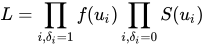
L = ∏ i , δ i = 1 f ( u i ) ∏ i , δ i = 0 S ( u i ) {\displaystyle L=\prod _{i,\delta _{i}=1}f(u_{i})\prod _{i,\delta _{i}=0}S(u_{i})} {\displaystyle L=\prod _{i,\delta _{i}=1}f(u_{i})\prod _{i,\delta _{i}=0}S(u_{i})}

where f ( u i ) {\displaystyle f(u_{i})} {\displaystyle f(u_{i})} = the probability density function evaluated at u i {\displaystyle u_{i}} {\displaystyle u_{i}},

and S ( u i ) {\displaystyle S(u_{i})} {\displaystyle S(u_{i})} = the probability that T i {\displaystyle T_{i}} {\displaystyle T_{i}} is greater than u i {\displaystyle u_{i}} {\displaystyle u_{i}}, called the survival function.

This can be simplified by defining the hazard function, the instantaneous force of mortality, as

λ ( u ) = f ( u ) / S ( u ) {\displaystyle \lambda (u)=f(u)/S(u)} {\displaystyle \lambda (u)=f(u)/S(u)}

so

f ( u ) = λ ( u ) S ( u ) {\displaystyle f(u)=\lambda (u)S(u)} {\displaystyle f(u)=\lambda (u)S(u)}.

Then

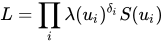
L = ∏ i λ ( u i ) δ i S ( u i ) {\displaystyle L=\prod _{i}\lambda (u_{i})^{\delta _{i}}S(u_{i})} {\displaystyle L=\prod _{i}\lambda (u_{i})^{\delta _{i}}S(u_{i})}.

For the exponential distribution, this becomes even simpler, because the hazard rate, λ {\displaystyle \lambda } {\displaystyle \lambda }, is constant, and S ( u ) = exp ⁡ ( − λ u ) {\displaystyle S(u)=\exp(-\lambda u)} {\displaystyle S(u)=\exp(-\lambda u)}. Then:

L ( λ ) = λ k exp ⁡ ( − λ ∑ u i ) {\displaystyle L(\lambda )=\lambda ^{k}\exp(-\lambda \sum {u_{i}})} {\displaystyle L(\lambda )=\lambda ^{k}\exp(-\lambda \sum {u_{i}})},

where k = ∑ δ i {\displaystyle k=\sum {\delta _{i}}} {\displaystyle k=\sum {\delta _{i}}}.

From this we easily compute λ ^ {\displaystyle {\hat {\lambda }}} {\displaystyle {\hat {\lambda }}}, the maximum likelihood estimate (MLE) of λ {\displaystyle \lambda } {\displaystyle \lambda }, as follows:

l ( λ ) = log ⁡ ( L ( λ ) ) = k log ⁡ ( λ ) − λ ∑ u i {\displaystyle l(\lambda )=\log(L(\lambda ))=k\log(\lambda )-\lambda \sum {u_{i}}} {\displaystyle l(\lambda )=\log(L(\lambda ))=k\log(\lambda )-\lambda \sum {u_{i}}}.

Then

d l / d λ = k / λ − ∑ u i {\displaystyle dl/d\lambda =k/\lambda -\sum {u_{i}}} {\displaystyle dl/d\lambda =k/\lambda -\sum {u_{i}}}.

We set this to 0 and solve for λ {\displaystyle \lambda } {\displaystyle \lambda } to get:

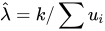
λ ^ = k / ∑ u i {\displaystyle {\hat {\lambda }}=k/\sum u_{i}} {\displaystyle {\hat {\lambda }}=k/\sum u_{i}}.

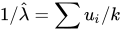
Equivalently, the mean time to failure is:

1 / λ ^ = ∑ u i / k {\displaystyle 1/{\hat {\lambda }}=\sum u_{i}/k} {\displaystyle 1/{\hat {\lambda }}=\sum u_{i}/k}.

This differs from the standard MLE for the exponential distribution in that the censored observations are considered only in the numerator.

See also

[edit]
  • Data analysis
  • Detection limit
  • Imputation (statistics)
  • Inverse probability weighting
  • Sampling bias
  • Saturation arithmetic
  • Survival analysis
  • Winsorising

References

[edit]
  1. ^ Helsel, D. (2010). "Much Ado About Next to Nothing: Incorporating Nondetects in Science". Annals of Occupational Hygiene. 54 (3): 257–262. doi:10.1093/annhyg/mep092. PMID 20032004.
  2. ^ Bernoulli, D. (1766). "Essai d'une nouvelle analyse de la mortalité causée par la petite vérole". Mem. Math. Phy. Acad. Roy. Sci. Paris, reprinted in Bradley (1971) 21 and Blower (2004)
  3. ^ Quesenberry, C. P. Jr.; et al. (1989). "A survival analysis of hospitalization among patients with acquired immunodeficiency syndrome". American Journal of Public Health. 79 (12): 1643–1647. doi:10.2105/AJPH.79.12.1643. PMC 1349769. PMID 2817192.
  4. ^ Lin, D. Y.; et al. (1997). "Estimating medical costs from incomplete follow-up data". Biometrics. 53 (2): 419–434. doi:10.2307/2533947. JSTOR 2533947. PMID 9192444.
  5. ^ Wijeysundera, H. C.; et al. (2012). "Techniques for estimating health care costs with censored data: an overview for the health services researcher". ClinicoEconomics and Outcomes Research. 4: 145–155. doi:10.2147/CEOR.S31552. PMC 3377439. PMID 22719214.
  6. ^ Tobin, James (1958). "Estimation of relationships for limited dependent variables" (PDF). Econometrica. 26 (1): 24–36. doi:10.2307/1907382. JSTOR 1907382.
  7. ^ Lu Tian, Likelihood Construction, Inference for Parametric Survival Distributions (PDF), Wikidata Q98961801.

Further reading

[edit]
  • Blower, S. (2004), D, Bernoulli's ""An attempt at a new analysis of the mortality caused by smallpox and of the advantages of inoculation to prevent it" (PDF). Archived from the original (PDF) on 2017-08-08. Retrieved 2019-06-25. (146 KiB)", Reviews of Medical Virology, 14: 275–288
  • Bradley, L. (1971). Smallpox Inoculation: An Eighteenth Century Mathematical Controversy. Nottingham. ISBN 0-902031-23-6.{{cite book}}: CS1 maint: location missing publisher (link)
  • Mann, N. R.; et al. (1975). Methods for Statistical Analysis of Reliability and Life Data. New York: Wiley. ISBN 047156737X.
  • Bagdonavicius, V., Kruopis, J., Nikulin, M.S. (2011),"Non-parametric Tests for Censored Data", London, ISTE/WILEY,ISBN 9781848212893.

External links

[edit]
  • "Engineering Statistics Handbook", NIST/SEMATEK, [1]
  • v
  • t
  • e
Statistics
  • Outline
  • Index
Descriptive statistics
Continuous data
Center
  • Mean
    • Arithmetic
    • Arithmetic-Geometric
    • Contraharmonic
    • Cubic
    • Generalized/power
    • Geometric
    • Harmonic
    • Heronian
    • Heinz
    • Lehmer
  • Median
  • Mode
Dispersion
  • Average absolute deviation
  • Coefficient of variation
  • Interquartile range
  • Percentile
  • Range
  • Standard deviation
  • Variance
Shape
  • Central limit theorem
  • Moments
    • Kurtosis
    • L-moments
    • Skewness
Count data
  • Index of dispersion
Summary tables
  • Contingency table
  • Frequency distribution
  • Grouped data
Dependence
  • Partial correlation
  • Pearson product-moment correlation
  • Rank correlation
    • Kendall's τ
    • Spearman's ρ
  • Scatter plot
Graphics
  • Bar chart
  • Biplot
  • Box plot
  • Control chart
  • Correlogram
  • Fan chart
  • Forest plot
  • Histogram
  • Pie chart
  • Q–Q plot
  • Radar chart
  • Run chart
  • Scatter plot
  • Stem-and-leaf display
  • Violin plot
Data collection
Study design
  • Effect size
  • Missing data
  • Optimal design
  • Population
  • Replication
  • Sample size determination
  • Statistic
  • Statistical power
Survey methodology
  • Sampling
    • Cluster
    • Stratified
  • Opinion poll
  • Questionnaire
  • Standard error
Controlled experiments
  • Blocking
  • Factorial experiment
  • Interaction
  • Random assignment
  • Randomized controlled trial
  • Randomized experiment
  • Scientific control
Adaptive designs
  • Adaptive clinical trial
  • Stochastic approximation
  • Up-and-down designs
Observational studies
  • Cohort study
  • Cross-sectional study
  • Natural experiment
  • Quasi-experiment
Statistical inference
Statistical theory
  • Population
  • Statistic
  • Probability distribution
  • Sampling distribution
    • Order statistic
  • Empirical distribution
    • Density estimation
  • Statistical model
    • Model specification
    • Lp space
  • Parameter
    • location
    • scale
    • shape
  • Parametric family
    • Likelihood (monotone)
    • Location–scale family
    • Exponential family
  • Completeness
  • Sufficiency
  • Statistical functional
    • Bootstrap
    • U
    • V
  • Optimal decision
    • loss function
  • Efficiency
  • Statistical distance
    • divergence
  • Asymptotics
  • Robustness
Frequentist inference
Point estimation
  • Estimating equations
    • Maximum likelihood
    • Method of moments
    • M-estimator
    • Minimum distance
  • Unbiased estimators
    • Mean-unbiased minimum-variance
      • Rao–Blackwellization
      • Lehmann–Scheffé theorem
    • Median unbiased
  • Plug-in
Interval estimation
  • Confidence interval
  • Pivot
  • Likelihood interval
  • Prediction interval
  • Tolerance interval
  • Resampling
    • Bootstrap
    • Jackknife
Testing hypotheses
  • 1- & 2-tails
  • Power
    • Uniformly most powerful test
  • Permutation test
    • Randomization test
  • Multiple comparisons
Parametric tests
  • Likelihood-ratio
  • Score/Lagrange multiplier
  • Wald
Specific tests
  • Z-test (normal)
  • Student's t-test
  • F-test
Goodness of fit
  • Chi-squared
  • G-test
  • Kolmogorov–Smirnov
  • Anderson–Darling
  • Lilliefors
  • Jarque–Bera
  • Normality (Shapiro–Wilk)
  • Likelihood-ratio test
  • Model selection
    • Cross validation
    • AIC
    • BIC
Rank statistics
  • Sign
    • Sample median
  • Signed rank (Wilcoxon)
    • Hodges–Lehmann estimator
  • Rank sum (Mann–Whitney)
  • Nonparametric anova
    • 1-way (Kruskal–Wallis)
    • 2-way (Friedman)
    • Ordered alternative (Jonckheere–Terpstra)
  • Van der Waerden test
Bayesian inference
  • Bayesian probability
    • prior
    • posterior
  • Credible interval
  • Bayes factor
  • Bayesian estimator
    • Maximum posterior estimator
  • Correlation
  • Regression analysis
Correlation
  • Pearson product-moment
  • Partial correlation
  • Confounding variable
  • Coefficient of determination
Regression analysis
  • Errors and residuals
  • Regression validation
  • Mixed effects models
  • Simultaneous equations models
  • Multivariate adaptive regression splines (MARS)
  • Template:Least squares and regression analysis
Linear regression
  • Simple linear regression
  • Ordinary least squares
  • General linear model
  • Bayesian regression
Non-standard predictors
  • Nonlinear regression
  • Nonparametric
  • Semiparametric
  • Isotonic
  • Robust
  • Homoscedasticity and Heteroscedasticity
Generalized linear model
  • Exponential families
  • Logistic (Bernoulli) / Binomial / Poisson regressions
Partition of variance
  • Analysis of variance (ANOVA, anova)
  • Analysis of covariance
  • Multivariate ANOVA
  • Degrees of freedom
Categorical / multivariate / time-series / survival analysis
Categorical
  • Cohen's kappa
  • Contingency table
  • Graphical model
  • Log-linear model
  • McNemar's test
  • Cochran–Mantel–Haenszel statistics
Multivariate
  • Regression
  • Manova
  • Principal components
  • Canonical correlation
  • Discriminant analysis
  • Cluster analysis
  • Classification
  • Structural equation model
    • Factor analysis
  • Multivariate distributions
    • Elliptical distributions
      • Normal
Time-series
General
  • Decomposition
  • Trend
  • Stationarity
  • Seasonal adjustment
  • Exponential smoothing
  • Cointegration
  • Structural break
  • Granger causality
Specific tests
  • Dickey–Fuller
  • Johansen
  • Q-statistic (Ljung–Box)
  • Durbin–Watson
  • Breusch–Godfrey
Time domain
  • Autocorrelation (ACF)
    • partial (PACF)
  • Cross-correlation (XCF)
  • ARMA model
  • ARIMA model (Box–Jenkins)
  • Autoregressive conditional heteroskedasticity (ARCH)
  • Vector autoregression (VAR) (Autoregressive model (AR))
Frequency domain
  • Spectral density estimation
  • Fourier analysis
  • Least-squares spectral analysis
  • Wavelet
  • Whittle likelihood
Survival
Survival function
  • Kaplan–Meier estimator (product limit)
  • Proportional hazards models
  • Accelerated failure time (AFT) model
  • First hitting time
Hazard function
  • Nelson–Aalen estimator
Test
  • Log-rank test
Applications
Biostatistics
  • Bioinformatics
  • Clinical trials / studies
  • Epidemiology
  • Medical statistics
Engineering statistics
  • Chemometrics
  • Methods engineering
  • Probabilistic design
  • Process / quality control
  • Reliability
  • System identification
Social statistics
  • Actuarial science
  • Census
  • Crime statistics
  • Demography
  • Econometrics
  • Jurimetrics
  • National accounts
  • Official statistics
  • Population statistics
  • Psychometrics
Spatial statistics
  • Cartography
  • Environmental statistics
  • Geographic information system
  • Geostatistics
  • Kriging
  • Category
  • icon Mathematics portal
  • Commons
  • WikiProject
Retrieved from "https://teknopedia.ac.id/w/index.php?title=Censoring_(statistics)&oldid=1291846083"
Categories:
  • Statistical data types
  • Survival analysis
  • Reliability engineering
  • Unknown content
Hidden categories:
  • Articles with short description
  • Short description is different from Wikidata
  • CS1 maint: location missing publisher

  • indonesia
  • Polski
  • العربية
  • Deutsch
  • English
  • Español
  • Français
  • Italiano
  • مصرى
  • Nederlands
  • 日本語
  • Português
  • Sinugboanong Binisaya
  • Svenska
  • Українська
  • Tiếng Việt
  • Winaray
  • 中文
  • Русский
Sunting pranala
url url url url url url url url url url url url url url url url url url url url url url url url url url url url url url url url url url url url url url url url url url url url url url url url url url url url url url url url url url url url url url url url url url url url url url url url url url url url url url url url url url url url url url url url url url url url url url url url url url url url url url url url url url url url url url url url url url url url url url url url url url url url url url url url url url url url url url url url url url url url url url url url url url url url url url url url url url url url url url url url url url url url url url url url url url url url url url url url url url url url url url url url url url url url url url url url url url url url url url url url url url url url url url url url url url url url url url url url url url url url url url url url url url url url url url url url url url url url url url url url url url url url url url url url url url url url url url url url url url url url url url url url url url url url url url url url url url url url url url url url url url url url url url url url url url url url url url url url url url url url url url url url url url url url url url url url url url url url url url url url url url url url url url url url url url url url url url url url url url url url url url url url url url url url url url url url url url url url url url url url url url url url url url url url url url url url url url url url url url url url url url url url url url url url url url url url url url url url url url url url url url url url url url url url url url url url url url url url url url url url url url url url url url url url url url url url url url url url url url url url url url url url url url url url url url url url url url url url url url url url url url url url url url url url url url url url url url url url url url url url url url url url url url url url url url url url url url url url url url url url url url url url url url url url url url url url url url url url url url url url url url url url url url url url url url url url url url url url url url url url url url url url url url url url url url url url url url url url url url url url url url url url url url url url url url url url url url url url url url url url url url url url url url url url url url url url url url url url url url url url url url url url url url url url url url url url url url url url url url url url url url url url url url url url url url url url url url url url url url url url url url url url url url url url url url url url url url url url url url url url url url url url url url url url url url url url url url url url url url url url url url url url url url url url url url url url url url url url url url url url url url url url url url url url url url url url url url url url url url url url url url url url url url url url url url url url url url url url url url url url url url url url url url url url url url url url url url url url url url url url url url url url url url url url url url url url url url url url url url url url url url url url url url url url url url url url url url url url url url url url url url url url url url url url url url url url url url url url url url url url url url url url url url url url url url url url url url url url url url url url url url url url url url url url url url url url url url url url url url url url url url url url url url url url url url url url url url url url url url url url url url url url url url url url url url url url url url url url url url url url url url url url url url url url url url url url url url url url url url url url url url url url url url url url url url url url url url url url url url url url url url url url url url url url url url url url url url url url url url url url url url url url url url url url url url url url url url url url url url url url url url url url url url url url url url url url url url url url url url url url url url url url url url url url url url url url url url url url url url url url url url url url url url url url url url url url url url url url url url url url url url url url url url url url url url url url url url url url url url url url url url url url url url url url url url url url url url url url url url url url url url url url url url url url url url url url url url url url url url url url url url url url url url url url url url url url url url url url url url url url url url url url url url url url url url url url url url url url url url url url url url url url url url url url url url url url url url url url url url url url url url url url url url url url url url url url url url url url url url url url url url url url url url url url url url url url url url url url url url url url url url url url url url url url url url url url url url url url url url url url url url url url url url url url url url url url url url url url url url url url url url url url url url url url url url url url url url url url url url url url url url url url url url url url url url url url url url url url url url url url url url url url url url url url url url url url url url url url url url url url url url url url url url url url url url url url url url url url url url url url url url url url url url url url url url url url url url url url url url url url url url url url url url url url url url url url url url url url url url url url url url url url url url url url url url url url url url url url url url url url url url url url url url url url url url url url url url url url url url url url url url url url url url url url url url url url url url url url url url url url url url url url url url url url url url url url url url url url url url url url url url url url url url url url url url url url url url url url url url url url url url url url url url url url url url url url url url url url url url url url url url url url url url url url url url url url url url url url url url url url url url url url url url url url url url url url url url url url url url url url url url url url url url url url url url url url url url url url url url url url url url url url url url url url url url url url url url url url url url url url url url url url url url url url url url url url url url url url url url url url url url url url url url url url url url url url url url url url url url url url url url url url url url url url url url url url url url url url url url url url url url url url url url url url url url url url url url url url url url url url url url url url url url url url url url url url url url url url url url url url url url url url url url url url url url url url url url url url url url url url url url url url url url url url url url url url url url url url url url url url url url url url url url url url url url url url url url url url url url url url url url url url url url url url url url url url url url url url url url url url url url url url url url url url url url url url url url url url url url url url url url url url url url url url url url url url url url url url url url url url url url url url url url url url url url url url url url url url url url url url url url url url url url url url url url url url url url url url url url url url url url url url url url url url url url url url url url url url url url url url url url url url url url url url url url url url url url url url url url url url url url url url url url url url url url url url url url url url url url url url url url url url url url url url url url url url url url url url url url url url url url url url url url url url url url url url url url url url url url url url url url url url url url url url url url url url url url url url url url url url url url url url url url url url url url url url url url url url url url url url url url url url url url url url url url url url url url url url url url url url url url url url url url url url url url url url url url url url url url url url url url url url url url url url url url url url url url url url url url url url url url url url url url url url url url url url url url url url url url url url url url url url url url url url url url url url url url url url url url url url url url url url url url url url url url url url url url url url url url url url url url url url url url url url url url url url url url url url url url url url url url url url url url url url url url url url url url url url url url url url url url url url url url url url url url url url url url url url url url url url url url url url url url url url url url url url url url url url url url url url url url url url url url url url url url url url url url url url url url url url url url url url url url url url url url url url url url url url url url url url url url url url url url url url url url url url url url url url url url url url url url url url url url url url url url url url url url url url url url url url url url url url url url url url url url url url url url url url url url url url url url url url url url url url url url url url url url url url url url url url url url url url url url url url url url url url url url url url url url url url url url url url url url url url url url url url url url url url url url url url url url url url url url url url url url url url url url url url url url url url url url url url url url url url url url url url url url url url url url url url url url url url url url url url url url url url url url url url url url url url url url url url url url url url url url url url url url url url url url url url url url url url url url url url url url url url url url url url url url url url url url url url
Pusat Layanan

UNIVERSITAS TEKNOKRAT INDONESIA | ASEAN's Best Private University
Jl. ZA. Pagar Alam No.9 -11, Labuhan Ratu, Kec. Kedaton, Kota Bandar Lampung, Lampung 35132
Phone: (0721) 702022
Email: pmb@teknokrat.ac.id