Epstein Files Full PDF

CLICK HERE
Technopedia Center
PMB University Brochure
Faculty of Engineering and Computer Science
S1 Informatics S1 Information Systems S1 Information Technology S1 Computer Engineering S1 Electrical Engineering S1 Civil Engineering

faculty of Economics and Business
S1 Management S1 Accountancy

Faculty of Letters and Educational Sciences
S1 English literature S1 English language education S1 Mathematics education S1 Sports Education
teknopedia

  • Registerasi
  • Brosur UTI
  • Kip Scholarship Information
  • Performance
Flag Counter
  1. World Encyclopedia
  2. Dirichlet integral - Wikipedia
Dirichlet integral - Wikipedia
From Wikipedia, the free encyclopedia

Integral of sin(x)/x from 0 to infinity
Not to be confused with Dirichlet energy.
Peter Gustav Lejeune Dirichlet
Part of a series of articles about
Calculus
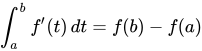
∫ a b f ′ ( t ) d t = f ( b ) − f ( a ) {\displaystyle \int _{a}^{b}f'(t)\,dt=f(b)-f(a)} {\displaystyle \int _{a}^{b}f'(t)\,dt=f(b)-f(a)}
  • Fundamental theorem
  • Limits
  • Continuity
  • Rolle's theorem
  • Mean value theorem
  • Inverse function theorem
Differential
Definitions
  • Derivative (generalizations)
  • Differential
    • infinitesimal
    • of a function
    • total
Concepts
  • Differentiation notation
  • Second derivative
  • Implicit differentiation
  • Logarithmic differentiation
  • Related rates
  • Taylor's theorem
Rules and identities
  • Sum
  • Product
  • Chain
  • Power
  • Quotient
  • L'Hôpital's rule
  • Inverse
  • General Leibniz
  • Faà di Bruno's formula
  • Reynolds
Integral
  • Lists of integrals
  • Integral transform
  • Leibniz integral rule
Definitions
  • Antiderivative
  • Integral (improper)
  • Riemann integral
  • Lebesgue integration
  • Contour integration
  • Integral of inverse functions
Integration by
  • Parts
  • Discs
  • Cylindrical shells
  • Substitution (trigonometric, tangent half-angle, Euler)
  • Euler's formula
  • Partial fractions (Heaviside's method)
  • Changing order
  • Reduction formulae
  • Differentiating under the integral sign
  • Risch algorithm
Series
  • Geometric (arithmetico-geometric)
  • Harmonic
  • Alternating
  • Power
  • Binomial
  • Taylor
Convergence tests
  • Summand limit (term test)
  • Ratio
  • Root
  • Integral
  • Direct comparison

  • Limit comparison
  • Alternating series
  • Cauchy condensation
  • Dirichlet
  • Abel
Vector
  • Gradient
  • Divergence
  • Curl
  • Laplacian
  • Directional derivative
  • Identities
Theorems
  • Gradient
  • Green's
  • Stokes'
  • Divergence
  • Generalized Stokes
  • Helmholtz decomposition
Multivariable
Formalisms
  • Matrix
  • Tensor
  • Exterior
  • Geometric
Definitions
  • Partial derivative
  • Multiple integral
  • Line integral
  • Surface integral
  • Volume integral
  • Jacobian
  • Hessian
Advanced
  • Calculus on Euclidean space
  • Generalized functions
  • Limit of distributions
Specialized
  • Fractional
  • Malliavin
  • Stochastic
  • Variations
Miscellanea
  • Precalculus
  • History
  • Glossary
  • List of topics
  • Integration Bee
  • Mathematical analysis
  • Nonstandard analysis
  • v
  • t
  • e

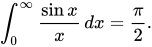
In mathematics, there are several integrals known as the Dirichlet integral, after the German mathematician Peter Gustav Lejeune Dirichlet, one of which is the improper integral of the sinc function over the positive real number line.

∫ 0 ∞ sin ⁡ x x d x = π 2 . {\displaystyle \int _{0}^{\infty }{\frac {\sin x}{x}}\,dx={\frac {\pi }{2}}.} {\displaystyle \int _{0}^{\infty }{\frac {\sin x}{x}}\,dx={\frac {\pi }{2}}.}

This integral is not absolutely convergent, meaning | sin ⁡ x x | {\displaystyle \left|{\frac {\sin x}{x}}\right|} {\displaystyle \left|{\frac {\sin x}{x}}\right|} has an infinite Lebesgue or Riemann improper integral over the positive real line, so the sinc function is not Lebesgue integrable over the positive real line. The sinc function is, however, integrable in the sense of the improper Riemann integral or the generalized Riemann or Henstock–Kurzweil integral.[1][2] This can be seen by using Dirichlet's test for improper integrals.

It is a good illustration of special techniques for evaluating definite integrals, particularly when it is not useful to directly apply the fundamental theorem of calculus due to the lack of an elementary antiderivative for the integrand, as the sine integral, an antiderivative of the sinc function, is not an elementary function. In this case, the improper definite integral can be determined in several ways: the Laplace transform, double integration, differentiating under the integral sign, contour integration, and the Dirichlet kernel. But since the integrand is an even function, the domain of integration can be extended to the negative real number line as well.

Evaluation

[edit]

Laplace transform

[edit]

Let f ( t ) {\displaystyle f(t)} {\displaystyle f(t)} be a function defined whenever t ≥ 0. {\displaystyle t\geq 0.} {\displaystyle t\geq 0.} Then its Laplace transform is given by L { f ( t ) } = F ( s ) = ∫ 0 ∞ e − s t f ( t ) d t , {\displaystyle {\mathcal {L}}\{f(t)\}=F(s)=\int _{0}^{\infty }e^{-st}f(t)\,dt,} {\displaystyle {\mathcal {L}}\{f(t)\}=F(s)=\int _{0}^{\infty }e^{-st}f(t)\,dt,} if the integral exists.[3]

A property of the Laplace transform useful for evaluating improper integrals is L [ f ( t ) t ] = ∫ s ∞ F ( u ) d u , {\displaystyle {\mathcal {L}}\left[{\frac {f(t)}{t}}\right]=\int _{s}^{\infty }F(u)\,du,} {\displaystyle {\mathcal {L}}\left[{\frac {f(t)}{t}}\right]=\int _{s}^{\infty }F(u)\,du,} provided lim t → 0 f ( t ) t {\displaystyle \lim _{t\to 0}{\frac {f(t)}{t}}} {\displaystyle \lim _{t\to 0}{\frac {f(t)}{t}}} exists.

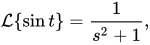
In what follows, one needs the result L { sin ⁡ t } = 1 s 2 + 1 , {\displaystyle {\mathcal {L}}\{\sin t\}={\frac {1}{s^{2}+1}},} {\displaystyle {\mathcal {L}}\{\sin t\}={\frac {1}{s^{2}+1}},} which is the Laplace transform of the function sin ⁡ t {\displaystyle \sin t} {\displaystyle \sin t} (see the section 'Differentiating under the integral sign' for a derivation) as well as a version of Abel's theorem (a consequence of the final value theorem for the Laplace transform).

Therefore, ∫ 0 ∞ sin ⁡ t t d t = lim s → 0 ∫ 0 ∞ e − s t sin ⁡ t t d t = lim s → 0 L [ sin ⁡ t t ] = lim s → 0 ∫ s ∞ d u u 2 + 1 = lim s → 0 arctan ⁡ u | s ∞ = lim s → 0 [ π 2 − arctan ⁡ ( s ) ] = π 2 . {\displaystyle {\begin{aligned}\int _{0}^{\infty }{\frac {\sin t}{t}}\,dt&=\lim _{s\to 0}\int _{0}^{\infty }e^{-st}{\frac {\sin t}{t}}\,dt=\lim _{s\to 0}{\mathcal {L}}\left[{\frac {\sin t}{t}}\right]\\[6pt]&=\lim _{s\to 0}\int _{s}^{\infty }{\frac {du}{u^{2}+1}}=\lim _{s\to 0}\arctan u{\Biggr |}_{s}^{\infty }\\[6pt]&=\lim _{s\to 0}\left[{\frac {\pi }{2}}-\arctan(s)\right]={\frac {\pi }{2}}.\end{aligned}}} {\displaystyle {\begin{aligned}\int _{0}^{\infty }{\frac {\sin t}{t}}\,dt&=\lim _{s\to 0}\int _{0}^{\infty }e^{-st}{\frac {\sin t}{t}}\,dt=\lim _{s\to 0}{\mathcal {L}}\left[{\frac {\sin t}{t}}\right]\\[6pt]&=\lim _{s\to 0}\int _{s}^{\infty }{\frac {du}{u^{2}+1}}=\lim _{s\to 0}\arctan u{\Biggr |}_{s}^{\infty }\\[6pt]&=\lim _{s\to 0}\left[{\frac {\pi }{2}}-\arctan(s)\right]={\frac {\pi }{2}}.\end{aligned}}}

Double integration

[edit]

Evaluating the Dirichlet integral using the Laplace transform is equivalent to calculating the same double definite integral by changing the order of integration, namely, ( I 1 = ∫ 0 ∞ ∫ 0 ∞ e − s t sin ⁡ t d t d s ) = ( I 2 = ∫ 0 ∞ ∫ 0 ∞ e − s t sin ⁡ t d s d t ) , {\displaystyle \left(I_{1}=\int _{0}^{\infty }\int _{0}^{\infty }e^{-st}\sin t\,dt\,ds\right)=\left(I_{2}=\int _{0}^{\infty }\int _{0}^{\infty }e^{-st}\sin t\,ds\,dt\right),} {\displaystyle \left(I_{1}=\int _{0}^{\infty }\int _{0}^{\infty }e^{-st}\sin t\,dt\,ds\right)=\left(I_{2}=\int _{0}^{\infty }\int _{0}^{\infty }e^{-st}\sin t\,ds\,dt\right),} ( I 1 = ∫ 0 ∞ 1 s 2 + 1 d s = π 2 ) = ( I 2 = ∫ 0 ∞ sin ⁡ t t d t ) ,  provided  s > 0. {\displaystyle \left(I_{1}=\int _{0}^{\infty }{\frac {1}{s^{2}+1}}\,ds={\frac {\pi }{2}}\right)=\left(I_{2}=\int _{0}^{\infty }{\frac {\sin t}{t}}\,dt\right),{\text{ provided }}s>0.} {\displaystyle \left(I_{1}=\int _{0}^{\infty }{\frac {1}{s^{2}+1}}\,ds={\frac {\pi }{2}}\right)=\left(I_{2}=\int _{0}^{\infty }{\frac {\sin t}{t}}\,dt\right),{\text{ provided }}s>0.} The change of order is justified by the fact that for all s > 0 {\displaystyle s>0} {\displaystyle s>0}, the integral is absolutely convergent.

Differentiation under the integral sign (Feynman's trick)

[edit]

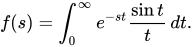
First rewrite the integral as a function of the additional variable s , {\displaystyle s,} {\displaystyle s,} namely, the Laplace transform of sin ⁡ t t . {\displaystyle {\frac {\sin t}{t}}.} {\displaystyle {\frac {\sin t}{t}}.} So let f ( s ) = ∫ 0 ∞ e − s t sin ⁡ t t d t . {\displaystyle f(s)=\int _{0}^{\infty }e^{-st}{\frac {\sin t}{t}}\,dt.} {\displaystyle f(s)=\int _{0}^{\infty }e^{-st}{\frac {\sin t}{t}}\,dt.}

In order to evaluate the Dirichlet integral, we need to determine f ( 0 ) . {\displaystyle f(0).} {\displaystyle f(0).} The continuity of f {\displaystyle f} {\displaystyle f} can be justified by applying the dominated convergence theorem after integration by parts. Differentiate with respect to s > 0 {\displaystyle s>0} {\displaystyle s>0} and apply the Leibniz rule for differentiating under the integral sign to obtain d f d s = d d s ∫ 0 ∞ e − s t sin ⁡ t t d t = ∫ 0 ∞ ∂ ∂ s e − s t sin ⁡ t t d t = − ∫ 0 ∞ e − s t sin ⁡ t d t . {\displaystyle {\begin{aligned}{\frac {df}{ds}}&={\frac {d}{ds}}\int _{0}^{\infty }e^{-st}{\frac {\sin t}{t}}\,dt=\int _{0}^{\infty }{\frac {\partial }{\partial s}}e^{-st}{\frac {\sin t}{t}}\,dt\\[6pt]&=-\int _{0}^{\infty }e^{-st}\sin t\,dt.\end{aligned}}} {\displaystyle {\begin{aligned}{\frac {df}{ds}}&={\frac {d}{ds}}\int _{0}^{\infty }e^{-st}{\frac {\sin t}{t}}\,dt=\int _{0}^{\infty }{\frac {\partial }{\partial s}}e^{-st}{\frac {\sin t}{t}}\,dt\\[6pt]&=-\int _{0}^{\infty }e^{-st}\sin t\,dt.\end{aligned}}}

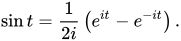
Now, using Euler's formula e i t = cos ⁡ t + i sin ⁡ t , {\displaystyle e^{it}=\cos t+i\sin t,} {\displaystyle e^{it}=\cos t+i\sin t,} one can express the sine function in terms of complex exponentials: sin ⁡ t = 1 2 i ( e i t − e − i t ) . {\displaystyle \sin t={\frac {1}{2i}}\left(e^{it}-e^{-it}\right).} {\displaystyle \sin t={\frac {1}{2i}}\left(e^{it}-e^{-it}\right).}

Therefore, d f d s = − ∫ 0 ∞ e − s t sin ⁡ t d t = − ∫ 0 ∞ e − s t e i t − e − i t 2 i d t = − 1 2 i ∫ 0 ∞ [ e − t ( s − i ) − e − t ( s + i ) ] d t = − 1 2 i [ − 1 s − i e − t ( s − i ) − − 1 s + i e − t ( s + i ) ] 0 ∞ = − 1 2 i [ 0 − ( − 1 s − i + 1 s + i ) ] = − 1 2 i ( 1 s − i − 1 s + i ) = − 1 2 i ( s + i − ( s − i ) s 2 + 1 ) = − 1 s 2 + 1 . {\displaystyle {\begin{aligned}{\frac {df}{ds}}&=-\int _{0}^{\infty }e^{-st}\sin t\,dt=-\int _{0}^{\infty }e^{-st}{\frac {e^{it}-e^{-it}}{2i}}dt\\[6pt]&=-{\frac {1}{2i}}\int _{0}^{\infty }\left[e^{-t(s-i)}-e^{-t(s+i)}\right]dt\\[6pt]&=-{\frac {1}{2i}}\left[{\frac {-1}{s-i}}e^{-t(s-i)}-{\frac {-1}{s+i}}e^{-t(s+i)}\right]_{0}^{\infty }\\[6pt]&=-{\frac {1}{2i}}\left[0-\left({\frac {-1}{s-i}}+{\frac {1}{s+i}}\right)\right]=-{\frac {1}{2i}}\left({\frac {1}{s-i}}-{\frac {1}{s+i}}\right)\\[6pt]&=-{\frac {1}{2i}}\left({\frac {s+i-(s-i)}{s^{2}+1}}\right)=-{\frac {1}{s^{2}+1}}.\end{aligned}}} {\displaystyle {\begin{aligned}{\frac {df}{ds}}&=-\int _{0}^{\infty }e^{-st}\sin t\,dt=-\int _{0}^{\infty }e^{-st}{\frac {e^{it}-e^{-it}}{2i}}dt\\[6pt]&=-{\frac {1}{2i}}\int _{0}^{\infty }\left[e^{-t(s-i)}-e^{-t(s+i)}\right]dt\\[6pt]&=-{\frac {1}{2i}}\left[{\frac {-1}{s-i}}e^{-t(s-i)}-{\frac {-1}{s+i}}e^{-t(s+i)}\right]_{0}^{\infty }\\[6pt]&=-{\frac {1}{2i}}\left[0-\left({\frac {-1}{s-i}}+{\frac {1}{s+i}}\right)\right]=-{\frac {1}{2i}}\left({\frac {1}{s-i}}-{\frac {1}{s+i}}\right)\\[6pt]&=-{\frac {1}{2i}}\left({\frac {s+i-(s-i)}{s^{2}+1}}\right)=-{\frac {1}{s^{2}+1}}.\end{aligned}}}

Integrating with respect to s {\displaystyle s} {\displaystyle s} gives f ( s ) = ∫ − d s s 2 + 1 = A − arctan ⁡ s , {\displaystyle f(s)=\int {\frac {-ds}{s^{2}+1}}=A-\arctan s,} {\displaystyle f(s)=\int {\frac {-ds}{s^{2}+1}}=A-\arctan s,}

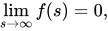
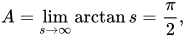
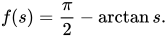
where A {\displaystyle A} {\displaystyle A} is a constant of integration to be determined. Since lim s → ∞ f ( s ) = 0 , {\displaystyle \lim _{s\to \infty }f(s)=0,} {\displaystyle \lim _{s\to \infty }f(s)=0,} A = lim s → ∞ arctan ⁡ s = π 2 , {\displaystyle A=\lim _{s\to \infty }\arctan s={\frac {\pi }{2}},} {\displaystyle A=\lim _{s\to \infty }\arctan s={\frac {\pi }{2}},} using the principal value. This means that for s > 0 {\displaystyle s>0} {\displaystyle s>0} f ( s ) = π 2 − arctan ⁡ s . {\displaystyle f(s)={\frac {\pi }{2}}-\arctan s.} {\displaystyle f(s)={\frac {\pi }{2}}-\arctan s.}

Finally, by continuity at s = 0 , {\displaystyle s=0,} {\displaystyle s=0,} we have f ( 0 ) = π 2 − arctan ⁡ ( 0 ) = π 2 , {\displaystyle f(0)={\frac {\pi }{2}}-\arctan(0)={\frac {\pi }{2}},} {\displaystyle f(0)={\frac {\pi }{2}}-\arctan(0)={\frac {\pi }{2}},} as before.

Complex contour integration

[edit]

Consider f ( z ) = e i z z . {\displaystyle f(z)={\frac {e^{iz}}{z}}.} {\displaystyle f(z)={\frac {e^{iz}}{z}}.}

As a function of the complex variable z , {\displaystyle z,} {\displaystyle z,} it has a simple pole at the origin, which prevents the application of Jordan's lemma, whose other hypotheses are satisfied.

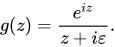
Define then a new function[4] g ( z ) = e i z z + i ε . {\displaystyle g(z)={\frac {e^{iz}}{z+i\varepsilon }}.} {\displaystyle g(z)={\frac {e^{iz}}{z+i\varepsilon }}.}

The pole has been moved to the negative imaginary axis, so g ( z ) {\displaystyle g(z)} {\displaystyle g(z)} can be integrated along the semicircle γ {\displaystyle \gamma } {\displaystyle \gamma } of radius R {\displaystyle R} {\displaystyle R} centered at z = 0 {\displaystyle z=0} {\displaystyle z=0} extending in the positive imaginary direction, and closed along the real axis. One then takes the limit ε → 0. {\displaystyle \varepsilon \to 0.} {\displaystyle \varepsilon \to 0.}

The complex integral is zero by the residue theorem, as there are no poles inside the integration path γ {\displaystyle \gamma } {\displaystyle \gamma }: 0 = ∫ γ g ( z ) d z = ∫ − R R e i x x + i ε d x + ∫ 0 π e i ( R e i θ + θ ) R e i θ + i ε i R d θ . {\displaystyle 0=\int _{\gamma }g(z)\,dz=\int _{-R}^{R}{\frac {e^{ix}}{x+i\varepsilon }}\,dx+\int _{0}^{\pi }{\frac {e^{i(Re^{i\theta }+\theta )}}{Re^{i\theta }+i\varepsilon }}iR\,d\theta .} {\displaystyle 0=\int _{\gamma }g(z)\,dz=\int _{-R}^{R}{\frac {e^{ix}}{x+i\varepsilon }}\,dx+\int _{0}^{\pi }{\frac {e^{i(Re^{i\theta }+\theta )}}{Re^{i\theta }+i\varepsilon }}iR\,d\theta .}

The second term vanishes as R {\displaystyle R} {\displaystyle R} goes to infinity. As for the first integral, one can use one version of the Sokhotski–Plemelj theorem for integrals over the real line: for a complex-valued function f defined and continuously differentiable on the real line and real constants a {\displaystyle a} {\displaystyle a} and b {\displaystyle b} {\displaystyle b} with a < 0 < b {\displaystyle a<0<b} {\displaystyle a<0<b} one finds lim ε → 0 + ∫ a b f ( x ) x ± i ε d x = ∓ i π f ( 0 ) + P ∫ a b f ( x ) x d x , {\displaystyle \lim _{\varepsilon \to 0^{+}}\int _{a}^{b}{\frac {f(x)}{x\pm i\varepsilon }}\,dx=\mp i\pi f(0)+{\mathcal {P}}\int _{a}^{b}{\frac {f(x)}{x}}\,dx,} {\displaystyle \lim _{\varepsilon \to 0^{+}}\int _{a}^{b}{\frac {f(x)}{x\pm i\varepsilon }}\,dx=\mp i\pi f(0)+{\mathcal {P}}\int _{a}^{b}{\frac {f(x)}{x}}\,dx,}

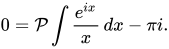
where P {\displaystyle {\mathcal {P}}} {\displaystyle {\mathcal {P}}} denotes the Cauchy principal value. Back to the above original calculation, one can write 0 = P ∫ e i x x d x − π i . {\displaystyle 0={\mathcal {P}}\int {\frac {e^{ix}}{x}}\,dx-\pi i.} {\displaystyle 0={\mathcal {P}}\int {\frac {e^{ix}}{x}}\,dx-\pi i.}

By taking the imaginary part on both sides and noting that the function sin ⁡ ( x ) / x {\displaystyle \sin(x)/x} {\displaystyle \sin(x)/x} is even, we get ∫ − ∞ + ∞ sin ⁡ ( x ) x d x = 2 ∫ 0 + ∞ sin ⁡ ( x ) x d x . {\displaystyle \int _{-\infty }^{+\infty }{\frac {\sin(x)}{x}}\,dx=2\int _{0}^{+\infty }{\frac {\sin(x)}{x}}\,dx.} {\displaystyle \int _{-\infty }^{+\infty }{\frac {\sin(x)}{x}}\,dx=2\int _{0}^{+\infty }{\frac {\sin(x)}{x}}\,dx.}

Finally, lim ε → 0 ∫ ε ∞ sin ⁡ ( x ) x d x = ∫ 0 ∞ sin ⁡ ( x ) x d x = π 2 . {\displaystyle \lim _{\varepsilon \to 0}\int _{\varepsilon }^{\infty }{\frac {\sin(x)}{x}}\,dx=\int _{0}^{\infty }{\frac {\sin(x)}{x}}\,dx={\frac {\pi }{2}}.} {\displaystyle \lim _{\varepsilon \to 0}\int _{\varepsilon }^{\infty }{\frac {\sin(x)}{x}}\,dx=\int _{0}^{\infty }{\frac {\sin(x)}{x}}\,dx={\frac {\pi }{2}}.}

Alternatively, choose as the integration contour for f {\displaystyle f} {\displaystyle f} the union of upper half-plane semicircles of radii ε {\displaystyle \varepsilon } {\displaystyle \varepsilon } and R {\displaystyle R} {\displaystyle R} together with two segments of the real line that connect them. On one hand the contour integral is zero, independently of ε {\displaystyle \varepsilon } {\displaystyle \varepsilon } and R ; {\displaystyle R;} {\displaystyle R;} on the other hand, as ε → 0 {\displaystyle \varepsilon \to 0} {\displaystyle \varepsilon \to 0} and R → ∞ {\displaystyle R\to \infty } {\displaystyle R\to \infty } the integral's imaginary part converges to 2 I + ℑ ( ln ⁡ 0 − ln ⁡ ( π i ) ) = 2 I − π {\displaystyle 2I+\Im {\big (}\ln 0-\ln(\pi i){\big )}=2I-\pi } {\displaystyle 2I+\Im {\big (}\ln 0-\ln(\pi i){\big )}=2I-\pi } (here ln ⁡ z {\displaystyle \ln z} {\displaystyle \ln z} is any branch of logarithm on upper half-plane), leading to I = π 2 . {\displaystyle I={\frac {\pi }{2}}.} {\displaystyle I={\frac {\pi }{2}}.}

Dirichlet kernel

[edit]

Consider the well-known formula for the Dirichlet kernel:[5] D n ( x ) = 1 + 2 ∑ k = 1 n cos ⁡ ( 2 k x ) = sin ⁡ [ ( 2 n + 1 ) x ] sin ⁡ ( x ) . {\displaystyle D_{n}(x)=1+2\sum _{k=1}^{n}\cos(2kx)={\frac {\sin[(2n+1)x]}{\sin(x)}}.} {\displaystyle D_{n}(x)=1+2\sum _{k=1}^{n}\cos(2kx)={\frac {\sin[(2n+1)x]}{\sin(x)}}.}

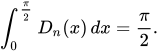
It immediately follows that: ∫ 0 π 2 D n ( x ) d x = π 2 . {\displaystyle \int _{0}^{\frac {\pi }{2}}D_{n}(x)\,dx={\frac {\pi }{2}}.} {\displaystyle \int _{0}^{\frac {\pi }{2}}D_{n}(x)\,dx={\frac {\pi }{2}}.}

Define f ( x ) = { 1 x − 1 sin ⁡ ( x ) x ≠ 0 0 x = 0 {\displaystyle f(x)={\begin{cases}{\frac {1}{x}}-{\frac {1}{\sin(x)}}&x\neq 0\\[6pt]0&x=0\end{cases}}} {\displaystyle f(x)={\begin{cases}{\frac {1}{x}}-{\frac {1}{\sin(x)}}&x\neq 0\\[6pt]0&x=0\end{cases}}}

Clearly, f {\displaystyle f} {\displaystyle f} is continuous when x ∈ ( 0 , π / 2 ] ; {\displaystyle x\in (0,\pi /2];} {\displaystyle x\in (0,\pi /2];} to see its continuity at 0 apply L'Hopital's Rule: lim x → 0 sin ⁡ ( x ) − x x sin ⁡ ( x ) = lim x → 0 cos ⁡ ( x ) − 1 sin ⁡ ( x ) + x cos ⁡ ( x ) = lim x → 0 − sin ⁡ ( x ) 2 cos ⁡ ( x ) − x sin ⁡ ( x ) = 0. {\displaystyle \lim _{x\to 0}{\frac {\sin(x)-x}{x\sin(x)}}=\lim _{x\to 0}{\frac {\cos(x)-1}{\sin(x)+x\cos(x)}}=\lim _{x\to 0}{\frac {-\sin(x)}{2\cos(x)-x\sin(x)}}=0.} {\displaystyle \lim _{x\to 0}{\frac {\sin(x)-x}{x\sin(x)}}=\lim _{x\to 0}{\frac {\cos(x)-1}{\sin(x)+x\cos(x)}}=\lim _{x\to 0}{\frac {-\sin(x)}{2\cos(x)-x\sin(x)}}=0.}

Hence, f {\displaystyle f} {\displaystyle f} fulfills the requirements of the Riemann-Lebesgue Lemma. This means: lim λ → ∞ ∫ 0 π / 2 f ( x ) sin ⁡ ( λ x ) d x = 0 ⟹ lim λ → ∞ ∫ 0 π / 2 sin ⁡ ( λ x ) x d x = lim λ → ∞ ∫ 0 π / 2 sin ⁡ ( λ x ) sin ⁡ ( x ) d x . {\displaystyle \lim _{\lambda \to \infty }\int _{0}^{\pi /2}f(x)\sin(\lambda x)dx=0\quad \Longrightarrow \quad \lim _{\lambda \to \infty }\int _{0}^{\pi /2}{\frac {\sin(\lambda x)}{x}}dx=\lim _{\lambda \to \infty }\int _{0}^{\pi /2}{\frac {\sin(\lambda x)}{\sin(x)}}dx.} {\displaystyle \lim _{\lambda \to \infty }\int _{0}^{\pi /2}f(x)\sin(\lambda x)dx=0\quad \Longrightarrow \quad \lim _{\lambda \to \infty }\int _{0}^{\pi /2}{\frac {\sin(\lambda x)}{x}}dx=\lim _{\lambda \to \infty }\int _{0}^{\pi /2}{\frac {\sin(\lambda x)}{\sin(x)}}dx.}

(The form of the Riemann-Lebesgue Lemma used here is proven in the article cited.)

We would like to compute: ∫ 0 ∞ sin ⁡ ( t ) t d t = lim λ → ∞ ∫ 0 λ π 2 sin ⁡ ( t ) t d t = lim λ → ∞ ∫ 0 π 2 sin ⁡ ( λ x ) x d x = lim λ → ∞ ∫ 0 π 2 sin ⁡ ( λ x ) sin ⁡ ( x ) d x = lim n → ∞ ∫ 0 π 2 sin ⁡ ( ( 2 n + 1 ) x ) sin ⁡ ( x ) d x = lim n → ∞ ∫ 0 π 2 D n ( x ) d x = π 2 {\displaystyle {\begin{aligned}\int _{0}^{\infty }{\frac {\sin(t)}{t}}dt=&\lim _{\lambda \to \infty }\int _{0}^{\lambda {\frac {\pi }{2}}}{\frac {\sin(t)}{t}}dt\\[6pt]=&\lim _{\lambda \to \infty }\int _{0}^{\frac {\pi }{2}}{\frac {\sin(\lambda x)}{x}}dx\\[6pt]=&\lim _{\lambda \to \infty }\int _{0}^{\frac {\pi }{2}}{\frac {\sin(\lambda x)}{\sin(x)}}dx\\[6pt]=&\lim _{n\to \infty }\int _{0}^{\frac {\pi }{2}}{\frac {\sin((2n+1)x)}{\sin(x)}}dx\\[6pt]=&\lim _{n\to \infty }\int _{0}^{\frac {\pi }{2}}D_{n}(x)dx={\frac {\pi }{2}}\end{aligned}}} {\displaystyle {\begin{aligned}\int _{0}^{\infty }{\frac {\sin(t)}{t}}dt=&\lim _{\lambda \to \infty }\int _{0}^{\lambda {\frac {\pi }{2}}}{\frac {\sin(t)}{t}}dt\\[6pt]=&\lim _{\lambda \to \infty }\int _{0}^{\frac {\pi }{2}}{\frac {\sin(\lambda x)}{x}}dx\\[6pt]=&\lim _{\lambda \to \infty }\int _{0}^{\frac {\pi }{2}}{\frac {\sin(\lambda x)}{\sin(x)}}dx\\[6pt]=&\lim _{n\to \infty }\int _{0}^{\frac {\pi }{2}}{\frac {\sin((2n+1)x)}{\sin(x)}}dx\\[6pt]=&\lim _{n\to \infty }\int _{0}^{\frac {\pi }{2}}D_{n}(x)dx={\frac {\pi }{2}}\end{aligned}}}

However, we must justify switching the real limit in λ {\displaystyle \lambda } {\displaystyle \lambda } to the integral limit in n , {\displaystyle n,} {\displaystyle n,} which will follow from showing that the limit does exist.

Using integration by parts, we have: ∫ a b sin ⁡ ( x ) x d x = ∫ a b d ( 1 − cos ⁡ ( x ) ) x d x = 1 − cos ⁡ ( x ) x | a b + ∫ a b 1 − cos ⁡ ( x ) x 2 d x {\displaystyle \int _{a}^{b}{\frac {\sin(x)}{x}}dx=\int _{a}^{b}{\frac {d(1-\cos(x))}{x}}dx=\left.{\frac {1-\cos(x)}{x}}\right|_{a}^{b}+\int _{a}^{b}{\frac {1-\cos(x)}{x^{2}}}dx} {\displaystyle \int _{a}^{b}{\frac {\sin(x)}{x}}dx=\int _{a}^{b}{\frac {d(1-\cos(x))}{x}}dx=\left.{\frac {1-\cos(x)}{x}}\right|_{a}^{b}+\int _{a}^{b}{\frac {1-\cos(x)}{x^{2}}}dx}

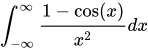
Now, as a → 0 {\displaystyle a\to 0} {\displaystyle a\to 0} and b → ∞ {\displaystyle b\to \infty } {\displaystyle b\to \infty } the term on the left converges with no problem. See the list of limits of trigonometric functions. We now show that ∫ − ∞ ∞ 1 − cos ⁡ ( x ) x 2 d x {\displaystyle \int _{-\infty }^{\infty }{\frac {1-\cos(x)}{x^{2}}}dx} {\displaystyle \int _{-\infty }^{\infty }{\frac {1-\cos(x)}{x^{2}}}dx} is absolutely integrable, which implies that the limit exists.[6]

First, we seek to bound the integral near the origin. Using the Taylor-series expansion of the cosine about zero, 1 − cos ⁡ ( x ) = 1 − ∑ k ≥ 0 ( − 1 ) ( k + 1 ) x 2 k 2 k ! = ∑ k ≥ 1 ( − 1 ) ( k + 1 ) x 2 k 2 k ! . {\displaystyle 1-\cos(x)=1-\sum _{k\geq 0}{\frac {{(-1)^{(k+1)}}x^{2k}}{2k!}}=\sum _{k\geq 1}{\frac {{(-1)^{(k+1)}}x^{2k}}{2k!}}.} {\displaystyle 1-\cos(x)=1-\sum _{k\geq 0}{\frac {{(-1)^{(k+1)}}x^{2k}}{2k!}}=\sum _{k\geq 1}{\frac {{(-1)^{(k+1)}}x^{2k}}{2k!}}.}

Therefore, | 1 − cos ⁡ ( x ) x 2 | = | − ∑ k ≥ 0 x 2 k 2 ( k + 1 ) ! | ≤ ∑ k ≥ 0 | x | k k ! = e | x | . {\displaystyle \left|{\frac {1-\cos(x)}{x^{2}}}\right|=\left|-\sum _{k\geq 0}{\frac {x^{2k}}{2(k+1)!}}\right|\leq \sum _{k\geq 0}{\frac {|x|^{k}}{k!}}=e^{|x|}.} {\displaystyle \left|{\frac {1-\cos(x)}{x^{2}}}\right|=\left|-\sum _{k\geq 0}{\frac {x^{2k}}{2(k+1)!}}\right|\leq \sum _{k\geq 0}{\frac {|x|^{k}}{k!}}=e^{|x|}.}

Splitting the integral into pieces, we have ∫ − ∞ ∞ | 1 − cos ⁡ ( x ) x 2 | d x ≤ ∫ − ∞ − ε 2 x 2 d x + ∫ − ε ε e | x | d x + ∫ ε ∞ 2 x 2 d x ≤ K , {\displaystyle \int _{-\infty }^{\infty }\left|{\frac {1-\cos(x)}{x^{2}}}\right|dx\leq \int _{-\infty }^{-\varepsilon }{\frac {2}{x^{2}}}dx+\int _{-\varepsilon }^{\varepsilon }e^{|x|}dx+\int _{\varepsilon }^{\infty }{\frac {2}{x^{2}}}dx\leq K,} {\displaystyle \int _{-\infty }^{\infty }\left|{\frac {1-\cos(x)}{x^{2}}}\right|dx\leq \int _{-\infty }^{-\varepsilon }{\frac {2}{x^{2}}}dx+\int _{-\varepsilon }^{\varepsilon }e^{|x|}dx+\int _{\varepsilon }^{\infty }{\frac {2}{x^{2}}}dx\leq K,}

for some constant K > 0. {\displaystyle K>0.} {\displaystyle K>0.} This shows that the integral is absolutely integrable, which implies the original integral exists, and switching from λ {\displaystyle \lambda } {\displaystyle \lambda } to n {\displaystyle n} {\displaystyle n} was in fact justified, and the proof is complete.

See also

[edit]
  • iconMathematics portal
  • Dirichlet distribution
  • Dirichlet principle
  • Sinc function
  • Fresnel integral

References

[edit]
  1. ^ Bartle, Robert G. (10 June 1996). "Return to the Riemann Integral" (PDF). The American Mathematical Monthly. 103 (8): 625–632. doi:10.2307/2974874. JSTOR 2974874. Archived from the original (PDF) on 18 November 2017. Retrieved 10 June 2017.
  2. ^ Bartle, Robert G.; Sherbert, Donald R. (2011). "Chapter 10: The Generalized Riemann Integral". Introduction to Real Analysis. John Wiley & Sons. pp. 311. ISBN 978-0-471-43331-6.
  3. ^ Zill, Dennis G.; Wright, Warren S. (2013). "Chapter 7: The Laplace Transform". Differential Equations with Boundary-Value Problems. Cengage Learning. pp. 274-5. ISBN 978-1-111-82706-9.
  4. ^ Appel, Walter. Mathematics for Physics and Physicists. Princeton University Press, 2007, p. 226. ISBN 978-0-691-13102-3.
  5. ^ Chen, Guo (26 June 2009). A Treatment of the Dirichlet Integral Via the Methods of Real Analysis (PDF) (Report).
  6. ^ R.C. Daileda. Improper Integrals (PDF) (Report).

External links

[edit]
  • Weisstein, Eric W. "Dirichlet Integrals". MathWorld.
  • v
  • t
  • e
Integrals
Types of
integrals
  • Riemann integral
  • Lebesgue integral
  • Burkill integral
  • Bochner integral
  • Daniell integral
  • Darboux integral
  • Henstock–Kurzweil integral
  • Haar integral
  • Hellinger integral
  • Khinchin integral
  • Kolmogorov integral
  • Lebesgue–Stieltjes integral
  • Pettis integral
  • Pfeffer integral
  • Riemann–Stieltjes integral
  • Regulated integral
Integration
techniques
  • Substitution
    • Trigonometric
    • Euler
    • Weierstrass
  • By parts
  • Partial fractions
  • Euler's formula
  • Inverse functions
  • Changing order
  • Reduction formulas
  • Parametric derivatives
  • Differentiation under the integral sign
  • Laplace transform
  • Contour integration
  • Laplace's method
  • Numerical integration
    • Simpson's rule
    • Trapezoidal rule
  • Risch algorithm
Improper integrals
  • Gaussian integral
  • Dirichlet integral
  • Fermi–Dirac integral
    • complete
    • incomplete
  • Bose–Einstein integral
  • Frullani integral
  • Common integrals in quantum field theory
Stochastic integrals
  • Itô integral
  • Russo–Vallois integral
  • Stratonovich integral
  • Skorokhod integral
Miscellaneous
  • Basel problem
  • Euler–Maclaurin formula
  • Gabriel's horn
  • Integration Bee
  • Proof that 22/7 exceeds π
  • Volumes
    • Washers
    • Shells
  • v
  • t
  • e
Peter Gustav Lejeune Dirichlet
  • Dirichlet distribution
  • Dirichlet character
  • Dirichlet process
  • Dirichlet-multinomial distribution
  • Dirichlet series
  • Dirichlet's theorem on arithmetic progressions
  • Dirichlet convolution
  • Dirichlet problem
  • Dirichlet integral
Retrieved from "https://teknopedia.ac.id/w/index.php?title=Dirichlet_integral&oldid=1296108328"
Categories:
  • Special functions
  • Integral calculus
  • Mathematical physics
Hidden categories:
  • Use American English from January 2019
  • All Wikipedia articles written in American English
  • Articles with short description
  • Short description is different from Wikidata
  • Pages using sidebar with the child parameter

  • indonesia
  • Polski
  • العربية
  • Deutsch
  • English
  • Español
  • Français
  • Italiano
  • مصرى
  • Nederlands
  • 日本語
  • Português
  • Sinugboanong Binisaya
  • Svenska
  • Українська
  • Tiếng Việt
  • Winaray
  • 中文
  • Русский
Sunting pranala
url url url url url url url url url url url url url url url url url url url url url url url url url url url url url url url url url url url url url url url url url url url url url url url url url url url url url url url url url url url url url url url url url url url url url url url url url url url url url url url url url url url url url url url url url url url url url url url url url url url url url url url url url url url url url url url url url url url url url url url url url url url url url url url url url url url url url url url url url url url url url url url url url url url url url url url url url url url url url url url url url url url url url url url url url url url url url url url url url url url url url url url url url url url url url url url url url url url url url url url url url url url url url url url url url url url url url url url url url url url url url url url url url url url url url url url url url url url url url url url url url url url url url url url url url url url url url url url url url url url url url url url url url url url url url url url url url url url url url url url url url url url url url url url url url url url url url url url url url url url url url url url url url url url url url url url url url url url url url url url url url url url url url url url url url url url url url url url url url url url url url url url url url url url url url url url url url url url url url url url url url url url url url url url url url url url url url url url url url url url url url url url url url url url url url url url url url url url url url url url url url url url url url url url url url url url url url url url url url url url url url url url url url url url url url url url url url url url url url url url url url url url url url url url url url url url url url url url url url url url url url url url url url url url url url url url url url url url url url url url url url url url url url url url url url url url url url url url url url url url url url url url url url url url url url url url url url url url url url url url url url url url url url url url url url url url url url url url url url url url url url url url url url url url url url url url url url url url url url url url url url url url url url url url url url url url url url url url url url url url url url url url url url url url url url url url url url url url url url url url url url url url url url url url url url url url url url url url url url url url url url url url url url url url url url url url url url url url url url url url url url url url url url url url url url url url url url url url url url url url url url url url url url url url url url url url url url url url url url url url url url url url url url url url url url url url url url url url url url url url url url url url url url url url url url url url url url url url url url url url url url url url url url url url url url url url url url url url url url url url url url url url url url url url url url url url url url url url url url url url url url url url url url url url url url url url url url url url url url url url url url url url url url url url url url url url url url url url url url url url url url url url url url url url url url url url url url url url url url url url url url url url url url url url url url url url url url url url url url url url url url url url url url url url url url url url url url url url url url url url url url url url url url url url url url url url url url url url url url url url url url url url url url url url url url url url url url url url url url url url url url url url url url url url url url url url url url url url url url url url url url url url url url url url url url url url url url url url url url url url url url url url url url url url url url url url url url url url url url url url url url url url url url url url url url url url url url url url url url url url url url url url url url url url url url url url url url url url url url url url url url url url url url url url url url url url url url url url url url url url url url url url url url url url url url url url url url url url url url url url url url url url url url url url url url url url url url url url url url url url url url url url url url url url url url url url url url url url url url url url url url url url url url url url url url url url url url url url url url url url url url url url url url url url url url url url url url url url url url url url url url url url url url url url url url url url url url url url url url url url url url url url url url url url url url url url url url url url url url url url url url url url url url url url url url url url url url url url url url url url url url url url url url url url url url url url url url url url url url url url url url url url url url url url url url url url url url url url url url url url url url url url url url url url url url url url url url url url url url url url url url url url url url url url url url url url url url url url url url url url url url url url url url url url url url url url url url url url url url url url url url url url url url url url url url url url url url url url url url url url url url url url url url url url url url url url url url url url url url url url url url url url url url url url url url url url url url url url url url url url url url url url url url url url url url url url url url url url url url url url url url url url url url url url url url url url url url url url url url url url url url url url url url url url url url url url url url url url url url url url url url url url url url url url url url url url url url url url url url url url url url url url url url url url url url url url url url url url url url url url url url url url url url url url url url url url url url url url url url url url url url url url url url url url url url url url url url url url url url url url url url url url url url url url url url url url url url url url url url url url url url url url url url url url url url url url url url url url url url url url url url url url url url url url url url url url url url url url url url url url url url url url url url url url url url url url url url url url url url url url url url url url url url url url url url url url url url url url url url url url url url url url url url url url url url url url url url url url url url url url url url url url url url url url url url url url url url url url url url url url url url url url url url url url url url url url url url url url url url url url url url url url url url url url url url url url url url url url url url url url url url url url url url url url url url url url url url url url url url url url url url url url url url url url url url url url url url url url url url url url url url url url url url url url url url url url url url url url url url url url url url url url url url url url url url url url url url url url url url url url url url url url url url url url url url url url url url url url url url url url url url url url url url url url url url url url url url url url url url url url url url url url url url url url url url url url url url url url url url url url url url url url url url url url url url url url url url url url url url url url url url url url url url url url url url url url url url url url url url url url url url url url url url url url url url url url url url url url url url url url url url url url url url url url url url url url url url url url url url url url url url url url url url url url url url url url url url url url url url url url url url url url url url url url url url url url url url url url url url url url url url url url url url url url url url url url url url url url url url url url url url url url url url url url url url url url url url url url url url url url url url url url url url url url url url url url url url url url url url url url url url url url url url url url url url url url url url url url url url url url url url url url url url url url url url url url url url url url url url url url url url url url url url url url url url url url url url url url url url url url url url url url url url url url url url url url url url url url url url url url url url url url url url url url url url url url url url url url url url url url url url url url url url url url url url url url url url url url url url url url url url url url url url url url url url url url url url url url url url url url url url url url url url url url url url url url url url url url url url url url url url url url url url url url url url url url url url url url url url url url url url url url url url url url url url url url url url url url url url url url url url url url url url url url url url url url url url url url url url url url url url url url url url url url url url url url url url url url url url url url url url url url url url url url url url url url url url url url url url url url url url url url url url url url url url url url url url url url url url url url url url url url url url url url url url url url url url url url url url url url url url url url url url url url url url url url url url url url url url url url url url url url url url url url url url url url url url url url url url url url url url url url url url url url url url url url url url url url url url url url url url url url url url url url url url url url url url url url url url url url url url url url url url url url url url url url url url url url url url url url url url url url url url url url url url url url url url url url url url url url url url url url url url url url url url url url url url url url url url url url url url url url url
Pusat Layanan

UNIVERSITAS TEKNOKRAT INDONESIA | ASEAN's Best Private University
Jl. ZA. Pagar Alam No.9 -11, Labuhan Ratu, Kec. Kedaton, Kota Bandar Lampung, Lampung 35132
Phone: (0721) 702022
Email: pmb@teknokrat.ac.id